Sunday, May 14, 2023

Dragon Eggs

Dragon Eggs are wonderful treasures, bringing all sorts of trouble for PCs once they hatch.

Dragon Egg by Jack Wang and WotC
 

Most games presume that Dragons are related to reptiles and/or birds, so that what hatches from the egg depends entirely on what ovipositor the egg slurped out of.

But what if Dragon Eggs are neutral in disposition, and their specific contents - chiefly the type of dragon - are dictated by the amount and type of loot is layered around them in the nest? Environment has little impact on what hatches, it is all about the hoard.

The hoard matters, not just in contents, but in quality AND quantity.  The larger the hoard, the more potent the hatchling.  This is why some Draconic dynasties and 'bloodlines' are so well-known; one massive hoard leads to 

It is even whispered that the types of magic items in the hoard may influence the newly-hatched Dragon's other abilities.  

Yes, other abilities.  Because book dragons are just the basic form, even if ancient.  These other abilities most often manifest themselves as the spells that spellcasting Dragons hurl, but not always.  Sometimes these other abilities are entwined with the Dragon's breath, or impregnated in the Dragon's scales and bone.  

Granted, Dragons do tend to be like their parent dragon (are dragons gendered or do all dragons lay eggs?  Dragons as hermaphrodites? I think it is now canon in my world that all true Dragons can lay eggs), given that those hoards are what begot the parent.

Still, clever or lucky adventurers can acquire eggs and hatch whatever type of dragon they desire - be it through trial and error or dedicated research.  Such research is likely to be expensive and hard-to-find, because Dragons prefer non-Dragons to stay out of their business and tend to eat nosey sorts.  

-----

Ancient Gold Dragon by Simon Dominic

The more commonly encountered dragons - and what hatches them - are as follows:

Brass - rare woods, textiles (fine clothing and tapestries), fine leatherwork; honey, preferably a (giant) bee hive; bottles and barrels of mead; sentient beings talking (dragon eggs carried by wandering tribes of honorable desert sentients often hatch Brass dragons).

Bronze - children (dragon eggs incubated in an orphanage or school) laughter and song and innocence, driftwood, pearls, seashells, carvings made from coral, scrimshaw on whalebone and walrus ivory; the dragon(s) hatched tend to become protectors of one or more of the children.

Copper - scorpions crawling about, puzzle boxes, riddle books, raw gemstones, raw precious ores, ceramics (be it fine dishes, vases, or statues), the sound of laughter, illusions. 

Gold - sculptures, jewelry, paintings and tapestries of beautiful landscapes, artists performing music and reciting poetry, the sound of running water (from a fountain), the sound of birds, spellbooks; bottles of fine wine.

Silver - suits of full plate and field plate armor, lances, swords (weapons and armor preferably magical), tales of chivalry and quests and knights, fine horses (egg incubated in a stable); pennants of notable knights, shields bearing coats of arms, other collections of heraldry; jewelry; murals, bas-reliefs, tapestries of knights on quests.

Dragon's Hoard by Adam Paquette

Black - shallow water, tarnished silver, sounds of catoblepas bellowing, smell of foul mud, broken statuary, lesser undead, anything that makes mortals fear.

Blue - sapphires, other cut gems, iron lightning rods, turquoise and silver jewelry, sandstone, caravan trappings (carts, wagons, tackle for horses and camels, tents).

Green - throne(s), crowns, items that allow scrying (crystal balls, certain spell scrolls), emeralds, jade statues and masks, items that allow long-distance sight (telescopes), growing plants that are poisonous to most other sentients. 

Red - anything stolen, but preferably gold and cut gems; sounds of anguish and screams of pain; sulfur, pumice, and volcanic ash; treasure maps, merchant scales, written inventories of treasuries and caravans; bones belonging to whatever owned the stolen treasure.

White - mammoth tusks, tanned furs, diamonds, ice sculptures (though frozen things work), scrimshawed bones, silence of snow falling.

Red Dragon by Andrey Kuzinskiy

As might be imagined, the more refined and beautiful and rare and magical the items in a hoard, the more potent the dragons hatched will be.  

In all cases, eggs incubated with spell scrolls, spellbooks, and wands often find some or all these spells imprinted upon them, and these fortunate dragons gain the ability to cast these spells as they grow older.

When in doubt, the larger the hoard, the better for the hatched dragon.

-----

Legends tell of other sorts of dragons and foolhardy nonDragons may (accidentally) hatch entirely new dragons based on whatever the egg is incubated with or in.  These Dragons are often identified by their breath weapons.

Note that Dragonborn come about when Dragon Eggs are incubated in mortal (ideally Human or Elf) blood, in addition to the requisite treasure (blood for metallic dragonborn being freely given in sacrifice to a greater cause).  Dragonborn themselves are forever sterile, lacking the necessary bits to have any sort of youngling, although adoption is possible.

-----

What hoards lead to which new dragons in your games?  What lists of nontraditional Dragon abilities do you work from?  Would you share those lists?

Goblin Punch features some unique hoard ideas from The Dragonhole.

Let me know!

Saturday, April 15, 2023

Scrimshaw

Scrimshaw is such a lovely word, conjuring up images of 18th-century whalers and explorers crossing the oceans in their quest for loot.  For those unaware, Scrimshaw is not just a lovely pilsner from North Coast Brewing Company, but also an artform in its own right.

Scrimshanders craft their art on bone.  Whale bone and walrus tusks are what immediately spring to mind, but any bone or ivory will do.  This being a gaming blog means magical creatures and their magical bones are eligible, as well.

Dragon bones, in particular, but also the tusks, teeth, skulls, and other large bones of fiends, giants, unicorns, wizards, and anything else in your favorite monster manual.  Giant beetle carapaces, even. 

Artwork - and many examples of scrimshaw are artwork - in DnD games is just fragile gp in an encumbrancing form.  Generally speaking, the more gp a piece of art is worth, the more fragile and/or awkward it is to bring back to civilization to cash it in.  So it goes with scrimshaw, but it doesn't have to stop with being interesting gp.

Maps are always a desirable treasure in a DnDish game, but a scrimshawed map on a dragon's fang is somehow even better - if the map leads to the dragon's lair and the rest of the dragon the fang is from, all the better!

Wizard skulls might have spell formulae scrimshawed onto them, for fragile and interesting scrolls - or spellbooks, even, if the skulls are kept in mineral oils.

Seriously, based on my extensive 5 minutes of research on the wiki page linked up above, bone and ivory deteriorate with time, and organic oils, like those found in skin, accelerate the process.  So, keeping the scrimshawed skulls in jars of mineral oil means Mr. Wizard doesn't travel far from home, and also means that enterprising PC wizards have quite the challenge looting Mr. Wizard's sanctum.

Because every solution to a problem should be the beginning of a new problem.

In addition to scrolls and maps, scrimshawed bones could be alternate forms of potions or even tattoos.  Just find your favorite magic tattoo ruleset and go from there - the rules from Tasha's Cauldron of Everything is a good start, but Cottage of Everything, an old Reddit thread, Electric Rain, and Blood and Ink provide other options to work with.

Maybe mixing both tattoos and scrimshaw, with tusked and horned beings getting their tusks and horns scrimshawed with magical markings, allowing for the interesting choice of desecrating a corpse to get the kewl magik bits or leaving it whole and going without.  

Decisions, decisions.  

Maybe the beings scrimshawed on these teeth can be called forth to perform a service?  

-----

Yes, I am overly impressed and inspired by the beer.  But any inspiration is good inspiration, right?


Monday, April 10, 2023

Session Zero Considerations

Session 0 is the pregame of an RPG, falling somewhere between recruiting players and beginning the campaign.  Its usefulness as a tool cannot be understated.  Even among friends (vs acquaintances or strangers) there are a few key points I feel necessary to discuss between DM and players, even in groups that have gamed together in the past, because new things can - and arguably should - always be tried.  

Among known people, I don't know that the Consent in Gaming checklist is needed, but I would have it ready if gaming with utter strangers, such as when putting together a new group.  Arguably, even among friends and family, it is useful - we don't know our friends and family half as well as we'd like to think.

Regardless of game, I firmly believe that addressing the following topics should cover most issues before they come up.

A good Session Zero helps prevent this.

-----

1.  Game expectations.  My default expectation is that we're here to explore dungeons, not characters, but I know not every player uses that default.  This topic also covers setting/genre and if the goal is to play through a published Adventure Path or WotC hardback - both of which are railroad stories that anticipate PCs/players running through the steps or a more sandbox-style.  Also addressed is what the game is NOT about.  A partial method is to use step 1 of the Gygax 75 Challenge (some examples laid out here) and show pictures/movies/songs that inspire the setting.  Hammering out each player's and the DM's expectations early should allow for a better game for all.

2.  Rules and major houserules. Especially those houserules that may impact race/class choices.  This is a fine time to discuss metagaming, specifically your definition of metagaming. Houserules may incorporate some or all of the other topics on this list, as well as anything else.  DMs should have enough printed copies to go around, or at least share the document digitally.

3.  PC creation.  Which rulebooks are players allowed to pull from, plus any other bits and pieces, such as necessity of backgrounds and how stats are generated.  Ask if PCs already know one another and perhaps they should.  I'm in the camp that Session 0 is also when PCs are created.  Not only does creating PCs together facilitate shared backgrounds, it also allows for players to possibly fill the various party roles that make up successful adventuring bands.

4. Plot armor for PCs.  DMs need to be open about whether or not PCs are going to die, as well as the likelihood of PC death. If you're going to go all deus ex machina in your game, be up front about it. This is a fine time to address how replacement PCs will be brought into the game (I am not above having the new PC be a prisoner in the next room), particularly at which level and with how much starting gear.  

5. Dice rolling.  This covers rolling combat dice in front of players or behind a screen, what happens when a die hits the floor, and types of dice allowed (my personal rule is if I cannot read it upside down across the table, it cannot be used - save your art dice for another game!).  If online, which dicebot you're using and what else that bot does (use Avrae because it also has an insult generator!).

6. Scheduling.  Not just when you'll play (hopefully more than once a month), but what happens if someone cannot make it and the agreed-upon etiquette of WHEN the group is notified of an impending absence.  The reality is that people miss sessions, be it for work or family (or other reasons).  Not having a plan for absences can lead to frustration for all.  Have a plan in writing when multiple people are absent - cancel the session or just play a different game for those folks?  Or carry on?  Related to this is what happens if a player's schedule changes and they can no longer play at all.  

7.  Puzzles.  Some players love them, others hate them.  Address if puzzles in this game are aimed at the PLAYERS to solve or can be solved by throwing enough dice at them and calling it PC-solved puzzles.  This is probably a good time to discuss how finding and opening/disarming secret doors and traps will be accomplished in game - be it player description of PC actions, flavorless dice rolls, or some combination of the two.

8.  PvP. I'm not a fan of players openly competing against one another, but some are.  Regardless, it needs to be covered and should include using Charisma-based skills against one another, as well as all the other nonsense implied by 'its what my character would do.'   If nothing else, use this section to remind players that it is 100% their responsibility to find reasons for their PCs to adventure with the other PCs.  In a cooperative adventure game.

9. Table and house etiquette.  Even if the game is in a store instead of a personal home, there are social rules to be followed, like smoke outside, don't feed the dog table scraps, I'm deathly allergic to shellfish, don't show up drunk or stoned, keep cell phones away, etc.   A big piece of etiquette involves inviting friends to the game without letting the DM and host know.

10.  XP or Milestone leveling.  If XP, provide a solid list of what does and what does not garner XP.

11.  Contact Information.  Trade cell numbers, invite everyone to a private Discord server, provide a link to shared files or a blog.  Just have a way to send reminders about game night, if nothing else.  I'm a fan of Discord, though, so that folks can handle admin and individual tasks without wasting table time at it.

12.  Safety Tools.  In addition to the Consent in Gaming checklist in the opening paragraphs of the post, are a variety of tools designed to allow everyone at the table to enjoy themselves: X-Cards, Lines and Veils, Stars and Wishes, and Thorns and Roses.  Golden Lasso Games describes each of these better than I could, so go read that post.   

-----

Twelve points of consideration to discuss before a game actually begins.  To be honest, Session Zero is everyone's chance to decide if that particular game is, in fact, for them.  

And it may not be.

And that is okay.  

There are other games and other tables, even with the same people.

Will addressing all of these 12 points make games go better?  Maybe.  Probably.  Hopefully.  

Will ignoring some or all of these to just jump right into the game cause issues down the line?  

Yes.  Unequivocally.  

-----

What is this list missing?  What should this list not include?  Take advantage of the comments to tell me.

11/2/23 EDIT: Necropraxis wrote up 20 questions about game mechanics that are worth discussing in session 0.


Wednesday, March 29, 2023

Starting PC Backgrounds

A key part of any gaming campaign is its opening session, when the PCs first come together.  Popular (and therefore undesirable) tropes are meeting in a tavern, in jail requiring a prison break, at a festival when something happens, or - my favorite - the ship/train/spaceship you're all on wrecks elsewhere and you must unite to survive!

An iconic party of adventurers from my childhood

My issue with this method is that roleplaying an awkward group blind date is somehow worse than an actual blind date - but not by much.  Plus, this puts way too much work on the DM's shoulders of this cooperative game we call our own.

If you as a DM enjoy extra effort on your part, by all means ignore this post and write out your opening scenario that somehow binds the disparate PCs together in a lasting campaign.  Just don't come fussing on the FB when it comes crashing down due to the PCs' backstories/players' expectations.

(As an aside, I firmly believe it is 100% the players' responsibility to ensure their PCs have a reason to travel and adventure with the group as a whole - DnDish games being cooperative games, after all).

Then again, if you are interested in pushing work off onto players while improving the game as a whole, then consider making the PCs a circle of friends.  Not the tv show, but kinda like the tv show.  After all, the six main characters of Friends were a mix of siblings, roommates, (former) co-workers, childhood friends, and eventually (ex-)lovers.  Everybody knew everyone else, but not in the same fashion, nor to the same degree.

And it worked.  

-----

Since it works for television, there is no reason the same idea shouldn't work at the gaming table.  So here is a random table of potential shared backgrounds for your party members.  

d30 Individual PC Relationships

1    in-laws

2    siblings (half or whole)

3    cousins

4    spouses

5    parent-child

6    other family

7    (ex-)lovers

8    betrothed (willingly or arranged)

9    rivals

10    childhood friends

11    parents are friends

12    current/former co-workers

13    same faith

14    same ship's crew

15    same punishment

16    same military unit

17    same acting troupe

18    same orphanage

19    same school or academy

20    same master (presuming both apprentices)

21    same pursuer (just or unjust)

22    same dream 

23    Master-Apprentice

24    Teacher-Student

25    Knight-Squire

26    Debt Holder-Debtor

27    current/former roommates

28    chasing same person

29    drinking buddies (like on Cheers!)

30    local celebrity-fan

Some of these are merely variations on a theme, but the very terms imply different relationships beyond Person in Authority-Person Subject to Authority or Same Organization.  Thanks, connotation!

Technically, if the party makeup consists of an Elf or other long-lived demihuman alongside short-lived races, like humans, then another possible relationship is that of a family sponsor or pet owner (the Elf) and the sponsored family or pets (one or more humans).  Depending on the players, this could make for some awesome moments or a spectacular train-wreck.  

Either way, being able to look at someone and tell them honestly, 'I helped raise your great-great-grandfather, your great-grandfather, your grandfather, and your father. Each and every one reacts in similar fashion to such stresses as these. Do not presume to tell me I don't know you.' 

-----

The lovely part about using this method for PC backgrounds is that the relationships alone provide ample fuel for the role-playing fire.  These predetermined backgrounds imply that the players themselves fill out the details about their family or shared past, providing names and places and events to the DM.

Incidental collaborative world building at its finest, and all it requires is the DM pointing at players and saying, 'your PC knows their two; your PC knows these two; etc.'  In my opinion, this works best when no one knows everyone from background, just two others.  

Using this feels like an odd mixture of the popular 'I know a guy' houserule and what Axian Spice did with his Who Are You tables from his Notable Novices and Notorious Newcomers in the Axian Library collection.  All with a sprinkle of d4 Caltropsimmediate backgrounds for new PCs.  

But it works.

Note that such a circle of friends isn't necessarily jazz band adventuring, but is related and with time becomes close enough for government work.  

The same adventurers from above, presuming they are stuck in DnDland through adulthood.  Poor Uni!

-----

EDIT: I found this at Coins and Scrolls, and it allows for a quick background, once you determine how to roll a 1d500.  - 4/9/23

EDIT: Another fine example of a circle of friends is the crew of Firefly. I'm not sure how I forgot them.  - 4/9/23

EDIT: As always, Phlox has an amazing take on starting characters.  - 4/20/23

EDIT: This time from Sly Flourish: relationships for PCs at the Keep on the Borderlands and here with Fiasco-style PC relationships. - 7/3/23

Monday, March 27, 2023

Monday MtG: 5 Ways to Reduce a Deck's Perceived Power

Normally, Magic players are trying to improve their decks.  That said, sometimes social pressures result in a need to reduce a deck's power level.  Not necessarily its playability, just how fast and consistently it wins.

Especially in the Commander format.

So here are five ways to reduce your deck's perceived power level.

-----

1.  Remove nonland tutors.


Tutors not only slow the game down with searching and shuffling, but tutoring also effectively allows for multiple copies of a card in a format whose largest draw is the singleton format.  Tutors are really wild cards that can provide threats, answers, or anything else that is needed.

Removing nonland tutors means some Commanders, notably Zur, Arcum, and Magda, among others, become unusable.  Such is life.

To compensate for this lack of utility in the 99, replace your tutors with more draw, be it cantrips or bigger spells.  Every color has draw spells, just like every color has tutors, albeit some colors are better at drawing cards (and tutoring) than others.


2. Remove 0-cmc and 1-cmc rocks. 


Granted, Sol Ring or Mana Crypt are lackluster draws on turn 11, but the reason these cards and their ilk are in decks is for the early game - presuming your opening hand holds them, of course.

A turn 1 Sol Ring can speed the game immensely, especially when none of the other players answer it or play one themselves.  Slowing the opening turns just a small amount matters, and can make you appear as less of a threat.

Especially in an artifact or colorless heavy deck that untaps artifacts via this or these two.

There's a reason these rocks are banned in the Duel (or French) Commander format, after all.


3. Readjust your landbase.


Either go heavy on the basic lands or run the dual lands that enter play tapped - perhaps without Amulet of Vigor in the wings.

The inefficiency of basics and the lost turns from lands entering the battlefield tapped reduces your deck's options - and therefore power - immensely. 

An upside of heavy basics is that it saves you from people like me that run nonbasic land hate, such as Blood Moon and Ruination.  Why, if you go heavy basics, you could even run the nonbasic landhate yourself!

4.  Avoid extra turn cards, or at least the easily exploited blue ones.

Red's extra turns aren't as obnoxious, because of the phrase 'Take an extra turn after this one. At the beginning of that turn's end step, you lose the game.' Yes, there are ways to get around this, but they require effort and rather telegraph themselves.

Blue - especially in a UG shell - can take all the turns with little effort.  It's neat the first time you see it, but after that it's just an opportunity for the rest of the table to grab food or pee while the UG plays with themself.

5.  Reconsider deck strategy.

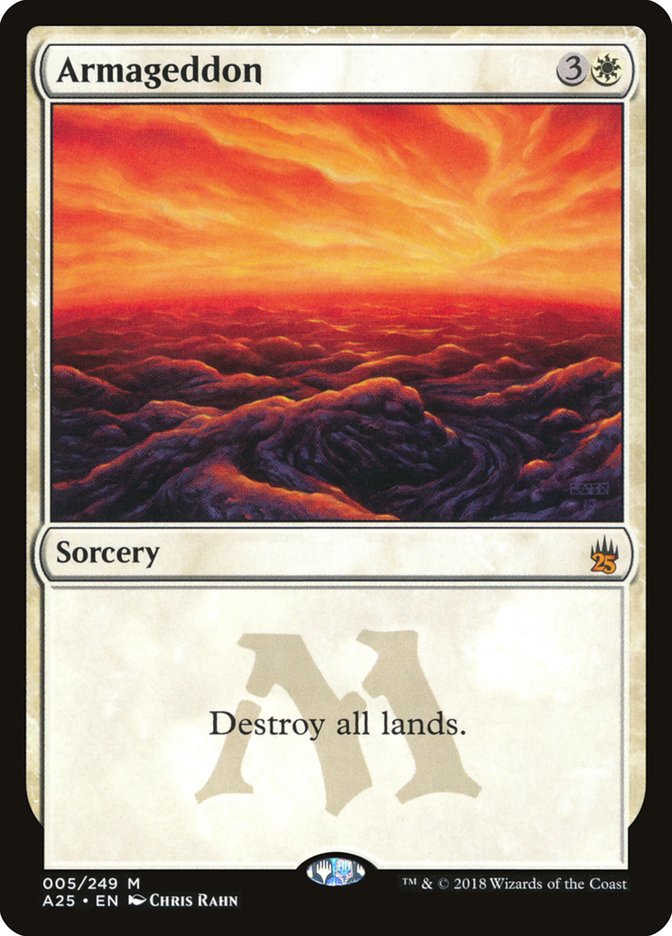
This final option is admittedly a bit extreme.  If your deck is based around Mass Land Destruction (MLD), heavy Stax strategies, heavy chaos, or Poison, don't run that deck or at least pull those cards.  These strategies can be frustrating for veteran players, but are oppressive enough to make new players quit the game or even find a new hobby in smaller local metagames. 

If your local playgroup is small enough, decks like these can ensure you aren't included in games any more, shrinking your playgroup immensely.

-----

None of these recommendations mean you cannot run interaction, strong synergies, combos, or 'I win' cards, nor does it mean deliberately making bad plays despite answers in hand and untapped mana.  

These options just slow your game enough that less invested players are willing to stick around and keep playing, either with you or at all.  

I know, you want to play the objectively good cards in an objectively good deck, so your opponents need to step up their game.  But how to convince them to do so?

There are two actions you can take to build your local player base.

Ideally, you're willing and able to tactfully improve the newer players' threat evaluation skills.  

Being new, they are unlikely to realize the potential of some cards or know that a card in play is one half of a game-winning combo.  Remind the new player that there are other options for their targeted removal and take the time to explain why specific cards might need killing more than what the player initially targets.  

Even if the biggest threat is under your control.

Especially if it is under your control.  

The other simple way to improve your opponents' decks is to tactfully make card recommendations and, if possible, give, trade, or sell them said cards.  

If nothing else, generically encouraging more interaction in a deck is a must for better games.  If you've ever been the only person running answers in a pod, you know the pain of trying to forward your gamestate while everyone looks to you to prevent someone from winning.  

Everyone bitches about blue countermagic until it would be clutch, then blue wizards are the savior yet are harassed for not countering a spell!  Blue just cannot win the social game, no matter how many Magic games it does win.

-----

A bonus video, but not by me.  Command Zone recently provided this on YouTube about affordable replacements for the expensive Commander staples.  While this video doesn't quite fall along the lines of the rest of this post, the overlap is there.

So give it a watch.


Friday, March 24, 2023

Stat Locks

Not Stat Blocks, although those are related.  

Stat Locks - fiendish magical locks that anyone can open, provided they are willing to temporarily let one of their stats drain a bit.  Not too long, but just long enough to make a return trip from opening one or more a dangerous proposition.  

Most DnDish games feature the same six stats: Strength, Dexterity, Constitution, Intelligence, Wisdom, and Charisma.  Even if your ruleset uses different amounts of stats with different names, these locks can still be used.

-----

So it looks something like this.

When discovered, a Stat Lock looks like raised block with a five-fingered handprint on it, for a right or left hand - it doesn't matter which.  It is cool to the touch, and immediately activates when in contact with the flesh of a living being's hand.  The first round drains whichever stat the lock is attuned to and changes color to red.  It drains a point of the stat each round, changing colors from red to yellow to finally green, at which point it opens with a pop and a hiss. 

Unless destroyed, the lock resets itself after 3 hours of first being activated, forcing the sequence and drain to begin anew.  This 3-hour timer includes the time the lock is open, then it closes (the door with it, as well), and the lock resets.  

Beings with hands can generally rotate through, each only losing a point before the next person slaps their hand onto the lock.  Except for the rarer version that looks a bit like a metal glove you slip your hand into - these clench around the hand until the lock is full, then it releases.  

Depending on how much is drained, this can be fatal.

Given the nature of these locks, they are typically only found in places that have plentiful minions, slaves, or prisoners because those employing these locks are not foolish enough to drain themselves.  

But PCs are foolish enough, or at least willing to try - and that's what makes these locks interesting - they attack the character sheet.  Note that regular use of such locks makes retainers and henchmen even more useful, although this will force loyalty checks.

Each lock requires a specific amount of a stat before opening (8 points is what most of my locks are), but some instead attack restfulness, leading to levels of exhaustion (4 levels is what I prefer, given that 6 levels kills a person - which is fine for NPCs, but perhaps a bit much for PCs).

While a long rest and some magics restore the stats at your rulesets various paces, this restoration eats up resources, which is the point of the exercise.  

-----

One lock might be bad enough, but they are often found in groups of 2, 3, 6, or sometimes all 7.  And they all look the same - although close inspection under bright light reveals small runes and symbols that represent the drained stat.  

The locks requiring two hands are often spheres or pyramids with handprints, while those with more may be found on a pillar or all in a row along a wall.  


Or in any other configuration the room allows.

These locks are rarely found alone and are often tied into alarm systems that bring guards before the lock even opens.   This becomes another decision point for players, because at least one PC will be occupied (back to the fight) opening the lock(s), while the others hold off trouble.  

Note that locks such as these are not picked as much as opened by forcibly draining others - a guard pressing someone else's hand to the lock is unaffected, as the lock drains whomever hand is being held there.  

Dispel Magic disables the lock, but does not open it.  Knock opens the lock, but remember the close and reset time - which might be dangerous if everyone is inside the locked area when it reseals.

-----

At the table, these locks force backwards math and maybe kill someone if a stat drops below 0 or Exhaustion hits level 6.  In addition, players/PCs will go hunting a safe place to rest and regain their stats - or burn Restoration spells doing so.  

Have fun!


Sunday, March 5, 2023

Buying Magic Items

Magic items are staples of fantasy fiction and roleplaying games.

After all, they boost the individual or group using them, they are fun in their own right, and they allow a DM to loredump without inflicting reading homework on the players.  

They are such a staple that many DMs include Magic Item Shoppes in their game worlds, and then spend hours stocking them, and then spend more hours determining how such a store does not get robbed/burgled/looted by transient PCs or NPCs.

There are several common recommendations.

From somewhere on the internet.  Not my work, though.

1. Such shops don't exist.  If that is the case, make sure your players know in session 0.  Various rulesets and player plans are item-based, and not being able to easily acquire such items is frustrating.

2. The shopkeeper is a retired high-level adventurer of sorts, using magical alarms, illusions, traps, extradimensional spaces, and other things to safeguard the product.  Probably extraplanar guard-things.

3. The shopkeeper is a retired low-level adventurer who has powerful friends (because regular folk cannot afford magic items).  Adventurers and world leaders call upon this person to keep them supplied.  They will come looking for the thieves, doubly so if the shopkeeper - their friend and source - was murdered in the process.

4. The shopkeeper pays protection to the local thieves' guild, who will assuredly come seeking to make an example of whomever made them lose face.  

5. It is a specialty store that only crafts items on commission, which is never an overnight affair.

6.  Some combination of 2-5.

7.  DM fiat.  The players automatically fail, regardless of what they do.  Don't do this.  This is terrible.

On top of all this is the need to determine an inventory.  If the store is Magical WalMart, it may have anything, and lots of it - then dice are used, and PCs end up with items that make the campaign ... difficult for the DM.  Alternatively, the DM painstakingly handpicks or even handcrafts the inventory, and is stuck describing everything multiple times to indifferent players.

All of which is a poor investment of DM time that makes me twitchy just thinking about.

-----

While magic item auctions are a possibility, they can be difficult to pull off at the table, unless you can score some guest players to run the NPC competition.  Then an auction can be awesome.  

My preferred method is to use a magic item broker or agent.  These are merchants that traffic in magic items, but do not keep their wares with them, instead procuring things as needed by wealthy customers.  Granted, such transactions are expensive and time-consuming, requiring a nonrefundable payment up front and the remainder upon delivery. 

These payments may not even be entirely in coin, but instead cost other items, goods, favors, or the like.  No doubt the contracts are signed under the watchful eye of the local deity of contracts and justice, who will (or its clergy will) ensure bad things happen to whichever party reneges on the deal.

Of course, whatever the customer wants may not be available.  Something similar may be found, or items can be commissioned, but these all take time.  Time measured in months, years, or even decades (depending on how crafting works in your game world).  I like this method because it allows PCs to have items they (mostly) want at a rate that doesn't suddenly break the table. 

Note this method means that items provided by such a broker or agent may not be exactly what the players/PCs want.  The item may have quirks or flaws, it might be a scimitar rather than a longsword, or it might be outright cursed. This is all part of the negotiations with the broker. Once a deal is struck, though, to quote what my children learned in preschool, you get what you get and you don't fuss a bit.  

Luckily, DnD even has such beings in place, at least to a degree.  The Arcane.

from the 2e Monstrous Manual

Or the Mercane, if your preferred ruleset is from a later edition.  This Deep Dive on the Mercane/Arcane is worth the time to skim read if you want extraplanar merchants that just appear as needed by PC request or DM plot.

A second species to consider as a broker is the Arcanaloth.  Granted, smart PCs should be wary of these denizens of the lower planes, because fiends historically do not have the best intentions for anything not themselves.  

A third species for a broker is the Rakshasa.  These lion-headed, backwards-handed shapeshifters are just as devious as Arcanaloths and only marginally more trustworthy.

For myself, though, I prefer brokers of standard species.  Given that my homebrew world is humanocentric, that means the main item brokers are/were human (with a few half-elves among them... and a shape-shifted dragon), with Grandfather Favarro and the rest of his family being my favorite examples from my campaign world.

Regardless of what species the broker is, these item brokers are terribly useful, both as procurers of wares and as patrons of adventurers.  After all, the magical items scattered across the lands and planes have to be recovered by someone, and who better to brave the dangers inherent in this than adventurers?

An item broker may not be all that potent, mechanics-wise, though will lean towards higher Intelligence, Wisdom, and Charisma scores and skills.  They may not be spellcasters at all, merely keeping one or more spellcasters on staff, or at least on retainer.

One thing for certain is that magic item brokers do not keep much - if any - inventory on hand.  The items they may have are for their use alone.  Any additional items lying about have been paid for and are awaiting pick up - stealing these items from the vault makes the thieves powerful enemies.

What the brokers do have on-hand are contacts: they know sages and bards to research specific items, they know mages and other casters to commission items from, and they know adventurers to go fetch the items from their last known locations/owners. 

Related to these contacts are the broker's customer base.  The sorts of people that do business with an item broker tend towards the powerful, politically and mechanically.  People robbing the broker make enemies of these customers, at least some of whom will come gunning for the thieves.

-----

Some players may want to skip all this and Wish for an item instead, which is completely doable.

Just decide during session 0 - and tell the players, not that they'll pay attention - that Wishes, including those from the Deck of Many Things or other items (and beings) - are inherently lazy and will not create something wholesale, but rather take something that already exists and bring it to the wisher.  

In the case of magic items, the former owner WILL want it back, but the DM doesn't have to even create said former owner until needed.  Unless the source of the Wish is fiendish, then perhaps the owner appears with the item.  This is extra amusing when said owner is a dragon.

Perhaps more amusing is when the Wish transports the PC to the item's location, with or without friends and companions.

Monkey pawing even shows up in Magic the Gathering.  Wishclaw Talisman.

This messing with wishes is often called monkey-pawing (from this short story which all gamers should be familiar with), and is definitely NOT for all tables, so be careful when doing this.  Or at least be up front about it in session 0. 

Monkey-pawing wishes and my session 0 both sound like other posts, so I will close here.