Showing posts with label magic item. Show all posts

Saturday, July 5, 2025

Arik of the Hundred Eyes

Arik of the Hundred Eyes is an Immortal who shows up in a passing reference in the adventure B3: Palace of the Silver Princess.  The Vaults of Pandius write-up hits the highlights, which are not many.

Official information:

Arik - Celestial, sphere of Entropy, imprisoned for unspecified crimes heinous enough to get him locked away from the multiverse for eternity. Banished to a prison dimension, he seeks ways to return to the multiverse. (B3, WotI)

Arik uses giant rubies the size of a large man's fist as his eyes - the Hundred Eyes in his tile. These are detachable at will, and function as conduits for the Immortal's power. This conduit functions across dimensions and allows Arik to wield Immortal-level power in a location without being actually present.

His clerics customarily wear blood-red robes with hoods hiding their faces, decorated with a hundred eyes - wearing plate mail underneath. All carry shields with his symbol - a single large red eye.

Kobolds and orcs are attracted to his service, and he has some influence over minor undead like skeletons.

And that's it.

There are other versions of Arik, such as those here, here, and here on page 23 of the Codex Immortalis.

(As an aside, The Vaults of Pandius have - and continue to provide - an excellent overview of all things Mystara-related.  If you are curious about what a proper fan-base supported game world looks like, look no further than the Vaults of Pandius.  Adventures, resources, the Threshold e-zine, and more make for a richer game world.)

Presuming that all of Arik's Eyes appear as large rubies, it becomes simple to find and place them elsewhere, like in the Shrine of Evil Chaos in B2: Keep on the Borderlands.  Specifically, in room 58. 

At the western end of the temple area is a dais of black stone, with four lesser chairs on its lower tier and a great throne above.  The chairs are of bone; the ivory throne is set with gold and adorned with gems of red and black (10 black stones each worth 100 gold pieces, 10 red stones each worth 500 gold pieces, and one large red stone worth 1,000 g.p.).

In my games, that large red stone is an Eye of Arik, and is what draws the monsters to the Caves of Chaos, just like in B3.  Just describe it as pulsing with light - a red strobe light that pulses faster or slower depending on circumstances.

Furthermore, I extrapolated that while officially his eye attracts orcs and kobolds, other Eyes may do other things, or many other things, in addition to or instead of attracting orcs and kobolds.

But rather than list out the 100 Eyes, a random table seems more fitting, so I present 12 powers an Eye of Arik might provide its wielder.

The ruby-red forcefield that features in B3 is powered by DM-fiat, so is not included in this list.


-----

1 - summons giants (hill, frost, fire, stone - storm hear but can ignore the summons) and giant-kin (ogres, trolls, cyclops); their collective appetite soon strips the land.  (note that Against the Giants: The Liberation of Geoff might provide solid inspiration regarding what this looks like).

2 - summons corporeal undead who move towards the location regardless of time of day and weather; all that die in its glow reanimate as 1-3: zombies, 4-5: ghouls, 6: wights; wielder becomes an incorporeal undead when slain, bound to the gem. 1-2 wraith, 3-4 ghost, 5-6 spectre.

3 - this eye pulses raw arcane power, tinting everything in shades of red and transforming normal creatures into monstrous beasts and abominations that rage and feast darkly in the area.

4 - plant life grows riotous and verdant, becoming alive, sentient, malicious, and hungry.  The various plant monsters begin sprouting; the wielder quickly turns into a black hag that can control it all.

5 - troglodytes creep and tunnel towards the gem, worshipping the wielder (who in turn transforms into a giant frog-thing).

6 - summons beastmen (pig-head orcs, kobolds, gnolls, minotaurs, etc) to serve; the wielder becomes a beast-king (hill giant stats with the head of a lion).

7 - summons goblins, hobgoblins, bugbears and wolves (wargs); thouls often slip in with the hobgoblins and act as enforcers; the wielder's skin peels away to reveal a hobgoblin underneath and reigns as a potent goblin king.

8 - pulses after specific rituals (Arik winks the eye) and humans in the light transform into 1-4: wererats, 5-6 werewolves; orcs become wereboars.  Clerics of Arik become Devil Swine.

9 - magic warps the area, granting spell-like abilities to creatures normally without, spawning living spells that drift about wanting to be cast, awakening the spells of spellcasters in the area (these spells demand to be cast and on a failed save by the caster, will be cast), and clouds of wild magic that drift on the wind, changing (and infecting) magic used and encountered.  (DM Note: this could be an excuse to change rulesets in a campaign).

10 - raw magic permeates the area, animating objects and twisting insects and animals into giant and mutant versions of themselves.  As might be imagined, they are ravenous.

11 - inspires dragonlust for gold and hoarding; gold sickness; transforms beings of sufficient greed and power into red dragons

12 - calls Chaotic dragons to it, but mostly reds (but also black and green); dragons that sleep and bask in its glow grow more powerful in time (maxing out HP and other die rolls).

-----

The various monsters all come from the Rules Cyclopedia - originals are a fortune, but pdfs and POD hardbacks are quite affordable - and is a great example of what a one-book game should look like.

Anyhow, since so many of these options attract some type of nasty to it, it stands to reason that dungeon-building magic-users would be interested in acquiring one (or more) Eyes of Arik.  Given the potential power of magic-users in Mystara (level 36!), Arik doesn't mind his Eyes being used in this way and might even send his clerics as emissaries to magic-users with domains in order to "gift" them with an Eye for their dungeon.  

Maybe this time, the cultists will succeed in recruiting someone capable and willing to free Arik from the prison dimension! 

-----

Given the trouble that Eyes of Arik cause, destroying or containing one is a noble quest for heroic (or at least pragmatic) adventurers.

By way of example, the Eye of Arik in B3 (green cover) provides several specific methods:

The ruby can only be destroyed in three ways: (1) Three particular notes played on the Ice Harp will shatter the ruby.  (2) If the party brings two (or more) statuettes of the silver dragon into the room, the dragon Ariksbane will be freed from the Dimension of Ice.  The dragon's breath will disintegrate the ruby (without harming anything else in the room). (3) If some character touches the ruby Sword of Arik to the ruby Eye of Arik, both will crumble into worthless powder.  

Following the example of B3 suggests that each Eye's destruction requires significant effort, even if Ariksbane and the Ice Harp exist in your world, because they would still need finding. 

Wednesday, August 14, 2024

Summer Games, Session Six

We got to play again!  We were told our laughter could be heard down the hall through two closed doors, something I consider a win.  Once classes start back up, we may need to tone it down a bit.

Earlier logs are here: onetwothreefour, five.

Summary: met a new NPC, went upstairs, met three more NPCs, then killed them.

-----

Chesire Cat

The party stood in front of a statue of a wizard, right arm extended and hand upright (waiting for a high-five, perhaps), and the left holding a large book, a book that is chained to the statue's waist.

Before the PCs (Varda, mostly, with an assist from Daffyd) could do much investigating, they heard a voice, followed by seeing a smile, then eyes, then the rest of the Chesire Cat appear and a conversation ensued.  The major question asked by the players being "is this the cartoon or live action Chesire Cat?"

Disney's cartoon, of course.


As the Chesire Cat disappeared, it implied it would be watching the party, as they were so very entertaining.

It gone, the PCs got back to the important business of examining the statue and looting it of hidden treasure.

Part of the examination involved high-fiving the statue, so as I held out my hand (roleplaying the statue, naturally) I planned to describe a mild electric shock.  Instead, real life intervened and when our hands touched, there was audible static shock, derailing all of us with laughter.

That done, the PCs determined how to open the cover of the book, which was basically a stone box.  Within it, they found a leather-wrapped candle in the shape of a wizard, with the wick poking out of its pointy hat.

 As they agonized over what to do with the candle, Dave's ring pulsed upon his finger, and he suddenly had the idea that he should light the candle (which he didn't do).  DM note - the ring is a Ring of Uffish Thought, and when the players are dithering, it pulses and the wearer has a DM-provided idea about what to do next; not necessarily THE answer, but a possible answer to their dilemma. There is no requirement they follow through on the idea.

Now possessing a Little Wax Wizard, Varda tucked it away in her pack rather than light it.  It's like the players don't quite trust me! 

Finished with the statue, the explorers moved to the staircase heading up.

But again, failed to search it.

Alas...

-----

Upstairs

At the top of the stairs, the party found themselves on a landing, with a stone wall to their left, a heavy curtain to their right, and another staircase headed down in front of them.  They sent Dack the Boar with Daffyd the head under the curtain as a reconnaissance team of sorts.  Hearing no combat, the rest of the team joined them in a large chamber, with a single large heavy curtain concealing the stairs landing, and a pair of large double doors to the north.

Varda's infravision revealed what appeared to be three moving heat sources on the far side of the door - she could see it through the crack between door bottom and floor.  With this information, the party hatched a plan.

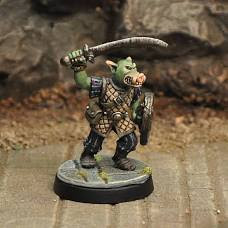
One of many fine minis from Otherworld Miniatures - if I had the money, these are what I would use!

Opening the doors let the PCs, led by Varda, see three pig-head orcs (porcs?).  The orcs, on the other hand, only saw her and a few others (DM note - I didn't consider what the orcs would see with their infravision).  The reaction roll was middling, so the orcs were willing to talk, but since Varda is an elf (whose player doesn't know the lore involving Gruumsh, Corellon, and an eye), they weren't particularly kind.  Negotiations broke down when bribes/tolls were demanded, and the fight was on!

It was a terrible fight, with many rolls on both sides below 8.  Eventually, the PCs prevailed, with Dack the Boar charging the lead orc and knocking it prone and Dave charging a second, grabbing an arrow out of the door (from a botched ranged attack) all Legolas-style and stabbing the orc with it.  Roro finished the prone orc by driving the Cutlass Sierra through its face and head, then spent the rest of the fight throwing brain matter at people.  Varda and Alistar double-teamed an orc, and the last orc standing traded blows for several rounds until Dack put it down.

The orcs passed morale checks throughout, to their demise.

-----

Brains!

The brutal assault on the orcs finished, Roro found herself with a handful of orc-brain left, so she threw it at Brother Frank, rolling a natural 20, which resulted in Frank catching much of it in his mouth, mid-praising Avrae.  This in turn caused Brother Frank to start puking his guts up and our laughter to be heard waaaaaaaaaaaaaaaaaay down the hall. 

After recovering, Brother Frank pointed at Roro and gave her an angry glare.  It's a good thing first- level clerics cannot cast spells in BX, or Roro might have caught one!

While the brains were being thrown about, the orc corpses were looted, using a repurposed random table.  Not much of value was found.

-----

Treasure recovered this session was minimal: the wizard candle, a scroll (actually a map, but they didn't open it), a large full wineskin, and three orc scimitars (Alistar kept one) - I won't be using that random table for loot again.  Maybe I can find that die-drop loot table I printed from Run from Kelvin's Brainsplurge! (Dyson reformatted it) before next session.

MVP for the session was Roro, for the natural 20 when throwing brains at Brother Frank.  We laughed LOTS at that.

Describing what Varda sees with Infravision makes things interesting.  It might be time for me to do research beyond my very fuzzy experience with thermal cameras from years ago.  Thermal cameras are fun - I ended up down a rabbit hole of watching videos of people farting, belching, and peeing through a thermal lens.  Humans generate lots of heat.

I also found this (italics and boldface mine) online, here.  That said, its original source is likely the AD&D DMG: 

"Creatures with infravisual capability of unusual nature, such as those which see infravisually to 90', are actually emitting infrared radiation from their eyes and seeing what is within this visual range by receiving the reflected radiation. Such creatures can easily distinguish floor, ceiling, wall, and other areas, as well as furnishings within an area. The eyes of all such creatures will appear as very brightly glowing red when observed by any other creature with standard infravision. Most monsters inhabiting underground areas will have this form of infravision."

Next time, I will be more deliberate in my use of infravision.


Thursday, July 11, 2024

The Staff of Pmurt the Orange

A magic item that came to me as I drove home.  

I promise the write-up for session four is almost done and should hopefully be finished tonight.

------

Pmurt the Orange was an average wizard born to wealthy parents.  His parents' wealth brought him everything but skill at magic, which could only be achieved through patience and practice.  Given that Pmurt lacked patience, it was only a matter of time before a magical experiment went awry, permanently staining his flesh and hair a sickly shade of orange, a shade that cannot be hidden under any magics yet tried - which only served to increase the anger that Pmurt the Orange felt at being born.

With time, however, Pmurt the Orange did master his craft, at least enough to craft a magestaff of some potency.

Unfortunately, the staff picked up some of Pmurt's negative personality traits during its creation and, as such, using the staff can be exhausting.  Indeed, merely attuning to it costs the wielder 1d4+1 temporary Charisma loss, a loss which can only be restored when the wielder gives up the staff.  Getting it to actually work requires the wielder to force their will upon the staff, and the more potent the power, the more exhausting the battle of wills.

Mechanically this means that to activate a power safely requires the wielder to make a Charisma save; failure to make the save means the power is still used, but the wielder acquires one or more levels of exhaustion. 

DC10, 1 level of exhaustion - Light, Dancing Lights, Ventriloquism

DC12, 1 level of exhaustion - Detect Thoughts, Knock 

DC14, 1 level of exhaustion - Suggestion, Charm Person

DC16, 2 levels of exhaustion - Dispel Magic, Wall of Ice

DC18, 3 levels of exhaustion - Confusion, Fear

DC20, 4 levels of exhaustion - Teleport Self (like Teleport, but only the wielder goes)

In addition to the above powers, Pmurt's staff has a pair of unique abilities that only exhaust others:

Fleeting Luck - when this power is active, the wielder rolls all rolls at advantage; the drawback is that one of their local allies (chosen at random or by DM fiat) suffers the opposite, and all of their rolls are at disadvantage.  When active, it lasts for 8 hours before having to be reactivated.

Energy Vampire - the wielder heals themself of damage at the expense of their allies.  When activated, a local ally is chosen at random (or DM fiat), and the wielder is brought up to full hit points.  This ability can even heal some conditions, but not exhaustion.  

These abilities seem harsh, but the truth is that Pmurt the Orange was a narcissist, and cared not at all for his allies beyond what they could do for him in the short-term.

Lastly, using the staff slowly stains its wielder the same ugly orange as Pmurt, beginning with the palms of their hands and spreading outwards, until the body is covered.  Using the more powerful abilities makes the stains spread faster; to date, there is no record of what happens to a wielder who goes completely orange, although it is speculated that this is a form of slow-moving possession, and one that reaches full orange becomes Pmurt himself (and therefore, an NPC).

-----

Note that the Staff is sentient and will activate the Teleport Self if it believes it or its wielder is in danger.  This has the side effect of making the wielder appear to be a coward in the eyes of allies.

Being sentient, it can speak, but chooses not too unless absolutely necessary.  

Friday, April 19, 2024

Magic Item: Ring of Shadows

Occasionally referred to as Lightbane, the Ring of Shadows is a tarnished silver band that feels chilled and greasy when first donned.  Runes of power etched upon it can be seen to glow a noticeable blue when the ambient temperature is below 0 degrees Fahrenheit (-17 Celsius for my metric readers).

It radiates necromancy and illusion magic under a Detect Magic spell or its equivalent.


Attunement: this is a permanent loss of 1d4 Constitution points as it binds itself to the flesh of the fool being that slips it upon their finger.  Even if the ring is successfully removed, those Constitution points are gone.

Passive Powers: once attuned, the wearer gets Advantage on all hiding-related checks.  In addition, shadows shift about the wearer, granting them both an AC bonus as well as Advantage on intimidate checks in dim light.

Activated Powers: the wearer can shadow walk, at the cost of a Constitution save.  Failure to save (DC 12) means an exhaustion level is acquired upon exit from the shadows.  The wearer can bring others with them on this shadow walk, if all involved are holding hands.  The ring-wearer must make saves for each additional person on the walk; these saves increase by 2 each time, so taking three people on a shadow walk requires four saves (the wearer and three companions) at DC 12, 14, 16, and 18.   

Shadow Walking allows quick transit, up to 50 miles per round moved.

In addition, the wearer can sever a sentient being's shadow, resulting in the being going increasingly mad as their shadow darts around them and taunts them from a distance, because it has limited freedom and sentience.  Others can plainly see the shadow moving of its own accord and act accordingly (probably in a fearful fashion). This is a slow process, and mechanically, this madness manifests as the being refusing to rest until it reattaches the shadow (impossible without magic), gaining a level of exhaustion per day until death, spending all of their energy focused on the shadow, to the point of not eating.  Then they rise as a free-willed shadow of maximum hit dice.

Manifestations: the wearer's breath is always visible, as if breathing out on a chill frosty morning.  This is noticeable to anyone with eyes. In addition, shadows within 30' of the wearer dance and twist of their own accord, as if trying to attach themselves to the wearer.

Drawbacks: While living, the wearer suffers Disadvantage to all rolls in daylight. When the wearer dies, they become a shadow with maximum hit points and twisted memories of the past, leaving them convinced that their former allies (the surviving PCs) were at fault for their death and undeath.  As such, they can be used as a source of information about said allies, but only the most potent of necromancers can bind them long enough to gain that knowledge.

The ring can only be removed by severing the living finger or removing it from the shrunken husk of a corpse.   Furthermore, those who die while wearing the Ring of Shadows can be neither resurrected nor reincarnated under normal circumstances.

Research suggests that traveling to the Underworld and making a trade with the God(dess) of Death can restore a person lost to the Ring of Shadows to life, but the same research suggests that the cost is more than most mortals are willing to accept.

-----

For all its over-reliance on rules and books and more books, 5e's exhaustion is a lovely mechanic.  

Even more lovely is the idea of advantage and disadvantage.  I daresay this is both elegant and easily portable as a houserule into other systems.

Wednesday, January 31, 2024

Sentient Items and the Spirits That Inhabit Them

Several years back, I wrote - at length - about sentient items, to include a few examples.

In a way, this post is both summation and refinement of that post. 

A sentient amulet named The Mouth of Mimulus, from the book Return to Brookmere

-----

d10 Possible Spirits Providing Sentience

1 - a bound Celestial, willingly there to ensure a greater goal is achieved

2 - a bound Devil, tries to force bargains before using abilities

3 - a bound Demon, finding brief pleasure in monkeypawing the wielder's intents

4 - a Fey Spirit, determined to the make the most of its condition

5 - a Dragon, benevolent if metallic, maleficent if chromatic

6 - a bound Elemental, most likely a Djinn or Ifrit

7 - a normal animal, acting on instinct

8 - a Sphinx, speaks in riddles but knows much

9 - a ghost, perhaps of the first person slain by the item, its first wielder, or its creator

10 - a PC class, deliberately slain in the crafting process to inhabit the device


d10 Agendas Items Pursue Especially When Dominating Wielder

1 - Freedom - either through trading places, destruction of the item, or merely traveling extensively

2 - Vengeance - against a place, a cause, a faith, a family, or an individual

3 - Chaos - death and destruction for its own sake - the more grand, the better

4 - Self-Preservation - survival first, which may involve cowardice or acting in extremis

5 - Genocide - including forced suicide if a member of the race it hates tries to wield it

6 - Assist - it wants to help a place, person, cause, or faith and ensures they are helped

7 - Guide - the item leads (or drives) wielders to a specific place or conclusion

8 - Rule - the item wants to rule, and will do so through the wielder

9 - New Experiences - lives vicariously through its wielders, and after several centuries, is quite jaded

10 - Wealth - either in decorations for itself or donations to a cause or faith

-----

Share your favorite sentient item stories in the comments, please.

Sunday, January 21, 2024

Magic Item: Wheel of Fortune

The Rules Cyclopedia never fails to reveal something new with subsequent readings.  This time, I found the Wheel of Fortune on page 242, between Wheel of Floating and Wheel, Square.

Wheel of Fortune, by Daniel Gelon

The best part of the item description is this:
If desired, the wedges may be numbered from 1-20, 1-100, or some other conveniently determined number, and a chart may be made with more varied results.

That's right - customization is encouraged.  The basic Wheel of Fortune provides 6 positive results and 6 negative results, so an equal amount of both types of results makes complete sense.  

Looking at other BECMI and BX sources, we see that eating rock chips in B1 and drinking from a fountain in B5 both provide random effects (d20 and d8, respectively).  What all three have in common are the number of ways to raise and lower various (or all) attribute scores. B1 and the RC both provide free treasure in the form of cash, gems, and even minor magic items, as well as take it away.  It's worth noting that BECMI doesn't have a Deck of Many Things (at least the Rules Cyclopedia doesn't), but the DoMT is a similar item worth looting of ideas.

Using all these as potential sources, I have this as my draft expanded d20 Wheel of Fortune.

It features 10 positive and 10 negative results, with source in parentheses.

1 - Subtract 1 from each ability score (B5)

2 - Add 1 to each ability score (B5)

3 - Subtract 1 from Prime Requisite (RC)

4 - Add 1 to Prime Requisite (RC)

5 - Permanently lose 1d4+1 hit points (B5ish)

6 - Permanently gain 1d4+1 hit points (B5ish)

7 - Gems on person crumble to dust

8 - 3d10 gems appear in your mouth, stuffing your cheeks (Goonies).

9 - Jewelry on person turns into cheap costume jewelry worth nothing.

10 - 2d4 pieces of jewelry appear on your body.  

11 - Coins on person turn to lead.

12 - Coins rain down from above! type 1d8 1-2 copper, 3-5 silver, 6-7 gold, 8 platinum; 1d4 thousand copper and silver, 1d4 hundred gold and platinum.

13 - The least valuable magical item carried by spinner disintegrates (RC).

14 - A random weapon carried by spinner gains an enchantment (B1ish).

15 - Cursed! Roll on the Cursed! subtable below (B1ish).

16 - Blessed! Roll on the Blessed! subtable below.

17 - All nonmagical items carried and worn disintegrate into dust (RCish).

18 - All nonmagical items carried and worn become the finest quality possible, to include changing materials and workmanship.  

19 - Spinner dies.  No saving throw. (RC)

20 - Grants a wish, and the spinner knows it and can use it whenever they like.


Cursed! (d8) Note that a Remove Curse spell will suppress the curses for a time, but a true cure is required to finally be rid of each curse; knowledge of the true cure comes with the curse.

1 - Lycanthropy - d8 1-3 Wererat, 4-6 Werewolf, 7- Weretiger, 8- Devil Swine.

2 - Slow Healing - magic only heals 1 hp per casting; normal healing takes twice as long.

3 - Berserker - when combat begins, won't stop until all around are down, allies included.

4 - Unlucky - rolls disadvantage on all rolls.

5 - Marked - Charisma effectively reduced to 5 for reaction rolls, loyalty checks, and such.

6 - Hunted - something wants you dead - and it's coming.  DM choice of monster.

7 - Polymorph - d6 1-4 become a talking normal sized animal; 5-6 become a monster.  DM choice.

8 - Geased! - DM choice of what the spinner MUST do.


Blessed!

1 - Polyglot - gains the ability to speak and understand (but not read) 1d6+1 additional languages.

2 - Sniffer - can smell metal with concentration, as per the detect metal ability (like a magic sword). Full disclosure, I lifted this entry from the Idalium Story Hour on Dragonsfoot.

3 - Healer - can lay on hands to heal a person of disease, blindness, poison, or damage. 1/day

4 - Confident - Charisma raises to 18 for reaction rolls, loyalty checks, and such.

5 - Caster - can cast one useful spell per day: d6 1-3 Detect Magic, 4-5 Continual Light, 6 Knock

6 - Nature's Friend - animals are friendly towards you; you can Speak with Animals at will.

7 - Lucky - roll all nonattack and nondamage rolls at advantage. 

8 - Regenerate - as per ring; note that weapons that damage regenerators affect you, now

-----

It occurs to me that a group of enterprising (and morally questionable) individuals, be they PCs or organized bandits, might force captives to spin the wheel to harvest the treasure they may generate.

After all, the rules themselves state:

A charmed creature cannot move the wheel, and each user can spin the wheel only once per day. p241

So anyone charmed cannot spin the Wheel of Fortune.  Everyone else, though, can.

Forcing captives at swordpoint to spin the Wheel results in wealth-farming.  Yes, the captives may die, but I don't see that being an issue to bandits (or many PCs).  Why, an enterprising sort may even charge others for a spin, while a scholarly sort might try and document likely effects to 'find the pattern'.  Canny individuals will eventually realize the bad spins that disintegrate wealth and items only affects items carried, so stripping naked (or to a loincloth for PG-rated games) mitigates those rolls.  

If only using the book version of the Wheel of Fortune, there are 4 (out of 12) chances to score wealth: 1,000 gp OR 10 garnets OR a brooch OR a miscellaneous magic item.  These treasures just appear.  Me being me, I'd argue that this treasure comes from somewhere, likely a nearby dragon hoard or the treasure vaults of someone or something powerful.  As written though, they just materialize through the power of magic.  

Those wanting to cheat the house through telekinesis, other magic, or outright damage to the Wheel find that it all fizzles.  All magic fails except for Wish - wishes involving the Wheel of Fortune in any way cause it to disappear, but for good or just teleporting away to another location, the rulebook doesn't say.

The rules do specify that the wheel weighs 20,000 coins (2,000 pounds) and can only be moved by a creature with 26+ HD or levels, meaning that only the most powerful PCs are going to be able to move this into their strongholds, and then only by brute force, as the wheel is immune to pretty much all magic.  A mean translation suggests that even draft animals won't help, as they lack the HD.  

It would be far simpler for PCs to turn the location of the Wheel of Fortune into their stronghold; it would likely be cheaper, as well.

A Cursed! but Wealthy regular spinner of the Wheel of Fortune

-----

A bonus entry I am not sure where to put:

Dragon - a rift opens above you, streaming down thousands of silver, gold, and platinum coins, as well as dozens of gems and pieces of jewelry. With this wealth falls 2d4+1 magic items.  You dream at night of flight and flame, and find yourself changing ... shifting ... into a red dragon in 1d8 days.  The DM takes control of this now-NPC.

Sunday, November 12, 2023

Magic Item: Dragonseye Amulet

It's Sunday, I performed some minor home repairs, I got to talk with my son, there's a rye and coke on ice, and I'm feeling creative.

-----

A Facebook post asked about a magical item for an 'artificer artillerist.'  That smacks of 5e, but I am firmly entrenched in the idea that all permanent magical items should have some form of drawback.

Still, I thought of this, the Dragonseye Amulet.


The Dragonseye Amulet is noted for its potency, as it allows its wielder to channel primal chaos and draconic magic into their own castings, resulting in spells of greater power than normally possible. Legends say that while it increases the power of spells, channeling this eldritch primordial power leaves its user drained and exhausted - sometimes fatally so.

After all, the Dragonseye Amulet is how Gyges the Faithless leveled the city of Sarnath, La Voisin the Red annihilated the Army of Abramelin, and how Hudolf Ress the Fool brought the caverns of Nemetorszag down upon his head (and the heads of his companions and the combined might of several Underdark kingdoms).  He and his companions were widely known as fools throughout the multiverse, so it was both a fitting and expected end - it being a useful end was entirely accidental. 

Mechanically, this item adds 3d4 dice to whatever spell is cast; the downside being the same amount of temporary Constitution damage is dealt to the user, which can mean possible death.  In my games, at least, this roll is subject to our cascading (or exploding) dice rules, meaning that it can get out of hand quickly.

For example, say your Fireball normally does 6d6 damage.  Utilizing the Dragonseye Amulet lets you roll 3d4 and add that many d6 dice to the damage, which sounds great until the caster using it collapses unconscious.

In addition, in games (like 5e) that care about exhaustion, using the Dragonseye Amulet gives its user two levels of exhaustion.  

Of course, variations abound - half the dice in Con damage and one level of exhaustion may be more than enough to save this device for only the most difficult situations.

-----

Moral of the story - don't ever use Constitution as a dump stat.

Monday, October 9, 2023

Magic Item: Hag-Soap

How the PCs gain the Hag-Soap varies.  Sometimes they loot it from huts and lairs, and other times they trade for it.  On rare occasions it is offered as a gift.

In all cases, it is a bar of soap crafted by a Hag of one sort or another, and only a desperate fool would bathe with it.  As it happens, the phrase desperate fool is often synonymous with the word PC.


  1. Disguise - washing with this soap causes the bather's skin to slough away, revealing skin of a far different color (and perhaps patterned or plaid, as well).
  2. Curing - the bather has all of their current diseases and curses washed away.
  3. Youth - the years are literally washed away from the bather, to the tune of 3d4 per wash - if the bather loses too many years, they dissolve into egg and sperm.
  4. Revival - washing a dead thing with this soap restores it to life, Pet Sematary style.  
  5. Cleansing - the soap washes away all impurities - scars, birthmarks, tattoos, moles, skin tags, anything asymmetric about the person.  These impurities later rise as a twisted clone of the bather, hellbent on destroying the bather's reputation and then the bather themselves.
  6. Magic - the lather of this soap is full of latent possibilities.  When the last of it is rinsed away, the bather can now work magic - just not well or any degree of control.  In fact, all spells cast by or in the presence of the caster force a roll on a wild magic surge table.  If 5e is your jam, its a free level in wild magic sorcerer.
  7. Power - this soap transforms the bather into a powerful werewolf.  Of course, when the change comes over the bather, they become a temporary NPC and their player rolls on this table to see what they get up to.  
  8. Charming - the bather using this soap is utterly vulnerable to charm effects, getting no saving throw at all for the next 24 hours.  This soap also has the best smell, so is popular among the more insidious crowd.

-----

The real question is what becomes of that which is washed away: the skin, the curses, the disease, the death, the normalcy.  If bathing in a tub, and the tub water is drained or thrown out, wherever it lands tends to kill the plant and insect life immediately (a hint) and that area may become a small wild magic zone.

If bathing in a stream or under a small waterfall, the runoff heads downstream, wreaking havoc as it goes.  The worst is when it is a curse that is washed away, as all sorts of creatures end up with it, although diseases that are washed away are almost as bad.

Note that if any of these soaps are bargained for from a Hag, the Hag is likely to recommend bathing in a nearby stream 'as part of the magic' to ensure later chaos.  

Local druids, fey, and other sylvan creatures are likely to become irate with whomever left their waste behind like this.  

A secondary question is what materials go into these soaps.  None of it is wholesome, but it explains what happens to the people the Hags kidnap.

Sunday, August 13, 2023

Balefire, Sentient Sword

I have many, far too many, unfinished posts.  Here is one of them - if it ends up in your game, let me know!

-----

Most DnDish campaigns make use of magical items, so here is one you're welcome to use in your campaign.

Balefire is a ancient blade that has appeared time and again throughout history, always in the hands of a tyrannical warlord leading an army of the damned.  Eventually, champions arise who put the tyrant down and the threat is gone until the next would-be emperor arises.

This is because the spirit bound to Balefire is an ancient lich-king who failed in making the sword its phylactery, instead making it his eternal prison.  When not in active use, it waits patiently for the next fool to take hold of it, and then Balefire's reign of terror begins anew.

Balefire is sentient bastard sword that does not normally speak aloud - it is perfectly capable of speech, but prefers to use telepathy with its wielder and appear in dreams in whatever form the lich inside thinks will work best to persuade the wielder to continue the cyclical rampage that the sword causes.

-----

sword by GrimAngel on DeviantArt


Mechanically, Balefire is a flaming bastard sword, whose flames burn an ugly green and purple.  In addition to fire damage on the initial strike, the flames continue to burn the target, dealing a bit of fire damage, but more importantly, the fire burns the essence of the target, dealing temporary Constitution and Charisma damage.  Balefire is very much Lawful Evil, to the point where nonaligned - especially Chaotic Good - sorts experience these flames just by drawing the sword from its scabbard.

Sentient beings slain by Balefire rise under the sword's - NOT the wielder's - control.  Often, blade and wielder goals align, so it amounts to the same thing, especially if the wielder is chasing dreams of empire.  

Dreams implanted and reinforced by the spirit within Balefire, itself.

On occasion, the spirit within enjoys the irony of being trapped in a bastard sword.

The lich inhabiting Balefire has a full complement of spells - the wielder cannot cast these spells, but can bargain for help.  At times, Balefire casts spells of its own accord, for its own inscrutable reasons.

In addition to its offensive capabilities, Balefire heals after a fashion - with every sentient being slain with Balefire, the wielder gains half its hit points back or has a disease or condition cured.  This healing has the side effect of granting virtual immortality to its wielder.  As such, the best way to kill the wielder involves disarming the wielder and keeping the blade out of anyone else's hands - a challenge when undead under the sword's command are actively trying to rearm the wielder. 

Still, heroes arise and the sword disappears from history for a century or two.  

True heroes would destroy the blade, but to date, no one has learned how.

Perhaps your PCs will be the ones to do so.


Saturday, June 3, 2023

The Gilded Skull

The Gilded Skull is a thing of legend whispered about in the shadowy alcoves of Mage Academies scattered across the multiverse, from Strixhaven to Hogwarts to Winterhold to Brewkessel and beyond.

Aside from it being a potent artifact of great magic, none of the whispers can agree on just how potent it is, nor exactly what it does.  Yet the whispers persist until shushed by a proctor or hall monitor.

Skull of Orm by Daren Bader

The whispers are silenced because the proctors have a much better understanding of what the Gilded Skull is and can do.  A few even have awful first-hand experiences with the Gilded Skull, so shush out of mercy to the magelings.

What the Gilded Skull actually is, is a spellbook of sorts.  The bearer of the skull (not the carrier, and wielder isn't the proper verb) has access to a vast catalogue of arcane spells - several only available through the Skull.

Among these unique spells is a simple spell with the innocuous title Receive Knowledge.  This spell is the equivalent of a cantrip in complexity, but is actually a complex trap, because once casting of Receive Knowledge begins, it cannot be halted until complete.

Which is a lie, as killing the caster (who is also the unwitting target) of Receive Knowledge halts the spell in a particularly gruesome and painful fashion, as the caster's head explodes (like in the movie Scanners).

Not halting the spell results in the Gilded Skull replacing the caster's skull, slice by bloody slice, trading places, with the Gilded Skull disappearing from the bottom up and the caster's skull appearing from the bottom up.  For all the world, it looks like a 3-D printer in action.

As might be imagined, it is a painful process.

Horribly painful.

Like saving throw to remain conscious and a second save to remain sane painful.

Witnesses must save versus fear or run away, and even passing the save leaves the witnesses shaken and with nightmares.  

Once the spell is complete and the skulls transferred, the caster now has access to the knowledge within the Gilded Skull.

That knowledge includes not only the aforementioned spells, but also dark secrets that bring nightmares and madness, and the souls of former bearers of the Gilded Skull - because upon death, the body immediately wastes away, leaving the Gilded Skull behind.  

Which is how it is often found - in the head position of an empty set of clothes that looks vaguely wizardish in nature.

This is why the proctors try to quell the whispers, for they fear what happens should the Gilded Skull claim 1001 souls.

-----

Yes, this is not fully fleshed out (unintentional, I promise) for any particular ruleset, but is enough to riff off of, so feel welcome to do so.

Opinions - is this too much drawback for what it provides, or not enough?


Sunday, May 14, 2023

Dragon Eggs

Dragon Eggs are wonderful treasures, bringing all sorts of trouble for PCs once they hatch.

Dragon Egg by Jack Wang and WotC
 

Most games presume that Dragons are related to reptiles and/or birds, so that what hatches from the egg depends entirely on what ovipositor the egg slurped out of.

But what if Dragon Eggs are neutral in disposition, and their specific contents - chiefly the type of dragon - are dictated by the amount and type of loot is layered around them in the nest? Environment has little impact on what hatches, it is all about the hoard.

The hoard matters, not just in contents, but in quality AND quantity.  The larger the hoard, the more potent the hatchling.  This is why some Draconic dynasties and 'bloodlines' are so well-known; one massive hoard leads to 

It is even whispered that the types of magic items in the hoard may influence the newly-hatched Dragon's other abilities.  

Yes, other abilities.  Because book dragons are just the basic form, even if ancient.  These other abilities most often manifest themselves as the spells that spellcasting Dragons hurl, but not always.  Sometimes these other abilities are entwined with the Dragon's breath, or impregnated in the Dragon's scales and bone.  

Granted, Dragons do tend to be like their parent dragon (are dragons gendered or do all dragons lay eggs?  Dragons as hermaphrodites? I think it is now canon in my world that all true Dragons can lay eggs), given that those hoards are what begot the parent.

Still, clever or lucky adventurers can acquire eggs and hatch whatever type of dragon they desire - be it through trial and error or dedicated research.  Such research is likely to be expensive and hard-to-find, because Dragons prefer non-Dragons to stay out of their business and tend to eat nosey sorts.  

-----

Ancient Gold Dragon by Simon Dominic

The more commonly encountered dragons - and what hatches them - are as follows:

Brass - rare woods, textiles (fine clothing and tapestries), fine leatherwork; honey, preferably a (giant) bee hive; bottles and barrels of mead; sentient beings talking (dragon eggs carried by wandering tribes of honorable desert sentients often hatch Brass dragons).

Bronze - children (dragon eggs incubated in an orphanage or school) laughter and song and innocence, driftwood, pearls, seashells, carvings made from coral, scrimshaw on whalebone and walrus ivory; the dragon(s) hatched tend to become protectors of one or more of the children.

Copper - scorpions crawling about, puzzle boxes, riddle books, raw gemstones, raw precious ores, ceramics (be it fine dishes, vases, or statues), the sound of laughter, illusions. 

Gold - sculptures, jewelry, paintings and tapestries of beautiful landscapes, artists performing music and reciting poetry, the sound of running water (from a fountain), the sound of birds, spellbooks; bottles of fine wine.

Silver - suits of full plate and field plate armor, lances, swords (weapons and armor preferably magical), tales of chivalry and quests and knights, fine horses (egg incubated in a stable); pennants of notable knights, shields bearing coats of arms, other collections of heraldry; jewelry; murals, bas-reliefs, tapestries of knights on quests.

Dragon's Hoard by Adam Paquette

Black - shallow water, tarnished silver, sounds of catoblepas bellowing, smell of foul mud, broken statuary, lesser undead, anything that makes mortals fear.

Blue - sapphires, other cut gems, iron lightning rods, turquoise and silver jewelry, sandstone, caravan trappings (carts, wagons, tackle for horses and camels, tents).

Green - throne(s), crowns, items that allow scrying (crystal balls, certain spell scrolls), emeralds, jade statues and masks, items that allow long-distance sight (telescopes), growing plants that are poisonous to most other sentients. 

Red - anything stolen, but preferably gold and cut gems; sounds of anguish and screams of pain; sulfur, pumice, and volcanic ash; treasure maps, merchant scales, written inventories of treasuries and caravans; bones belonging to whatever owned the stolen treasure.

White - mammoth tusks, tanned furs, diamonds, ice sculptures (though frozen things work), scrimshawed bones, silence of snow falling.

Red Dragon by Andrey Kuzinskiy

As might be imagined, the more refined and beautiful and rare and magical the items in a hoard, the more potent the dragons hatched will be.  

In all cases, eggs incubated with spell scrolls, spellbooks, and wands often find some or all these spells imprinted upon them, and these fortunate dragons gain the ability to cast these spells as they grow older.

When in doubt, the larger the hoard, the better for the hatched dragon.

-----

Legends tell of other sorts of dragons and foolhardy nonDragons may (accidentally) hatch entirely new dragons based on whatever the egg is incubated with or in.  These Dragons are often identified by their breath weapons.

Note that Dragonborn come about when Dragon Eggs are incubated in mortal (ideally Human or Elf) blood, in addition to the requisite treasure (blood for metallic dragonborn being freely given in sacrifice to a greater cause).  Dragonborn themselves are forever sterile, lacking the necessary bits to have any sort of youngling, although adoption is possible.

-----

What hoards lead to which new dragons in your games?  What lists of nontraditional Dragon abilities do you work from?  Would you share those lists?

Goblin Punch features some unique hoard ideas from The Dragonhole.

Let me know!

Saturday, April 15, 2023

Scrimshaw

Scrimshaw is such a lovely word, conjuring up images of 18th-century whalers and explorers crossing the oceans in their quest for loot.  For those unaware, Scrimshaw is not just a lovely pilsner from North Coast Brewing Company, but also an artform in its own right.

Scrimshanders craft their art on bone.  Whale bone and walrus tusks are what immediately spring to mind, but any bone or ivory will do.  This being a gaming blog means magical creatures and their magical bones are eligible, as well.

Dragon bones, in particular, but also the tusks, teeth, skulls, and other large bones of fiends, giants, unicorns, wizards, and anything else in your favorite monster manual.  Giant beetle carapaces, even. 

Artwork - and many examples of scrimshaw are artwork - in DnD games is just fragile gp in an encumbrancing form.  Generally speaking, the more gp a piece of art is worth, the more fragile and/or awkward it is to bring back to civilization to cash it in.  So it goes with scrimshaw, but it doesn't have to stop with being interesting gp.

Maps are always a desirable treasure in a DnDish game, but a scrimshawed map on a dragon's fang is somehow even better - if the map leads to the dragon's lair and the rest of the dragon the fang is from, all the better!

Wizard skulls might have spell formulae scrimshawed onto them, for fragile and interesting scrolls - or spellbooks, even, if the skulls are kept in mineral oils.

Seriously, based on my extensive 5 minutes of research on the wiki page linked up above, bone and ivory deteriorate with time, and organic oils, like those found in skin, accelerate the process.  So, keeping the scrimshawed skulls in jars of mineral oil means Mr. Wizard doesn't travel far from home, and also means that enterprising PC wizards have quite the challenge looting Mr. Wizard's sanctum.

Because every solution to a problem should be the beginning of a new problem.

In addition to scrolls and maps, scrimshawed bones could be alternate forms of potions or even tattoos.  Just find your favorite magic tattoo ruleset and go from there - the rules from Tasha's Cauldron of Everything is a good start, but Cottage of Everything, an old Reddit thread, Electric Rain, and Blood and Ink provide other options to work with.

Maybe mixing both tattoos and scrimshaw, with tusked and horned beings getting their tusks and horns scrimshawed with magical markings, allowing for the interesting choice of desecrating a corpse to get the kewl magik bits or leaving it whole and going without.  

Decisions, decisions.  

Maybe the beings scrimshawed on these teeth can be called forth to perform a service?  

-----

Yes, I am overly impressed and inspired by the beer.  But any inspiration is good inspiration, right?


Friday, March 24, 2023

Stat Locks

Not Stat Blocks, although those are related.  

Stat Locks - fiendish magical locks that anyone can open, provided they are willing to temporarily let one of their stats drain a bit.  Not too long, but just long enough to make a return trip from opening one or more a dangerous proposition.  

Most DnDish games feature the same six stats: Strength, Dexterity, Constitution, Intelligence, Wisdom, and Charisma.  Even if your ruleset uses different amounts of stats with different names, these locks can still be used.

-----

So it looks something like this.

When discovered, a Stat Lock looks like raised block with a five-fingered handprint on it, for a right or left hand - it doesn't matter which.  It is cool to the touch, and immediately activates when in contact with the flesh of a living being's hand.  The first round drains whichever stat the lock is attuned to and changes color to red.  It drains a point of the stat each round, changing colors from red to yellow to finally green, at which point it opens with a pop and a hiss. 

Unless destroyed, the lock resets itself after 3 hours of first being activated, forcing the sequence and drain to begin anew.  This 3-hour timer includes the time the lock is open, then it closes (the door with it, as well), and the lock resets.  

Beings with hands can generally rotate through, each only losing a point before the next person slaps their hand onto the lock.  Except for the rarer version that looks a bit like a metal glove you slip your hand into - these clench around the hand until the lock is full, then it releases.  

Depending on how much is drained, this can be fatal.

Given the nature of these locks, they are typically only found in places that have plentiful minions, slaves, or prisoners because those employing these locks are not foolish enough to drain themselves.  

But PCs are foolish enough, or at least willing to try - and that's what makes these locks interesting - they attack the character sheet.  Note that regular use of such locks makes retainers and henchmen even more useful, although this will force loyalty checks.

Each lock requires a specific amount of a stat before opening (8 points is what most of my locks are), but some instead attack restfulness, leading to levels of exhaustion (4 levels is what I prefer, given that 6 levels kills a person - which is fine for NPCs, but perhaps a bit much for PCs).

While a long rest and some magics restore the stats at your rulesets various paces, this restoration eats up resources, which is the point of the exercise.  

-----

One lock might be bad enough, but they are often found in groups of 2, 3, 6, or sometimes all 7.  And they all look the same - although close inspection under bright light reveals small runes and symbols that represent the drained stat.  

The locks requiring two hands are often spheres or pyramids with handprints, while those with more may be found on a pillar or all in a row along a wall.  


Or in any other configuration the room allows.

These locks are rarely found alone and are often tied into alarm systems that bring guards before the lock even opens.   This becomes another decision point for players, because at least one PC will be occupied (back to the fight) opening the lock(s), while the others hold off trouble.  

Note that locks such as these are not picked as much as opened by forcibly draining others - a guard pressing someone else's hand to the lock is unaffected, as the lock drains whomever hand is being held there.  

Dispel Magic disables the lock, but does not open it.  Knock opens the lock, but remember the close and reset time - which might be dangerous if everyone is inside the locked area when it reseals.

-----

At the table, these locks force backwards math and maybe kill someone if a stat drops below 0 or Exhaustion hits level 6.  In addition, players/PCs will go hunting a safe place to rest and regain their stats - or burn Restoration spells doing so.  

Have fun!


Sunday, March 5, 2023

Buying Magic Items

Magic items are staples of fantasy fiction and roleplaying games.

After all, they boost the individual or group using them, they are fun in their own right, and they allow a DM to loredump without inflicting reading homework on the players.  

They are such a staple that many DMs include Magic Item Shoppes in their game worlds, and then spend hours stocking them, and then spend more hours determining how such a store does not get robbed/burgled/looted by transient PCs or NPCs.

There are several common recommendations.

From somewhere on the internet.  Not my work, though.

1. Such shops don't exist.  If that is the case, make sure your players know in session 0.  Various rulesets and player plans are item-based, and not being able to easily acquire such items is frustrating.

2. The shopkeeper is a retired high-level adventurer of sorts, using magical alarms, illusions, traps, extradimensional spaces, and other things to safeguard the product.  Probably extraplanar guard-things.

3. The shopkeeper is a retired low-level adventurer who has powerful friends (because regular folk cannot afford magic items).  Adventurers and world leaders call upon this person to keep them supplied.  They will come looking for the thieves, doubly so if the shopkeeper - their friend and source - was murdered in the process.

4. The shopkeeper pays protection to the local thieves' guild, who will assuredly come seeking to make an example of whomever made them lose face.  

5. It is a specialty store that only crafts items on commission, which is never an overnight affair.

6.  Some combination of 2-5.

7.  DM fiat.  The players automatically fail, regardless of what they do.  Don't do this.  This is terrible.

On top of all this is the need to determine an inventory.  If the store is Magical WalMart, it may have anything, and lots of it - then dice are used, and PCs end up with items that make the campaign ... difficult for the DM.  Alternatively, the DM painstakingly handpicks or even handcrafts the inventory, and is stuck describing everything multiple times to indifferent players.

All of which is a poor investment of DM time that makes me twitchy just thinking about.

-----

While magic item auctions are a possibility, they can be difficult to pull off at the table, unless you can score some guest players to run the NPC competition.  Then an auction can be awesome.  

My preferred method is to use a magic item broker or agent.  These are merchants that traffic in magic items, but do not keep their wares with them, instead procuring things as needed by wealthy customers.  Granted, such transactions are expensive and time-consuming, requiring a nonrefundable payment up front and the remainder upon delivery. 

These payments may not even be entirely in coin, but instead cost other items, goods, favors, or the like.  No doubt the contracts are signed under the watchful eye of the local deity of contracts and justice, who will (or its clergy will) ensure bad things happen to whichever party reneges on the deal.

Of course, whatever the customer wants may not be available.  Something similar may be found, or items can be commissioned, but these all take time.  Time measured in months, years, or even decades (depending on how crafting works in your game world).  I like this method because it allows PCs to have items they (mostly) want at a rate that doesn't suddenly break the table. 

Note this method means that items provided by such a broker or agent may not be exactly what the players/PCs want.  The item may have quirks or flaws, it might be a scimitar rather than a longsword, or it might be outright cursed. This is all part of the negotiations with the broker. Once a deal is struck, though, to quote what my children learned in preschool, you get what you get and you don't fuss a bit.  

Luckily, DnD even has such beings in place, at least to a degree.  The Arcane.

from the 2e Monstrous Manual

Or the Mercane, if your preferred ruleset is from a later edition.  This Deep Dive on the Mercane/Arcane is worth the time to skim read if you want extraplanar merchants that just appear as needed by PC request or DM plot.

A second species to consider as a broker is the Arcanaloth.  Granted, smart PCs should be wary of these denizens of the lower planes, because fiends historically do not have the best intentions for anything not themselves.  

A third species for a broker is the Rakshasa.  These lion-headed, backwards-handed shapeshifters are just as devious as Arcanaloths and only marginally more trustworthy.

For myself, though, I prefer brokers of standard species.  Given that my homebrew world is humanocentric, that means the main item brokers are/were human (with a few half-elves among them... and a shape-shifted dragon), with Grandfather Favarro and the rest of his family being my favorite examples from my campaign world.

Regardless of what species the broker is, these item brokers are terribly useful, both as procurers of wares and as patrons of adventurers.  After all, the magical items scattered across the lands and planes have to be recovered by someone, and who better to brave the dangers inherent in this than adventurers?

An item broker may not be all that potent, mechanics-wise, though will lean towards higher Intelligence, Wisdom, and Charisma scores and skills.  They may not be spellcasters at all, merely keeping one or more spellcasters on staff, or at least on retainer.

One thing for certain is that magic item brokers do not keep much - if any - inventory on hand.  The items they may have are for their use alone.  Any additional items lying about have been paid for and are awaiting pick up - stealing these items from the vault makes the thieves powerful enemies.

What the brokers do have on-hand are contacts: they know sages and bards to research specific items, they know mages and other casters to commission items from, and they know adventurers to go fetch the items from their last known locations/owners. 

Related to these contacts are the broker's customer base.  The sorts of people that do business with an item broker tend towards the powerful, politically and mechanically.  People robbing the broker make enemies of these customers, at least some of whom will come gunning for the thieves.

-----

Some players may want to skip all this and Wish for an item instead, which is completely doable.

Just decide during session 0 - and tell the players, not that they'll pay attention - that Wishes, including those from the Deck of Many Things or other items (and beings) - are inherently lazy and will not create something wholesale, but rather take something that already exists and bring it to the wisher.  

In the case of magic items, the former owner WILL want it back, but the DM doesn't have to even create said former owner until needed.  Unless the source of the Wish is fiendish, then perhaps the owner appears with the item.  This is extra amusing when said owner is a dragon.

Perhaps more amusing is when the Wish transports the PC to the item's location, with or without friends and companions.

Monkey pawing even shows up in Magic the Gathering.  Wishclaw Talisman.

This messing with wishes is often called monkey-pawing (from this short story which all gamers should be familiar with), and is definitely NOT for all tables, so be careful when doing this.  Or at least be up front about it in session 0. 

Monkey-pawing wishes and my session 0 both sound like other posts, so I will close here.


Sunday, October 30, 2022

Basket of Infinite Snakes

Even though the Magic card isn't so great, the art makes it playable.

When found, the Basket of Infinite Snakes is typically closed, and likely covered by a thin coating of dust.

At about 3 feet tall and 2 feet in diameter, the basket appears to be tightly woven, sturdy, and with a removable lid and a pair of handles near the top, just below the lid.  It weighs about 10 pounds.

Removing the lid brings the snakes.  The lid will not fit back on unless the command word is spoken - fortunately, the command word is on the bottom of the basket, viewable by either upending the basket (and dumping its contents) or by lifting it above one's head - awkward, but easily doable by folks with two arms.

Opening the basket and peering in reveals darkness and the smell of a snake house.  Leaving the basket upright and open allows 1d4+1 venomous snakes to crawl out each round until closed.  

Turning the basket on its side releases snakes - 3d4 come slithering out each round until sealed.  These snakes are venomous and attack anything not snaky.  When slain, the snakes disappear.  Survivors disappear after 8 hours - just long enough to cause a bit more trouble.

Upending the basket dumps 12 venomous snakes out, as well as the contents of the basket.  

Reaching into the basket allows a full dozen venomous snakes to get free attacks on the arm(s).  Armor may deflect some, but the fangs punch right through cloth, skin, and the lighter leathers.  

A curious byproduct of the magic that created the Basket of Infinite Snakes is that it can hold several hundred pounds without rupturing, similar to a bag of holding.  Unlike a bag, though, the basket's volume doesn't become deeper, so the only things that fit are what would fit in a normal basket of this size.

Rupturing or piercing the Basket of Infinite Snakes takes some doing, but a persistent (and/or unlucky) soul can do so.  Unfortunately, doing so opens a rift that sucks ALL things not nailed to the floor into the demiplane of snakes.  The terrain runs from jungle to desert to ocean - all overrun with snakes.  The smell of snake hangs heavy in the air.

Ophidians (snake people) rule this large demiplane, treating mammals as food and slaves.  

This rift stays open until sealed, allowing all sorts of snakes to drift through.  Ophidians and Yuan-Ti will no doubt thrive, but all other sorts of sentients will likely find their lives brutally cut short.

-----

Let me know if this makes it into one of your games, either as-is or in some related form. For the record, the Basket of Infinite Snakes rests in my megadungeon, containing some valuable loot and providing a valuable lesson to incautious adventurers.


Monday, September 5, 2022

Rings of Power

Magic Rings - always fun, always claimed, always tested by PCs donning them.  

Here are three for your games.

-----

From some online shop.  If you want a prop, buy it!


Ring of the Necromancer

This ring is made of bone and is carved into a skull shape.  It is cold to the touch. 

Attunement - 1 permanent Constitution loss; removing the ring results in immediate unattunement.

The wearer of the ring can control twice the number of undead that their level allows, and wearer-created undead are at maximum hit points when created.

In addition, the wearer's necromancy spells are always at maximum dice rolls.

This ring also has several quirks. The first being that the wearer is vulnerable to cold-based damage, suffering one additional damage die from such attacks, AND cold-based damage always does at least 2 points of damage per die rolled. The second is that all Death Saves are rolled at Disadvantage.  The third is that the wearer cannot be restored to life, regardless of magic, instead rising as a spell-casting wraith, it's spells being whatever was still memorized when the Necromancer wearing it died, the spells replenishing themselves every 24 hours.   Lesser quirks include that normal animals fear the wearer, trying to bolt and pissing everywhere in the wearer's presence, and that the wearer leaves footprints of dead grass and plantlife behind them as they walk - they literally stain the world as they move. 

DM Note: in my world, creating undead rips the spirit or soul from its afterlife, forcing it back into its physical body to animate it.  This is why Necromancy is considered evil, and also why undead hate the living.

-----

Ring of the Lich-King

A platinum band with diamond studs.  

Decades back, heroes (of a sort) battled the Lich-King and removed his hand.  The Wizard among the group placed the hand - with its ring still on a finger - within a protective glass display case.  This case prevents scrying and detection, which means that in the ensuing decades, the Lich-King has yet to find his missing ring.  It goes without saying that some enterprising fool adventurer will discover and remove it from the glass and don it.

Attunement - 1 permanent Constitution loss; the ring won't come off unless the finger is removed.  Doing so leaves a stump that will not grow back, even with a Wish.

The Ring of the Lich-King functions as a ring of spell turning, a (limited) ring of mind shielding, and a ring of wizardry that doubles both first and second level spell capacity for its wearer.  So a third-level wizard (foolishly) donning this ring would be able to memorize 8 first and 4 second level spells, rather than the RAW 4 first and 2 second (damn, 5e hands out spells like candy).

Living wearers are at Disadvantage for all saves.  In addition, nightmares come and go; with each attempt at a long rest, the PC must make a Wisdom save DC 15 or suffer a restless sleep, so gaining none of the benefits of a long rest.  If asked, these nightmares feature a crowned skeletal being actively pursuing the PC in question.

Once donned by a living being, the Lich-King knows and sends undead minions of increasing power to take it back.  This is the limitation of the ring of mind shielding - the Lich-King can (and will) get around it.  Undead target the Ring-wearer above all others, trying to reclaim the Ring for their master.

Should a living being be slain while wearing the Ring of the Lich-King, the being rises as a Wight the next round, completely under the thrall of the Lich-King, making haste to return the ring to its rightful owner.

The world will suffer if this happens.

-----

A ring from Amazon, so you know its quality!

Viper's Kiss

A silver ring featuring twin viper heads with carnelians in their mouths.  It feels incredibly dry to the touch.

When donned, the ring constricts around the finger and the fangs extend, piercing the skin.  This begins the attuning.  The ring injects a poison into the wearer, and if they make the DC14 Constitution save, the ring-wearer's eyes turn into snake-eyes, their tongue begins forking, and over time, their entire body begins to grow scales, starting at the finger.  This scaling is complete after a year.

Failing the save results in a particularly virulent poison coursing through the wearer's system, and the ring dropping off the finger.  This poison causes the wearer's skin to turn scaly and start dropping off, reducing Charisma (its gross watching someone's skin fall off in bits) and Dexterity (its painful to have skin chafing off) by 2d4 each.

Viper's Kiss provides its wearer with several benefits: immunity to reptile-based poisons; Advantage on saves versus other poisons; can speak with reptiles; reptiles are not immediately hostile to the wearer; the wearer can spit poison as a Guardian Naga.

Along with its benefits, Viper's Kiss also has drawbacks.  Chief among them is that cold and cold weather drop the wearer into a torpor, leaving the wearer effectively stunned in colder temperatures and paralyzed in temperatures below 0.  In addition, every time the PC wearing the ring levels up, they MUST molt, shedding their skin and becoming extremely vulnerable (also cannot wear anything but loose robes due to massive skin irritation).  What becomes of the PC-shaped skins is anyone's guess! 

I am confident a good DM will make sure the PC in question thinks about it....