Showing posts with label houserules. Show all posts

Sunday, March 20, 2022

Houserules During Play

While it is true that my expansive Experience Point rules do drive some game play, I have other rules that impact it, as well.

This incomplete excerpt addresses things that may happen during a session.  I've tried to source them all, but even that is incomplete.  If you know the original source of an idea, please let me know.

Big d30 – once per session per player, that player can choose to roll a d30 instead of the regular die for an attack, damage, saving throw, skill check, spell ability, or anything else a player can make a sound argument for.

Cascading Damage Dice – PC, opponent, and trap damage can all cascade.  A weapon dealing 1d6 rolls a 6, the die is rolled again and keeps getting rolled until a non-6 appears.  Then all the rolls are added together for the final number.  As such, critical hits are not doubled damage, but rather twice the dice thrown.  Other effects may cascade, if you can convince the DM to allow it.

Death Saves - These are rolled, and kept hidden, by the DM.  

Divine Intervention – a PC of any level can call out to their patron deity for relief and succor.  On a 20, the deity (or divine messenger) appears to answer that call.  Annoying deities with trivial matters is unwise; unwise or not, the deity will demand a specific service or sacrifice in return for its assistance.  It would be most unwise to not attend to that service with speed and efficiency.  Particularly pious or powerful callers may roll at advantage, and impious callers roll at disadvantage.  Calling out for help from deities that are not your patron (especially for Clerics and Paladins) is both unwise and foolhardy.

Downtime - prime adventuring season (like campaigning for war) is typically Spring, Summer, and Fall.  Winters in the Great North are too difficult for much, so are best spent indoors, making the Winter a grand time for crafting, researching, and the like. 

Encumbrance – it matters; use the illustrated handouts (PLEASE tell me who made these - they are awesome!) - it seems these all stem from someone named Takodo.  


Failing Forward - you still accomplish whatever the die roll was for, but it comes with a cost.  The more you miss the DC by, the greater the cost (think broken gear, alarms sounding, whatever the DM cooks up). That said, a natural 1 always fails and is always amusing for the DM bad.

Falling Damage – Falling is bad. 1d6 cumulative per 10’ fallen; 10’ = 1d6, 20’ = 1d6+2d6, 30’ = 1d6+2d6+3d6, etc. so a 60’ fall is 21d6. Cascading dice work here, too, so don't fall.

Flashback – players may spend a point of Inspiration to explain something they did in the past that wasn’t mentioned, as long as it is feasible and reasonable.  For example, if the party finds themselves fighting werewolves, the Fighter can Flashback to when they bought a silvered sword in town ‘on a hunch.’  (from Blades in the Dark)

Fleeting Luck – The PC’s each get a Fleeting Luck Point at the beginning of the session. If player rolls a Natural 20 or does something cool (DM discretion) then they get another point. If any of the players roll a Natural 1 then ALL of the players lose all of their Fleeting Luck. Fleeting Luck tokens can be spent as Inspiration or Advantage. (from DCC)

I Know a Guy… - In any situation (where it makes sense), a PC can declare “I know a guy,” and then quickly sketch that NPC & the relationship. Fewer details are usually better - that leaves room for the DM & PCs to play. Upon declaration, the NPC exists. Then, when the PCs try to interact with the NPC, the player who created that NPC makes a Charisma roll to see how the NPC reacts. Depending upon the situation, the DM may decide advantage/disadvantage applies. (from “I know a guy” house rule | Sage Advice D&D)

Living Expenses - At the beginning of each session all PCs - even those whose players are not present -  will be assessed living expenses for themselves and their henchmen, at 1% of their XP in gold pieces, minimum 1gp. (Jeff’s Gameblog)

Magic Items, Buying – auctions, commissioning, working through a broker, and trading with others is the best way to gain items.  Note that unless a PC personally crafts an item, it will almost inevitably have a drawback of some sort.  

Magic Items, Crafting – crafting items is the purview of wizards, clerics, and druids.  Other classes lack the training and background to bind their magic into items. See the DM about all that is needed to craft any specific item.

Magic Items, General - presume that all magic items have a cost to use beyond attunement.  Magic is dangerous - like radiation or stupidity. 

Silver Standard – After initial PC gear purchases, prices haven’t changed, but most coins seen are now silver.  10cp = 1 sp; 10sp = 1gp.  

Shenanigans - anything PCs can do, NPCs can do - often better.  If the players are good with nonsense being done unto their PCs, I will probably allow the PCs to perform such nonsense.  Things such as creating water in lungs to cause drowning, or an instant kill on a sleeping or incapacitated target, among others.  DM verifies PC actions with 'are you certain...'

Splintered Shields – any time you take damage, you can opt instead to say your shield absorbed the force of the blow. The shield is shattered and must be discarded, but you don't take any damage from that hit.  Magical shields permanently lose a + each time used this way, before finally needing to be discarded.  (from Trollsmyth: Shields Shall be Splintered!)

Morale – The only beings that do not make morale checks in combat are PCs. The morale score of a retainer is based on the Charisma score of the player hiring him (or her). Retainers must check morale after each adventure; If the morale check is failed, they will not adventure with their employer again. Retainers do not need to check morale in combat unless the danger is greater than might reasonably be expected. Beings that fail morale checks may surrender or retreat from battle. (from Moldvay Basic, 1981, B27)

Overloaded Encounter Die – random encounters happen; this DM uses a d6 every turn with these results (from Overloading the encounter die | Necropraxis):

1

Encounter

2

Spoor or Sign or Clue

3

Locality-specific

4

PC must rest

5

Torch (or candle) goes out

6

Lantern goes out

Reaction Rolls – (from Moldvay Basic, 1981, B24) - The first decision a party must make in an encounter is whether to fight, talk, run, or wait to see what the monster will do.

2d6

Monster Reaction

2

Immediate attack 

3-5

Hostile, possible attack

6-8

Uncertain, monster confused

9-11

No attack, monster leaves or considers offer

12

Enthusiastic friendship

The CLICK! Rule - in that moment between when a trap is triggered and when it goes off, you ask the player “what do you do?” You don’t tell them anything about what’s going on around them except that they triggered something. They caught a trip wire. They stepped on a pressure plate. Or the lid of the treasure chest caught for a moment and then clicked free. And then you say “what do you do?”

Now, take their answer, whatever it is, and figure out whether it would actually help them avoid the trap in a remarkable way OR if it would make them less likely to avoid the trap OR if it would have no effect at all. If it was an exceptionally GOOD reaction, give them a bonus to avoid the trap. If it was an exceptionally BAD reaction, give them a penalty to avoid the trap. And if it’s a normal response that really isn’t anything special, just let them roll normally. (from Traps Suck | The Angry GM

Under Pressure - At the start of combat, the DM may roll a d4. In that many rounds, something (usually something bad) will happen. 

Tuesday, March 8, 2022

End of Session

I need to write more, even if only in short amounts.

A generic WotC image I have seen all over the place.

So here is another small excerpt from my house rules, addressing what happens at the end of a session.

1. MVP - the players each nominate a different player for Most Valuable Player of the session.  It could be for a clever plan, a clutch die roll, stirring roleplaying, or even a joke that paused the game while everyone rolled with laughter.  DM breaks ties, via coin flip or opinion.  Winner of MVP for session gets 250xp for whichever PC they played.

This is to encourage everyone to participate beyond just rolling dice.

2. Plans for the next session - the players tell the DM what their PCs are doing on the following session.  If they aren't certain of a plan, I as DM will provide a (partial) list of currently dangling plot hooks.  The benefit of lots of hooks is that there is ALWAYS something to do.

This rule is to let me focus my planning, because I have limited time to do so, but want to provide a coherent experience for my players.

Plus, I am lazy.

3. Next session meeting - while a consistent weekly game is preferred, life interferes, so setting the date and time (and maybe location) of the next session needs to be nailed down.  If an in-person meeting is planned, snacks/food is discussed, as well.

That's it - wrapping up a session is fairly easy.

Post-session, the DM writes up the adventure log in the shared drive, mostly to provide a consistent listing of information that the PCs have learned.  

Preferably the evening or morning after the session.

Saturday, November 6, 2021

Sentient Items

Sentient items - historically swords, at least in Dungeons and Dragons - are often a fun addition to a party's arsenal of oddities and options.  Moorcock's Stormbringer is perhaps the classic example, but it isn't always weapons that are sentient.  Fiction gives us Bob the Skull from the Dresden Files, as well as an odd Dragon Amulet from the Return to Brookmere Endless Quest book.  

A fun book from my youth.  As I recall, it features Tim Truman art - well worth the look.

Monte Cook extensively covered rules for creating sentient items in the Book of Eldritch Might III (compiled here with the first two books), and to be honest, that was what opened my eyes to the possibilities. (As an aside, I find all of the Malhavoc Press product I read to be inspiring, and if 3.x is your jam, I recommend looking into them).  

The point being that anything can be sentient, with a bit of effort and creativity.  

In addition to their powers and plusses, sentient items bring their own agendas and occasionally dominate their wielder, forcing the wielder to pursue said agenda.  On rare occasions, the item's agenda and the wielder's agenda match, so no domination is necessary.

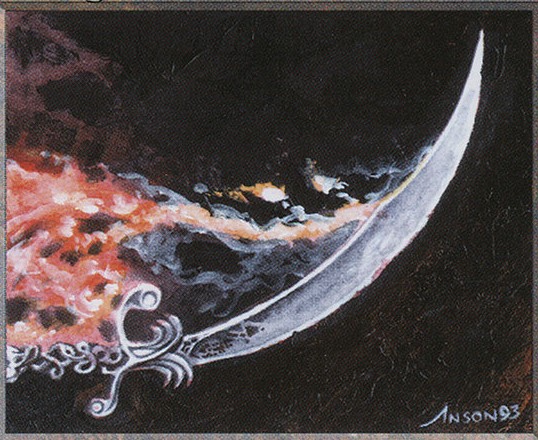
Dancing Scimitar, Anson Maddocks, 1993

Still, the question of where the sentience comes from is there, hanging in the air.

The rules for 5e have a few suggestions: possessed, haunted by a previous wielder, or self-aware because magic.  These rules work, but there are so many more, entertaining options.

I'd argue that starting with who/what is providing the item's sentience makes a better start point for the item's abilities, personality, alignment, and even goal.

After all, there are a good many powerfully magical creatures in the various Monster Manuals to provide a source of magic.

Djinn, Efreet, Marid, and Dao provide elemental options and occasional wishes.

Celestials provide a myriad of powers, and a few might have deliberately chosen to be bound to the item.  Alignment of wielder matters to these items.

Demons, Devils, Yugoloths, and other Fiends bring their own powers to bear, but like the Celestials bound, alignment matters, in that these items actively strive to bring the wielder's alignment to match the item's.

Dragons, Sphinxes, Kraken, Morkoths, and all the other beasties out there that have intelligence of their own, some degree of power, and preferably lair actions.

A wide variety of fey beings and assorted faeries could make for interesting spirits.

Expanding on the official options means asking who/what has possessed the item, who/what is the item haunted by, and what type of magic can create a fully sentient creature (then again, that is the dream of AI, correct?)  

An item that is actually the phylactery of a lich (or a horcrux, ala' Harry Potter), provides an opportunity to redeem the lich or at least use its powers for good before it destroys you.  

Hauntings might be the creator, one (or more) former wielders, beings slain or corrupted by the item or some combination of the above.  Related to this may be the beings that were sacrificed in the creation of the item itself.  A blade called Mocker that is imbued with the spirit of a polyglot sarcastic bard that regularly uses Vicious Mockery on opponents and wielder alike is a fine example, as is the sword named Glory, created from a glory-seeking fighter (or perhaps crusader) that forces the wielder to attack the biggest thing in sight.

Something fashioned entirely from magic would be beyond mortal ken, though not divinely (infernally?) inspired accident.  This isn't to say such items don't exist, merely that mortals (like ALL PCs) won't be creating these items.  

The 5e rules linked above state that "consumable items like potions and scrolls are never sentient."  That is hogwash. Horsefeathers, if you prefer.  A sentient consumable spends its time either desiring a suitably dramatic consumption or begging for its life, such as it is, to be spared.  From the DM perspective, this can provide a wealth of entertainment. 

Sentient items can be delightfully one-dimensional in personality and committed to their agendas.  If ever in doubt as to how to portray an item, I lean on Telecanter's Creepy Commentary for inspiration.

With all this talk of sentient items, I should probably provide a few of my own.  Here are three:

Hemp: Hemp is a sentient CN 50' coil of Rope that functions as a Rope of Climbing as well as a Rope of Entanglement.   Hemp wants to be useful and regularly makes suggestions for use.  If ignored, Hemp will uncoil and 'do it myself' in a huff, moving like a snake towards its objective.  If Hemp feels unappreciated, it is not above slipping away in the night.  If truly offended, it will strangle its owner in the night before slipping away. 

The spirit of a Brownie is bound to the rope, the process shattering the fey's psyche in the process, but leaving its desire to be helpful.  Aside from its Climbing and Entangling, the carrier of Hemp has a strong urge to seek out and consume honeyed milk.

Thirst: Thirst is a sentient LE dagger, technically an athame or maybe a kris, due to the wavy blade (when in a mood, Thirst will argue this point).  Thirst enjoys the terror that killing defenseless sentient beings brings, and feeds on it, because a fiend is bound to the dagger.  

The bound fiend is an Amnizu, and as such, it communicates solely through telepathy, and takes delight in compelling its wielder to commit vicious murders, through Dominate Person if smooth words fail to work.  Its regular urgings (and subsequent murders) cause all sorts of complications.

Wielders benefit from innate knowledge of Infernal, Darkvision, an immunity to poison, and resistance to both fire and cold.  When murdering a bound and conscious victim, the wielder is not only Healed as per the spell, but also gains temporary +1d4 to a random stat (S, D, C, I, W, or Ch).  Yes, murdering several helpless beings allows for multiple stat boosts that can stack.  These temporary boosts last until the next long rest.

What Thirst really wants is to be set free from the bindings.  Destroying the dagger is the simplest means to do, but the bound Amnizu is incapable of telling anyone how exactly to destroy it. 
  

Fortunato: Fortunato is a sentient NE ceramic theater mask of a bearded man wearing an odd helmet. An ancient bard is bound to this mask (due to well-deserved divine curse, but Fortunato is unlikely to share that, preferring a different story that paints him as the victim). Close inspection reveals the mask had been painted in the past, and Fortunato would love to be painted in full color again (being quite vain).  When carried, Fortunato haunts the dreams and whispers in the mind of the carrier, urging them to don the mask.  When worn, Fortunato confers all the skills, abilities, and spells of a 13th level bard with an 18 Charisma and can (and WILL) speak on its own.  Ideally, Fortunato is able to dominate person the wearer and become the dominant member of the relationship.  If Fortunato feels that attempts to dominate may not work, it instead urges to 'let me do this for you,' and strives to ingratiate itself with its usefulness.

If Fortunato successfully dominates its wearer, the wearer spends all ready wealth on a long bout of debauchery, carousing, and other forms of excessive hedonism - all while wearing Fortunato.  Of course, when the wearer regains control (if the wearer regains control), they are the ones left to suffer the regrets and consequences of Fortunato's actions. 

Note that Fortunato will force dominated wearers to attack bricklayers and anyone offering its wearer Amontillado to drink.

It occurs to me that two of the three items above are likely to get the boot once their agendas are discovered, so here is a fourth that PCs are more likely to keep around.


Astrophel: Astrophel is a sentient LG hand mirror with a Planetar bound to it. 

The bearer of Astrophel is immune to poison and charming, resists radiant damage, and saves at advantage against gaze attacks.  When aligned with Astrophel's purpose, the wielder knows when it hears deliberate lies, and can see through illusions via True Seeing.  In addition, Astrophel will Commune 1/day, Raise Dead 1/day upon anyone reflected in the mirror, and provide Healing Touch to anyone that concentrates while looking into the mirror.  

Those that do not align with Astrophel's purpose (not necessarily alignment) only see their doom when they look into the mirror, as the Planetar truly knows the myriad ways the viewer is likely to die in any number of possible futures.

Astrophel's purpose is to throw down the unjust Tyrant King and his infernal allies.   

Overall, sentient items bring lots to the table, and can be an interesting way to increase the capabilities of a single or few PC campaign without too many NPCs.  

What sentient items have shown up in your games?


Sunday, September 12, 2021

Wizards!

I may have mentioned before that I want to revamp my Random Encounter table for the Ironguard Campaign (despite it being on indefinite hiatus), modeled on what is going on here at Papers and Pencils.

2d6

Encounter

2

Dragon!

3

Weird

4

Weird

5

Weird Place

6

Build Place

7

Recurring Characters

8

Build Place

9

Weird Place

10

Weird

11

Weird

12

Wizard!

I'm a fan of Weird encounters, be they from books I've read, other blogs, or my own fevered imagination.  Anything that gives a player pause is good.  

To make the above work, I'll be making using of nested subtables, because I like nested subtables. I failed the search check for my notes on these four wizards, so was forced to build them from scratch.  Here are four, their modes of travel, and their majordomos

1d4

Wizard!

1

traveling in a carriage (with apprentice and choice retainers) made from the animated skeleton of a Mastadon trudging along; retinue consists of various undead.  Majordomo is a well-mannered ghoul in decaying finery.  They'd love to invite you to dinner!

2

traveling on roc-back (with apprentice and choice retainers), with retinue of flying monkeys (use gargoyles for stats).  Majordomo is larger flying monkey in a red velvet vest and matching Fez.  The Fez grants the ability to speak and understand all languages heard.

3

traveling in a large floating bubble (with apprentice and choice retainers in their own, smaller bubbles) seemingly drifting on the wind.  Dozens of smaller bubbles float among the larger ones.  Majordomo is a bubble golem, coalescing out of many bubbles joining together into a rough humanoid shape.   

4

traveling in a palanquin carried by 8 large, headless, humanoids.   Majordomo is a large floating head sporting a monocle.  


When it comes to naming wizards, I dip into history.  So far, no one has noticed, or if they have, they don't mention it.

Yes, all the Wizards! are traveling to and from somewhere, on one inscrutable purpose or another.  

d8

Purpose

1

Returning home from another mission; d6 1-3 celebratory mood of success, 4-6 dour mood of defeat.  PCs either get an invitation to party or are attacked out of frustration.

2

To investigate rumors or following a map; may trade information with PCs.

3

To make war upon a neighbor; mercenaries are welcome.

4

On a pilgrimage to a holy site; faithful are welcome to join, unbelievers are coldly turned away, heretics are destroyed utterly.

5

To fulfill a vow, oath, or other promise to provide aid of some sort; unhappy to be doing so, but promises must be kept.  Will gladly let the PCs serve in its stead. 

6

Off to the city, on a supply run and some well-deserved r&r; whether or not they will be welcomed is another question.

7

Gathering ingredients/specimens for research; PCs may provide needed item through trade or mere existence.

8

Exploring for its own sake.  Will gladly trade information and tales and a feast with PCs.  In the morning, when PCs awake, it will be as if nothing happened.


Once the hexmap is finalized, home and destination hex numbers can be assigned, but until then, these Wizards! are adrift in time and space (which probably doesn't bother them all that much).

Bonus Wizard!: traveling on the back of a gigantic millipede, with apprentice and retinue also on board.  If necessary, different sections of millipede break away into six-legged mounts, each with its own rider.  Major domo rides at the rear and breaks off to come address PCs; he is just a normal-looking human, with vibrant purple skin and a pair of antennae.

Tuesday, March 9, 2021

Houserules: In-person Only Edition

Lots of gaming takes place online, and there are lots of tools suitable for facilitating this play.

Still, in-person games provide the opportunity for manipulatives to be used at the table.

In my case, I am thinking of mechanics lifted from other sources, using items many gamers' homes already contain.

Dread is a horror role-playing game that makes use of a Jenga tower.  The mechanic of pulling and stacking bricks to build tension works in more traditional RPGs.  But when the tower inevitably collapses, it isn't automatic death of the PC, merely something BAD happening to the party as a whole.


Another idea is one I learned of yesterday.  At the blog Daddy Rolled a One, he discusses using cards to mimic wandering through dark twisty caves.  He cites the source of the idea as the YouTube Dungeoncraft Channel, so between the two, you'll get a solid idea of what I am going for.*  

While this trick could be mimicked online using a dice roller or other random generator, there is something more visceral with pulling a card from a spread and revealing it.

The last tangible I want to write about are Scrabble tiles.  I can't lie, Scrabble is one of my favorite board games, but is hell to play against people who cannot spell, have limited vocabularies, or both.


Anyhow, Gnomish Puzzle Locks appear in my megadungeon, and amount to a grid with a bowl of letter tiles underneath them.  Clues exist, but rarely in the same room.  

Players fit the Scrabble tiles to the grid.  Letters glow faintly (sometimes) when in the correct location.  When the final gridspace is filled, either the lock opens with a click-hiss OR the PC manipulating the letters gets an electric shock (meaner versions are actually Chain Lightning).

I wouldn't be much of a DM if there weren't enough spare letters in the bowl to spell out several different words, though.  Maybe wrong words trigger different results.

As I type this, the old computer game Betrayal at Krondor comes to mind, with its Moredhel Wordlock Chests. These chests were kind enough to have the riddle-clues written on them, so maybe I could take that route: riddle-clues in obscure languages in the room (or near it) of the Gnomish Puzzle Lock. Statues and giant brazen faces intoning riddles works as well.

Are any of these silly? Maybe.

Are any of these fun? Yes.  Yes, they are.


*Since I learned of it from a blog, you can guess my preferred method of information gathering.  Still, the Dungeoncraft Channel gets high marks from several sources, so if you like videos and D&D or other rpgs, check it out.


Tuesday, March 2, 2021

In the Dungeon, No One Can Hear You Scream

Dungeon maps walk a fine line between art and usefulness, especially in published products.  In an effort to make them visually appealing, dungeon maps can lose their usefulness.  Which is odd, because the map is for the DM to guide the PCs, providing the players input about what their PCs see, smell, feel, taste, and hear.  Ideally, the only person to see the map is the DM, so making it pretty rather defeats the purpose.

A portion of the map from Judges Guild's Tegel Manor

Tegel Manor was printed back in 1977.  Aside from its hook - a PC won the deed in a fixed card game against one of the living Rumps, so must clear it to claim it - Tegel Manor has an awesome map.  The segment above is a bit blurry, but you can see words in the hallways.  If you squint just right, you can read some of them: Crying, Quarreling, Rolling, and Creaking.  

The idea being that as PCs walk through those passages, they hear those unexplained sounds.  My question is, why don't more published adventures do this?

If you aren't published, but you still craft your own adventures, why don't you do this?  

Appealing to all the senses is a fiction-writing trick that DMs should make more use of.  Maps are another DM trick that do see regular use, but the maps are often near-useless without the key spread throughout the book.  While you can use the Tegel Manor method of random sounds (and sometimes those are great), a better use of sound in the dungeon (and on the map) is to foreshadow what lies in which direction.

Presume the adventuring party has reached a T-intersection, and are faced with the decision to go left or right.  A steady distant rumbling can be heard to the left, and what might be singing can be heard to the right.  Now the players have an interesting choice to make: rumbling or singing.

Writing these two words on the map itself makes life easier for the DM and more realistic for the players.  Without those two words, the players are likely to be annoyed when they go left and suddenly find themselves in a chamber with a deafening waterfall or when they go right and encounter harpies.  

Some DMs can and will quickly improvise as the PCs move towards the room with the waterfall or the harpies, often with a ham-fisted 'you can hear a noise that gets louder,' after reading the key while the PCs stand in the door way.  Spare yourself and your players the headache, and add foreshadowing words to hallways.  Especially sounds.


This much clearer segment of the map from Melan's excellent Castle Xyntillan uses this method, not only with noises (singing, in this case), but other notes.  Granted, Castle X is an homage to Tegel Manor, but the map is so useful that it is worth copying the technique in its own right.  As an aside, Castle Xyntillan is worth the shipping price from overseas and wait time to receive it.  No where before have I seen a catalogue of PCs and NPCs that died during playtesting and where/how they died; this alone is worth a read.

Another way to make use of sounds in the dungeon is to add them to the wandering monster/random encounter table.  Here is a rough example.  Note that some critters won't make noise, but will have other tells.

 d8

 monster

 sounds

 1

gorgon

snorting, clipclopping

 2

hobgoblin patrol

steady tramp of boots getting closer

 3

giant rattlesnake

a rattling

 4

sprites

giggles and laughter 

 5

ghost

weeping and wailing

 6

giant bees (or stirges)

buzzing 

 7

zombies

moaning

 8

roll on the sounds subtable


 d6

 sounds

 1

terrified begging that descends into screaming

 2

laughter that turns into weeping

 3

echoing voice calling for help

 4

roaring 

 5

dripping

 6

crashing


For giggles, items 1-3 on the sounds subtable are in one or more PC voices.  

Combining the two methods works as well: words on the map and a random encounter table that adds sound effects.  

In short, use the empty space on the map and expand your random encounter tables.

It sounds good to me.


Monday, March 1, 2021

Late Night Link

Now this is a fascinating page: Links to Wisdom

It is a large list of links regarding different aspects of roleplaying.  

The links run to a variety of blog articles that quite thoroughly explore various houserules pertaining to whichever broad category you're exploring.

Overall, it reminds me a bit of Blogs on Tape, but far more extensive.

So, if you're in need of some houserules, check it out.

Thursday, February 25, 2021

Dwarves of Ironguard Keep

almost titled this post Smiths of Ironguard, to capture the Farrier and his assistants, but they are just basic human NPCs named Werner, Pierre, and Uller.  Stablehands are Lars, Jean-Luc, and Georg.  I may provide details later.

Instead, I focused on the Dwarves of Ironguard, because these are the only four Dwarves in a large area. This is because the Dwarf race is comparatively few compared to Humans and many other races, but also because most Dwarves keep to themselves in their mountain homes.  


Snorri Ironbeard is the chief armorer and weaponsmith of Ironguard Keep, and the bulk of his  and his apprentices’ work is maintaining the weapons and armor of the Keep’s soldiers.  Still, being Dwarves, they make time for side projects at the forge.  So there will be a few weapons available for purchase, and they are willing to repair damaged armor and weapons, as well.


For a price, of course.  For a greater price, a commission for a high-quality item might be had.


Ori, Dori, and Nori Ironbeard are Snorri’s nephews - the sons of his sister, Flori, who still works the forge alongside her wife back in the Iron Hills.


Ori, Dori, and Nori from Peter Jackson's movie The Hobbit  (close enough for my game)


Snorri Ironbeard (M LN F5 Battle Master)

Ori Ironbeard (M LG F3 Battle Master)

Dori Ironbeard (M LN F2)

Nori Ironbeard (M LG F2)


A trio of well-made iron statues watch over the forge: Moradin Soulforger, flanked by Clangeddin Silverbeard on the right, and Berronar Truesilver on the left.  The nephews have a shrine to Vergadain in their shared chamber.


In case of siege or adventuring, each of the nephews dons plate and shield, hammer, crossbow, and shortsword.  In case of siege, Snorri also dons plate, but his armor provides a nonmagical +1 bonus to AC. Snorri’s weapons are a great enchanted two-handed maul named Foecrusher, a crossbow, and shortsword.  


Snorri and the boys always take an interest in recovered treasures bearing the arms of other Dwarves and Dwarf-clans, as well as rumors and proof of mithril and other exotic metals. They will purchase ingots of any such metals found.


While most Dwarves in my world are content to spend their long lives in their forges, workshops, and mines, there are those that suffer a wanderlust or have a life-purpose that requires them to leave. Snorri is one such Dwarf. 


He has been tasked by Queen Ulla Shieldbane of the Iron Hills to monitor and report (not necessarily spy) on the activities at Ironguard Keep, particularly the rising chaos and the human response to it.  As such, Snorri listens and observes, periodically sending a coded message back home using trusted contacts.  


It is a truth that Dwarves are staunch allies, but their allegiance is always to their liege first.  


While Snorri will not leave the forge to go adventuring, one of the nephews (only one at a time), may go out with a party that has qualified itself through repeated low-casualty, high-profit expeditions.  This not only allows that nephew to gain experience and treasure, but also provides a first-hand report for Snorri to send back home.


Use or ignore these four as you will.


Dwarves! I suspect this is from the 1938 film version of Snow White and the Seven Dwarves

I have zero qualms making use of the tropes and stereotypes from the past several decades of gaming and fantasy literature, and much about the Dwarves in my world reflect that.  Still, there are some differences in an attempt to make them more alien than they currently are.  I say this, because by RAW, Dwarves (and all the other humanoids and demihumans) are effectively funny-looking humans with mechanical bonuses, and are often played as such.  There is nothing inherently wrong with this approach, but is not exactly what I am looking for in a game.


The first and largest difference is that Dwarves in my world do not reproduce as mammals - especially humans - do.  While they do have the genitalia associated with most mortal species, it is because Moradin Soulforger modeled his first-carved after what he saw the Humans doing, and understood that by doing so, his people might be able to better relate to what even then was the far more numerous race.  


So the Dwarven method of reproduction is thus:


A couple work together to carve/forge/sculpt a statue of a Dwarf, and if Moradin Soulforger (chief deity of the Dwarves) approves, Moradin breathes life into the statue, and a new Dwarf is ‘born.’  These statues are fully grown, so Dwarf babies or children as humans know them don’t exist. Instead, Dwarves are merely younger or older, and claim parents and family names from their crafters.  


After completing the statue, the Dwarves involved bring in a Forgepriest of Moradin, who conducts the lifebreath ritual, and if Moradin approves, the statue steps down from its plinth, a full-fledged Dwarf. Generally speaking, experienced Forgepriests can often tell if Moradin would approve and will state as much.  If an otherwise fine statue does not come to life, the Forgepriest will question the Dwarves involved in an attempt to determine what transgression they have committed to cause such.


Moradin doesn’t care if the paired Dwarves are male-female, female-female, or male-male. The material(s) used often affect the new Dwarf’s personality, and after centuries, the average Dwarf knows enough about the entire process to have preferred materials for their ‘children’.  Typically, a pair of Dwarves will spend at least a decade on their ‘child,’ as any flaws come to life as personality or physical flaws.  Dwarf-Champions and Dwarf-Kings often (but not always) are the result of multiple decades, if not a century or two, of work.


Hushed legends exist of situations where a couple composed of a Dwarf and a nonDwarf carve/forge/sculpt a statue together, and what happens when it comes to life, but those are not recorded here.  


Since I am digressing about the Dwarves of my homebrew world, let’s talk about beards.  Yes, Dwarven women in my world have beards, but that is because I have borrowed something I read in one of the Facebook D&D groups: namely that Dwarven beards are filters, keeping out dust, dirt, disease, and the like and are also the in-game reason for Dwarf bonuses against poison.  Moradin blesses his people with thick beards because as creatures of the mine and forge, the Dwarves need this to help survive the dust and fumes associated with such work.


Shearing the beard (a punishment used only in extremis amongst the Dwarves, as a prelude to exile from their people), is not only a mark of shame, but also removes a Dwarf’s resistance to poison.  Such Dwarves are typically shorn in a public fashion, then physically driven out of their community.  In truly egregious cases, the ‘parents’ and ‘siblings’ of such a Dwarf are shorn and driven out, as well.  This shearing can drive a Dwarf mad, even if the beard does eventually grow back. According to Dwarf histories, this is how the Derro came to be (unlike what Shaver rambles about).


Derro (Jim Holloway, Monster Manual II, 1983)


(if you are the person who I borrowed this idea about Dwarf beards from, tell me, so I can give you proper credit.  It is pretty cool).


Now, due to the importance of the beard in Dwarf culture, younger Dwarves often place undue trust in other bearded humanoids and undue suspicion on those without beards. The human idea of smooth faces being attractive dumbfounds Dwarves, but with time and experience, Dwarves can learn to (mostly) trust beardless individuals, as well as accept the theory that a beard doesn't automatically make a nonDwarf better. This doesn't always translate well, though.


Yes, as might be imagined, I have similar treatments of Elves and Gnomes and Halflings.