Showing posts with label 5e. Show all posts

Thursday, July 11, 2024

The Staff of Pmurt the Orange

A magic item that came to me as I drove home.  

I promise the write-up for session four is almost done and should hopefully be finished tonight.

------

Pmurt the Orange was an average wizard born to wealthy parents.  His parents' wealth brought him everything but skill at magic, which could only be achieved through patience and practice.  Given that Pmurt lacked patience, it was only a matter of time before a magical experiment went awry, permanently staining his flesh and hair a sickly shade of orange, a shade that cannot be hidden under any magics yet tried - which only served to increase the anger that Pmurt the Orange felt at being born.

With time, however, Pmurt the Orange did master his craft, at least enough to craft a magestaff of some potency.

Unfortunately, the staff picked up some of Pmurt's negative personality traits during its creation and, as such, using the staff can be exhausting.  Indeed, merely attuning to it costs the wielder 1d4+1 temporary Charisma loss, a loss which can only be restored when the wielder gives up the staff.  Getting it to actually work requires the wielder to force their will upon the staff, and the more potent the power, the more exhausting the battle of wills.

Mechanically this means that to activate a power safely requires the wielder to make a Charisma save; failure to make the save means the power is still used, but the wielder acquires one or more levels of exhaustion. 

DC10, 1 level of exhaustion - Light, Dancing Lights, Ventriloquism

DC12, 1 level of exhaustion - Detect Thoughts, Knock 

DC14, 1 level of exhaustion - Suggestion, Charm Person

DC16, 2 levels of exhaustion - Dispel Magic, Wall of Ice

DC18, 3 levels of exhaustion - Confusion, Fear

DC20, 4 levels of exhaustion - Teleport Self (like Teleport, but only the wielder goes)

In addition to the above powers, Pmurt's staff has a pair of unique abilities that only exhaust others:

Fleeting Luck - when this power is active, the wielder rolls all rolls at advantage; the drawback is that one of their local allies (chosen at random or by DM fiat) suffers the opposite, and all of their rolls are at disadvantage.  When active, it lasts for 8 hours before having to be reactivated.

Energy Vampire - the wielder heals themself of damage at the expense of their allies.  When activated, a local ally is chosen at random (or DM fiat), and the wielder is brought up to full hit points.  This ability can even heal some conditions, but not exhaustion.  

These abilities seem harsh, but the truth is that Pmurt the Orange was a narcissist, and cared not at all for his allies beyond what they could do for him in the short-term.

Lastly, using the staff slowly stains its wielder the same ugly orange as Pmurt, beginning with the palms of their hands and spreading outwards, until the body is covered.  Using the more powerful abilities makes the stains spread faster; to date, there is no record of what happens to a wielder who goes completely orange, although it is speculated that this is a form of slow-moving possession, and one that reaches full orange becomes Pmurt himself (and therefore, an NPC).

-----

Note that the Staff is sentient and will activate the Teleport Self if it believes it or its wielder is in danger.  This has the side effect of making the wielder appear to be a coward in the eyes of allies.

Being sentient, it can speak, but chooses not too unless absolutely necessary.  

Monday, September 5, 2022

Rings of Power

Magic Rings - always fun, always claimed, always tested by PCs donning them.  

Here are three for your games.

-----

From some online shop.  If you want a prop, buy it!


Ring of the Necromancer

This ring is made of bone and is carved into a skull shape.  It is cold to the touch. 

Attunement - 1 permanent Constitution loss; removing the ring results in immediate unattunement.

The wearer of the ring can control twice the number of undead that their level allows, and wearer-created undead are at maximum hit points when created.

In addition, the wearer's necromancy spells are always at maximum dice rolls.

This ring also has several quirks. The first being that the wearer is vulnerable to cold-based damage, suffering one additional damage die from such attacks, AND cold-based damage always does at least 2 points of damage per die rolled. The second is that all Death Saves are rolled at Disadvantage.  The third is that the wearer cannot be restored to life, regardless of magic, instead rising as a spell-casting wraith, it's spells being whatever was still memorized when the Necromancer wearing it died, the spells replenishing themselves every 24 hours.   Lesser quirks include that normal animals fear the wearer, trying to bolt and pissing everywhere in the wearer's presence, and that the wearer leaves footprints of dead grass and plantlife behind them as they walk - they literally stain the world as they move. 

DM Note: in my world, creating undead rips the spirit or soul from its afterlife, forcing it back into its physical body to animate it.  This is why Necromancy is considered evil, and also why undead hate the living.

-----

Ring of the Lich-King

A platinum band with diamond studs.  

Decades back, heroes (of a sort) battled the Lich-King and removed his hand.  The Wizard among the group placed the hand - with its ring still on a finger - within a protective glass display case.  This case prevents scrying and detection, which means that in the ensuing decades, the Lich-King has yet to find his missing ring.  It goes without saying that some enterprising fool adventurer will discover and remove it from the glass and don it.

Attunement - 1 permanent Constitution loss; the ring won't come off unless the finger is removed.  Doing so leaves a stump that will not grow back, even with a Wish.

The Ring of the Lich-King functions as a ring of spell turning, a (limited) ring of mind shielding, and a ring of wizardry that doubles both first and second level spell capacity for its wearer.  So a third-level wizard (foolishly) donning this ring would be able to memorize 8 first and 4 second level spells, rather than the RAW 4 first and 2 second (damn, 5e hands out spells like candy).

Living wearers are at Disadvantage for all saves.  In addition, nightmares come and go; with each attempt at a long rest, the PC must make a Wisdom save DC 15 or suffer a restless sleep, so gaining none of the benefits of a long rest.  If asked, these nightmares feature a crowned skeletal being actively pursuing the PC in question.

Once donned by a living being, the Lich-King knows and sends undead minions of increasing power to take it back.  This is the limitation of the ring of mind shielding - the Lich-King can (and will) get around it.  Undead target the Ring-wearer above all others, trying to reclaim the Ring for their master.

Should a living being be slain while wearing the Ring of the Lich-King, the being rises as a Wight the next round, completely under the thrall of the Lich-King, making haste to return the ring to its rightful owner.

The world will suffer if this happens.

-----

A ring from Amazon, so you know its quality!

Viper's Kiss

A silver ring featuring twin viper heads with carnelians in their mouths.  It feels incredibly dry to the touch.

When donned, the ring constricts around the finger and the fangs extend, piercing the skin.  This begins the attuning.  The ring injects a poison into the wearer, and if they make the DC14 Constitution save, the ring-wearer's eyes turn into snake-eyes, their tongue begins forking, and over time, their entire body begins to grow scales, starting at the finger.  This scaling is complete after a year.

Failing the save results in a particularly virulent poison coursing through the wearer's system, and the ring dropping off the finger.  This poison causes the wearer's skin to turn scaly and start dropping off, reducing Charisma (its gross watching someone's skin fall off in bits) and Dexterity (its painful to have skin chafing off) by 2d4 each.

Viper's Kiss provides its wearer with several benefits: immunity to reptile-based poisons; Advantage on saves versus other poisons; can speak with reptiles; reptiles are not immediately hostile to the wearer; the wearer can spit poison as a Guardian Naga.

Along with its benefits, Viper's Kiss also has drawbacks.  Chief among them is that cold and cold weather drop the wearer into a torpor, leaving the wearer effectively stunned in colder temperatures and paralyzed in temperatures below 0.  In addition, every time the PC wearing the ring levels up, they MUST molt, shedding their skin and becoming extremely vulnerable (also cannot wear anything but loose robes due to massive skin irritation).  What becomes of the PC-shaped skins is anyone's guess! 

I am confident a good DM will make sure the PC in question thinks about it....


Thursday, June 30, 2022

Ironguard Summer 2022: Session 2

In attendance - Elren the Woodelf Druid 5 and Yelrah the HalfOrc Barbarian 5, backed by a half-dozen meatshields outlined HERE.

-----

Our game picks up where it left off last time - with the PCs hunting missing hunters.

Tracking the goblins to their lair, our heroes found themselves overlooking a valley full of goblins, as well as 5 humans tied to stakes near a large fire and a larger tent.  Elren summoned a pair of giant vultures to distract the goblins while Yelrah led a daring raid (himself, the Dwarf, and several people-at-arms) into the camp to free the captives.  

Cries of 'Bree-Yark' in all its variations filled the air as the vultures successfully distracted goblins.

As the minions were freeing the prisoners, a goblin stepped out of the central tent, laughed and growled 'another soul to power my ascension!' as its flesh rippled and it grew and grew into a 7-8 foot hairy goblin thing - definitely the source of the unknown scent!

Yelrah was unphased and uttered, 'eat this' then rolled initiative.  Winning by a large amount, Yelrah rolled first with advantage (raging) and connected critically.  Cascading damage dice houserule kicked in and the end state was a very dead goblin-thing (71 damage total between two hits).  With his first blow, Yelrah kneecapped the fiend, and as it fell forward, he pulped its skull.  The fiend collapsed onto the ground and immediately began smoking and bubbling, a sulfur stench filling the air until - within seconds - all that was left was a body-shaped outline of scorched earth.  

As the fiend melted away, the sounds of 'bree-Yark' grew closer as two groups of goblins rounded the large tent - a trio to the south and a trio to the north.  Boltag let fly a crossbow bolt at the south group, missing utterly, while Elren sent his vultures directly into combat - one missing as a Goblin ducked, and the other goblin getting its head crushed in a mighty beak, cutting off its words in mid-Bree.

Galrik the Dwarf charged the north trio and the vultures, while Yelrah walked towards the south trio.  Elren cast Thorn Whip, missing at first, but then catching the rhythm of it, sheared off a goblin's head.

The northern goblins knocked Galrik down and bleeding (maybe that is why he hates Goblins - he loses fights to them?), while the southern Goblns fell steadily to Yelrah's mighty blade.  Cries of 'Bree-Yark' filled the air as both trios were quickly dispatched and the remaining goblins failed their morale roll and bolted into the surrounding forest.

A healing word later had Galrik on his feet, pondering his sliced mail and rethinking his distrust of the elf.  His ponderings were cut short as Yelrah called him over and the two entered the central tent.  Inside was a sleeping area made of several furs, three amphorae filled with wine, and a large chest (two-person lift size and weight).  A quick search of the tent turned up a key to the otherwise simple lock.  Yelrah opened first the lock and then the chest, dodging most - but not all - of the spring-loaded darts that flew out of it.  Plucking the darts (3 damage between the two of them, blah) from himself, Yelrah's eyes focused on the coins glittering in the light - gold and silver all loose and jumbled deep together.  

Plunging his arms into the coins, he felt around for anything that might be hidden, finding a bottle or vial, and then the stem of a goblet.  Leaving both covered in coins, he closed the lid and then he and Galrik carried it to the others while Elren and Boltag stood in overwatch, and the others bound the wounds of the rescued humans.

-----

Three of the prisoners wore hunting leathers in brown and green, while the other two wore tattered robes of black and purple and yellow.  Yelrah recognized the robes, but wasn't sure exactly from where - despite their similarity to the ones worn by the chaos priests from his last adventure.

Interrogating the rescued prisoners, our heroes learned that their names were (courtesy of Gig Economy - it arrived!): the pair in leathers that are the missing hunters are Tambo the Steady and Corso the Lovely (with a lascivious smile - but no teeth!), while the third in leathers being named Eiron of the Swamp - and he smells like one.  Meanwhile, the two in robes are Toly Springall (who speaks only in cliches - this was fun to roleplay) and Craigie Pollock who smells of onions and garlic, but is quite interested in Yelrah's muscles. 

The robed individuals, Craigie, actually, provided useful information to the team - the shapeshifting goblin was a fiend from the lower planes called a Barghest. He didn't reveal much beyond that except that he and Toly were ambushed while on a pilgrimage.

A barghest.

When asked how Eibon came to be captured, he said goblins ambushed him and his friends, and his friends ran. After the q&a session, the hunters were asked if they knew an alternate route back to the keep, and all three acknowledged that they did.  Tambo and Corso's route was chosen over Eibon's, who just shrugged and went along with the group.  

This left the chest as the next order of business.

Yelrah opened it, with Elren watching over his shoulder.  As coins were sorted out, Elren noticed that some of the silver pieces were actually platinum, and he claimed those (12 pp).  Yelrah claimed the gold coins (100gp), and the two left the remaining coinage (1000sp and 1000cp) to be divided up among the others as the others saw fit.  This left the potion and the goblet.  

Examining the liquid in the bottle revealed it to be viscous and Yelrah said he was looking forward to drinking it in an emergency.  It's label read 'the key to the labyrinth of mazzamaxx.'  As for the goblet, it looked like this:

Maybe Yelrah will drink the potion from this goblet?

Coins in pockets, the freed prisoners commented that they were unarmed, their belongings taken by the goblins.  Heading back into the camp, they quickly picked up dropped goblin weapons - not the best, but better than nothing.  A wandering monster roll reminded all that they had dallied long enough - perhaps far too long.

Note that while the prisoners were gathering weapons, Yelrah handed Elren the wooden ring he had found.  Elren donned it and felt a tingle - as in 'spidey sense is tingling' tingle.

We ended with the group ready to head back to Ironguard Keep.

-----

All told, it was a fun session, with lots of laughs.  Initiative and cascading dice rolls made the fight with the Barghest not nearly what I was hoping for, but still lots of fun.  All those 6s that Yelrah rolled for damage!

The potion is a bottled memory, though the players don't know that yet.  As for the goblet, that is the Goblet of Apsethus.  Because when you have few players, you need NPCs to travel with them.

I haven't decided on what exactly the ring does, yet, but I do have some ideas.

Saturday, May 28, 2022

Magic Item: Cloak of Shadows

This dark hooded cloak is cool to the touch and always smells faintly of damp earth (being created from used grave shrouds, it makes sense).  Detect Magic reveals transmutation and necromancy magic.  Those that look for it also finds the Cloak of Shadows radiates mild Evil and milder sentience and malevolence.

Donning the cloak does nothing, but pulling the hood up over your head provides the wearer with several traits of Shadows, nominally the amorphous and shadow stealth traits.  Removing the hood brings the wearer back to reality, which can be fatal if in a place to small for their body.

However, malevolent, necromantic, and evil magic always comes at a cost.  

Image found on Twitter, by Lemoris Ashcraft @infernalshroud

In this case, the cost is as follows:  after each use, there is a cumulative chance that the wearer becomes a proper shadow, with the cloak detaching and falling to the ground in heap.  

Each wearer starts at 0%, and adds 1% per hood-donning. When the wearer goes to remove the hood, percentile dice are rolled, and the if the numbers come up at the percent or lower, the wearer moves to NPC status as a full free-willed shadow.  At this point, the wearer's gear falls from shadow into physical space with a clatter and thump, the Cloak of Shadows atop the pile.  

In addition, keeping the hood up for too long can add to the cumulative percentage.  If the wearer stays hooded for more than one turn, they suffer a level of exhaustion for each turn or fragment thereof.  A PC that dies from exhaustion inflicted by the Cloak of Shadows becomes a shadow, drifting free of its belongings as its mortal frame turns to dust.  

From 0% thru 49% the Cloak of Shadows is just a useful tool for sneaks and scouts.

At 50% a remove curse spell is required to remove the cloak; unhooding requires a DC12 Wisdom save; the Shadow trait of Sunlight Weakness takes hold, so the wearer suffers disadvantage on attack rolls, ability checks, and saving throws while in sunlight

At 75% the cloak whispers to the wearer, suggesting being used.  This plays out with the GM directly asking the player if the PC uses the cloak.  The unhooding save increases to DC 14.

At 80% the unhooding save increases to DC 16.  The Cloak whispers to the PC in dreams and when alone; long rests are disrupted by nightmares if the PC fails a DC 12 Wisdom save. 

At 90% the unhooding save increases to DC 18.  The Cloak's sentience and malevolence becomes active, and unhooding saves are at disadvantage.  Nightmares are a DC 14 Wisdom save and continue even if the PC successfully gets rid of the Cloak of Shadows.

At 99% the unhooding save becomes DC 20 at disadvantage as the Cloak is screaming into the PC's mind to join it in Shadow.  

At 100% the PC becomes a shadow as described further up post.

Nether Shadow, Christopher Rush, 1993 Magic Card

-----

GM Note: the GM can keep the growing number a secret if that is their jam, or they can create suspense and tension and paranoia by having the player keep up with the number, but not telling the player why.

-----

Something like this may already exist, and if so, someone please let me know.


Sunday, March 20, 2022

Houserules During Play

While it is true that my expansive Experience Point rules do drive some game play, I have other rules that impact it, as well.

This incomplete excerpt addresses things that may happen during a session.  I've tried to source them all, but even that is incomplete.  If you know the original source of an idea, please let me know.


Big d30 – once per session per player, that player can choose to roll a d30 instead of the regular die for an attack, damage, saving throw, skill check, spell ability, or anything else a player can make a sound argument for.

Cascading Damage Dice – PC, opponent, and trap damage can all cascade.  A weapon dealing 1d6 rolls a 6, the die is rolled again and keeps getting rolled until a non-6 appears.  Then all the rolls are added together for the final number.  As such, critical hits are not doubled damage, but rather twice the dice thrown.  Other effects may cascade, if you can convince the DM to allow it.

Death Saves - These are rolled, and kept hidden, by the DM.  

Divine Intervention – a PC of any level can call out to their patron deity for relief and succor.  On a 20, the deity (or divine messenger) appears to answer that call.  Annoying deities with trivial matters is unwise; unwise or not, the deity will demand a specific service or sacrifice in return for its assistance.  It would be most unwise to not attend to that service with speed and efficiency.  Particularly pious or powerful callers may roll at advantage, and impious callers roll at disadvantage.  Calling out for help from deities that are not your patron (especially for Clerics and Paladins) is both unwise and foolhardy.

Downtime - prime adventuring season (like campaigning for war) is typically Spring, Summer, and Fall.  Winters in the Great North are too difficult for much, so are best spent indoors, making the Winter a grand time for crafting, researching, and the like. 

Encumbrance – it matters; use the illustrated handouts (PLEASE tell me who made these - they are awesome!) - it seems these all stem from someone named Takodo.  


Failing Forward - you still accomplish whatever the die roll was for, but it comes with a cost.  The more you miss the DC by, the greater the cost (think broken gear, alarms sounding, whatever the DM cooks up). That said, a natural 1 always fails and is always amusing for the DM bad.

Falling Damage – Falling is bad. 1d6 cumulative per 10’ fallen; 10’ = 1d6, 20’ = 1d6+2d6, 30’ = 1d6+2d6+3d6, etc. so a 60’ fall is 21d6. Cascading dice work here, too, so don't fall.

Flashback – players may spend a point of Inspiration to explain something they did in the past that wasn’t mentioned, as long as it is feasible and reasonable.  For example, if the party finds themselves fighting werewolves, the Fighter can Flashback to when they bought a silvered sword in town ‘on a hunch.’  (from Blades in the Dark)

Fleeting Luck – The PC’s each get a Fleeting Luck Point at the beginning of the session. If player rolls a Natural 20 or does something cool (DM discretion) then they get another point. If any of the players roll a Natural 1 then ALL of the players lose all of their Fleeting Luck. Fleeting Luck tokens can be spent as Inspiration or Advantage. (from DCC)

I Know a Guy… - In any situation (where it makes sense), a PC can declare “I know a guy,” and then quickly sketch that NPC & the relationship. Fewer details are usually better - that leaves room for the DM & PCs to play. Upon declaration, the NPC exists. Then, when the PCs try to interact with the NPC, the player who created that NPC makes a Charisma roll to see how the NPC reacts. Depending upon the situation, the DM may decide advantage/disadvantage applies. (from “I know a guy” house rule | Sage Advice D&D)

Living Expenses - At the beginning of each session all PCs - even those whose players are not present -  will be assessed living expenses for themselves and their henchmen, at 1% of their XP in gold pieces, minimum 1gp. (Jeff’s Gameblog)

Magic Items, Buying – auctions, commissioning, working through a broker, and trading with others is the best way to gain items.  Note that unless a PC personally crafts an item, it will almost inevitably have a drawback of some sort.  

Magic Items, Crafting – crafting items is the purview of wizards, clerics, and druids.  Other classes lack the training and background to bind their magic into items. See the DM about all that is needed to craft any specific item.

Magic Items, General - presume that all magic items have a cost to use beyond attunement.  Magic is dangerous - like radiation or stupidity. 

Silver Standard – After initial PC gear purchases, prices haven’t changed, but most coins seen are now silver.  10cp = 1 sp; 10sp = 1gp.  

Shenanigans - anything PCs can do, NPCs can do - often better.  If the players are good with nonsense being done unto their PCs, I will probably allow the PCs to perform such nonsense.  Things such as creating water in lungs to cause drowning, or an instant kill on a sleeping or incapacitated target, among others.  DM verifies PC actions with 'are you certain...'

Splintered Shields – any time you take damage, you can opt instead to say your shield absorbed the force of the blow. The shield is shattered and must be discarded, but you don't take any damage from that hit.  Magical shields permanently lose a + each time used this way, before finally needing to be discarded.  (from Trollsmyth: Shields Shall be Splintered!)

Morale – The only beings that do not make morale checks in combat are PCs. The morale score of a retainer is based on the Charisma score of the player hiring him (or her). Retainers must check morale after each adventure; If the morale check is failed, they will not adventure with their employer again. Retainers do not need to check morale in combat unless the danger is greater than might reasonably be expected. Beings that fail morale checks may surrender or retreat from battle. (from Moldvay Basic, 1981, B27)

Overloaded Encounter Die – random encounters happen; this DM uses a d6 every turn with these results (from Overloading the encounter die | Necropraxis):

1

Encounter

2

Spoor or Sign or Clue

3

Locality-specific

4

PC must rest

5

Torch (or candle) goes out

6

Lantern goes out

Reaction Rolls – (from Moldvay Basic, 1981, B24) - The first decision a party must make in an encounter is whether to fight, talk, run, or wait to see what the monster will do.

2d6

Monster Reaction

2

Immediate attack 

3-5

Hostile, possible attack

6-8

Uncertain, monster confused

9-11

No attack, monster leaves or considers offer

12

Enthusiastic friendship

The CLICK! Rule - in that moment between when a trap is triggered and when it goes off, you ask the player “what do you do?” You don’t tell them anything about what’s going on around them except that they triggered something. They caught a trip wire. They stepped on a pressure plate. Or the lid of the treasure chest caught for a moment and then clicked free. And then you say “what do you do?”

Now, take their answer, whatever it is, and figure out whether it would actually help them avoid the trap in a remarkable way OR if it would make them less likely to avoid the trap OR if it would have no effect at all. If it was an exceptionally GOOD reaction, give them a bonus to avoid the trap. If it was an exceptionally BAD reaction, give them a penalty to avoid the trap. And if it’s a normal response that really isn’t anything special, just let them roll normally. (from Traps Suck | The Angry GM

Under Pressure - At the start of combat, the DM may roll a d4. In that many rounds, something (usually something bad) will happen. 

Saturday, November 6, 2021

Sentient Items

Sentient items - historically swords, at least in Dungeons and Dragons - are often a fun addition to a party's arsenal of oddities and options.  Moorcock's Stormbringer is perhaps the classic example, but it isn't always weapons that are sentient.  Fiction gives us Bob the Skull from the Dresden Files, as well as an odd Dragon Amulet from the Return to Brookmere Endless Quest book.  

A fun book from my youth.  As I recall, it features Tim Truman art - well worth the look.

Monte Cook extensively covered rules for creating sentient items in the Book of Eldritch Might III (compiled here with the first two books), and to be honest, that was what opened my eyes to the possibilities. (As an aside, I find all of the Malhavoc Press product I read to be inspiring, and if 3.x is your jam, I recommend looking into them).  

The point being that anything can be sentient, with a bit of effort and creativity.  

In addition to their powers and plusses, sentient items bring their own agendas and occasionally dominate their wielder, forcing the wielder to pursue said agenda.  On rare occasions, the item's agenda and the wielder's agenda match, so no domination is necessary.

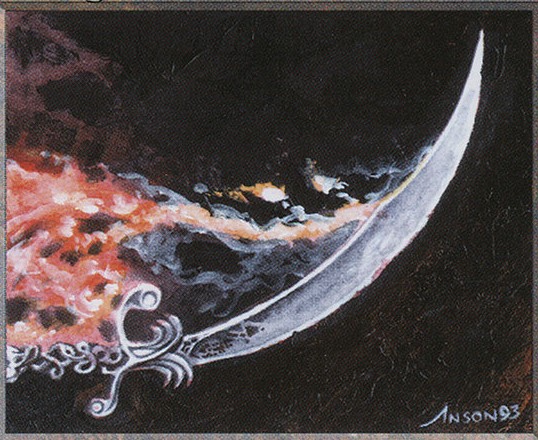
Dancing Scimitar, Anson Maddocks, 1993

Still, the question of where the sentience comes from is there, hanging in the air.

The rules for 5e have a few suggestions: possessed, haunted by a previous wielder, or self-aware because magic.  These rules work, but there are so many more, entertaining options.

I'd argue that starting with who/what is providing the item's sentience makes a better start point for the item's abilities, personality, alignment, and even goal.

After all, there are a good many powerfully magical creatures in the various Monster Manuals to provide a source of magic.

Djinn, Efreet, Marid, and Dao provide elemental options and occasional wishes.

Celestials provide a myriad of powers, and a few might have deliberately chosen to be bound to the item.  Alignment of wielder matters to these items.

Demons, Devils, Yugoloths, and other Fiends bring their own powers to bear, but like the Celestials bound, alignment matters, in that these items actively strive to bring the wielder's alignment to match the item's.

Dragons, Sphinxes, Kraken, Morkoths, and all the other beasties out there that have intelligence of their own, some degree of power, and preferably lair actions.

A wide variety of fey beings and assorted faeries could make for interesting spirits.

Expanding on the official options means asking who/what has possessed the item, who/what is the item haunted by, and what type of magic can create a fully sentient creature (then again, that is the dream of AI, correct?)  

An item that is actually the phylactery of a lich (or a horcrux, ala' Harry Potter), provides an opportunity to redeem the lich or at least use its powers for good before it destroys you.  

Hauntings might be the creator, one (or more) former wielders, beings slain or corrupted by the item or some combination of the above.  Related to this may be the beings that were sacrificed in the creation of the item itself.  A blade called Mocker that is imbued with the spirit of a polyglot sarcastic bard that regularly uses Vicious Mockery on opponents and wielder alike is a fine example, as is the sword named Glory, created from a glory-seeking fighter (or perhaps crusader) that forces the wielder to attack the biggest thing in sight.

Something fashioned entirely from magic would be beyond mortal ken, though not divinely (infernally?) inspired accident.  This isn't to say such items don't exist, merely that mortals (like ALL PCs) won't be creating these items.  

The 5e rules linked above state that "consumable items like potions and scrolls are never sentient."  That is hogwash. Horsefeathers, if you prefer.  A sentient consumable spends its time either desiring a suitably dramatic consumption or begging for its life, such as it is, to be spared.  From the DM perspective, this can provide a wealth of entertainment. 

Sentient items can be delightfully one-dimensional in personality and committed to their agendas.  If ever in doubt as to how to portray an item, I lean on Telecanter's Creepy Commentary for inspiration.

With all this talk of sentient items, I should probably provide a few of my own.  Here are three:

Hemp: Hemp is a sentient CN 50' coil of Rope that functions as a Rope of Climbing as well as a Rope of Entanglement.   Hemp wants to be useful and regularly makes suggestions for use.  If ignored, Hemp will uncoil and 'do it myself' in a huff, moving like a snake towards its objective.  If Hemp feels unappreciated, it is not above slipping away in the night.  If truly offended, it will strangle its owner in the night before slipping away. 

The spirit of a Brownie is bound to the rope, the process shattering the fey's psyche in the process, but leaving its desire to be helpful.  Aside from its Climbing and Entangling, the carrier of Hemp has a strong urge to seek out and consume honeyed milk.

Thirst: Thirst is a sentient LE dagger, technically an athame or maybe a kris, due to the wavy blade (when in a mood, Thirst will argue this point).  Thirst enjoys the terror that killing defenseless sentient beings brings, and feeds on it, because a fiend is bound to the dagger.  

The bound fiend is an Amnizu, and as such, it communicates solely through telepathy, and takes delight in compelling its wielder to commit vicious murders, through Dominate Person if smooth words fail to work.  Its regular urgings (and subsequent murders) cause all sorts of complications.

Wielders benefit from innate knowledge of Infernal, Darkvision, an immunity to poison, and resistance to both fire and cold.  When murdering a bound and conscious victim, the wielder is not only Healed as per the spell, but also gains temporary +1d4 to a random stat (S, D, C, I, W, or Ch).  Yes, murdering several helpless beings allows for multiple stat boosts that can stack.  These temporary boosts last until the next long rest.

What Thirst really wants is to be set free from the bindings.  Destroying the dagger is the simplest means to do, but the bound Amnizu is incapable of telling anyone how exactly to destroy it. 
  

Fortunato: Fortunato is a sentient NE ceramic theater mask of a bearded man wearing an odd helmet. An ancient bard is bound to this mask (due to well-deserved divine curse, but Fortunato is unlikely to share that, preferring a different story that paints him as the victim). Close inspection reveals the mask had been painted in the past, and Fortunato would love to be painted in full color again (being quite vain).  When carried, Fortunato haunts the dreams and whispers in the mind of the carrier, urging them to don the mask.  When worn, Fortunato confers all the skills, abilities, and spells of a 13th level bard with an 18 Charisma and can (and WILL) speak on its own.  Ideally, Fortunato is able to dominate person the wearer and become the dominant member of the relationship.  If Fortunato feels that attempts to dominate may not work, it instead urges to 'let me do this for you,' and strives to ingratiate itself with its usefulness.

If Fortunato successfully dominates its wearer, the wearer spends all ready wealth on a long bout of debauchery, carousing, and other forms of excessive hedonism - all while wearing Fortunato.  Of course, when the wearer regains control (if the wearer regains control), they are the ones left to suffer the regrets and consequences of Fortunato's actions. 

Note that Fortunato will force dominated wearers to attack bricklayers and anyone offering its wearer Amontillado to drink.

It occurs to me that two of the three items above are likely to get the boot once their agendas are discovered, so here is a fourth that PCs are more likely to keep around.


Astrophel: Astrophel is a sentient LG hand mirror with a Planetar bound to it. 

The bearer of Astrophel is immune to poison and charming, resists radiant damage, and saves at advantage against gaze attacks.  When aligned with Astrophel's purpose, the wielder knows when it hears deliberate lies, and can see through illusions via True Seeing.  In addition, Astrophel will Commune 1/day, Raise Dead 1/day upon anyone reflected in the mirror, and provide Healing Touch to anyone that concentrates while looking into the mirror.  

Those that do not align with Astrophel's purpose (not necessarily alignment) only see their doom when they look into the mirror, as the Planetar truly knows the myriad ways the viewer is likely to die in any number of possible futures.

Astrophel's purpose is to throw down the unjust Tyrant King and his infernal allies.   

Overall, sentient items bring lots to the table, and can be an interesting way to increase the capabilities of a single or few PC campaign without too many NPCs.  

What sentient items have shown up in your games?


Wednesday, May 12, 2021

Quirks, Flaws, and Imperfections in Magic Items

This document exists because I firmly believe that magic item usage in D&D should be a meaningful decision for players, not an automatic one.  As such, adding costs in the form of quirks, flaws, and imperfections to items make players truly think about the merits of using an item at any given time.  Either as part of a custom item or merely attached to something from a published source, these twenty options provide the DM with an imperfect method of balancing otherwise potent magic items.

Remove Curse spells do not remove these traits, and they have no affect on attunement, because these traits are not curses – they do not bind the cursed item to the user, they merely affect the user when the item is used.  Successfully unbinding one of these traits typically destroys the item in the process.

Some of these suggestions work better with certain types of items than with others.  Mixing and matching these effects can also make for some entertaining items.  Durations of these effects vary between long rests and entire sessions.  This is to prevent people gaming the system and the whole exercise being a waste of time.

Erol Otus, from Moldvay Basic, 1981
 

  1.  Exhaustion. Each use of this item leaves the user with a level of exhaustion. 
  2. Footprints. For the next several hours, the user’s footprints glow, sear, form chalk outlines, steam, or otherwise make it readily apparent which way the user went.  These footprints remain for the rest of the session.
  3. Glows. Using this item places a Faerie Fire upon the user.  This particular version lasts until the next session.  The color of the glow may be dictated by wielder’s alignment, by random, or may be a specific color each time. 
  4. Volume.  Using this item either makes the wielder mute until after the next long rest or forces them to shout everything until after the next long rest.  Roleplayers rejoice!
  5. Synesthesia.  Activating this item affects the user’s voice, and their words come out and appear above them in glowing letters.  These words are visible to anyone with eyes, and of course, the words can still be heard.  Shouted words are LARGE AND IN ALL CAPS, while whispered words are far smaller.  All of the words glow bright enough to see by.
  6. Addictive.  Using the item forces a Wisdom save DC 12 or immediately use it again, even if not a tactically sound move.  That time forces a DC 14 save.  The next time a DC 16.  Etc.  If a wielder successfully saves, the next time used starts at the DC left off on.  This is how stories of berserkers begin…
  7. Senseless. Using the item renders the user temporarily blind or deaf until after the next long rest.
  8. Reduces stat. This item is powered by its wielder’s Strength, Dexterity, Constitution, Intelligence, Wisdom, or Charisma.  Activating the item reduces the appropriate stat by 2d4+1 (or a fixed amount, as you prefer) for the rest of the session.
  9. Vulnerability. When carried, this item makes the carrier/user vulnerable to 1d6: 1 silver, 2 iron, 3 wood 4 fire 5 water 6 truth.  Alternatively, when activated, the user becomes vulnerable to that substance for the rest of the session. 
  10. Spell immunity. The bearer/user is immune from all spells of specific levels (typical 0 and 1, or 2, or 3, etc).  All spells, enemy, ally, and self, fail to work on the PC.  Discarding the item helps, but the immunity takes a month to wear off.
  11. Enrages.  All living and unliving things that encounter you are enraged and want to ruin you (physically or in reputation, if they cannot reasonably win a fight.  Even allies are affected, but their familiarity nets them a DC 14 save to not attack.  EDIT: It might just enrage beings of a certain race or species.
  12. Draws fire.  The user mystically draws the attention and anger of all opposing combatants, so when in doubt, they attack the user and try to kill him/her dead.
  13. Magic Surge.  When used, a blue sphere of light surges out from the user for 60’ in all directions. All spells cast in that 60’ radius automatically force a roll on a good Wild Magic table.  This affect wears off after a full night’s rest.
  14. Lucid Dreaming.  Using this item guarantees strange dreams or visions during the next long rest; even creatures that typically don’t dream are affected by it.  Some of these dreams are oracular in nature, providing a hint or answer to a current problem.  Others are hellish nightmares, resulting in the long rest being disrupted. 
  15. Unlucky.  This item is powered by fate.  Activating it makes the user roll at disadvantage the rest of the session.
  16. Vampiric. This item is powered by allies’ spell slots, luck, or hit points.  Never the bearer/user, though.  Just their allies.  If there are no allies to drain, the item fails to function. 
  17. Magic Draining.  This item is powered by other magic items or spell slots.  When used, the nearest item loses a charge or becomes useless if a single-use item.  If no items are available, the wielder loses their highest spell slot for a month.  Should the wielder not have an item or spell, the power is leeched from the nearest such item or caster.
  18. Forgotten.  With each use of this item’s power, a necessary NPC utterly forgets the PC’s existence. Family, friends, and patrons – all are eligible.  In theory, a PC might forget the other PC, but that requires actual roleplayers and DM scheming.  One person forgets per use.  A PC utterly forgotten by all s/he knows dissipates into nothingness.
  19. Haunted.  This item has one or more ghosts bound to it; exorcising them probably disenchants the item as well.  The ghost might be the creator, the first wielder, or one or more beings slain by it, if a weapon.  Go all American Werewolf in London and the ghosts only begin manifesting after the first being slain.  Of course, they all have their own agendas and offer all sorts of commentary. 
  20. Elemental.  Activating this item creates a wave of elemental energy that deals damage to all in a 60’ radius, to all but the wielder.  The element type may be random or may be static due to nature of item. 

Sunday, May 2, 2021

Fey Bargains

In many DnD games, bargaining with Fey beings is an option.  Fey being Fey, they have no need or desire for mundane things like gold or mortal magic.  Instead, their prices are more intangible, more meta.  Players being players, they readily accept such bargains, thinking they can weasel out of them or that they will otherwise emerge unscathed. 

The Fairy Market, by Charles Vess

Here are 10 prices for a Fey to ask.  What they need these things for is entirely their business, and prying mortals will regret asking.

1.     Your last breath.  Mechanically, this means your PC now only gets two death saves instead of three.  (I read this on Facebook, so if it is yours, thank you).

2.     Your luck.  Only three times, and only temporarily.  Mechanically, this means your PC rolls at disadvantage for everything for an entire session.  Three sessions, actually.  At the start of each session the DM (or the player under DM supervision) rolls a d6.  On a 1 or 2, this cost is paid.

3.     Your <stat>.  Stats are Strength, Dexterity, Constitution, Intelligence, Wisdom, and Charisma.  Only three times, and only temporarily.  Mechanically, this means your PC loses 2d4+1 in the named stat for an entire session.  Three sessions, actually.  At the start of each session the DM (or the player under DM supervision) rolls a d6.  On a 1 or 2, this cost is paid.

4.     Your innocent rest.  Only three times.  Mechanically, this means your PC suffers nightmares during a long rest, so it has no benefits.  Each time a long rest is attempted, roll a d6.  On a 1 or 2, this cost is paid.  Note that RAW, no more than one long rest can be attempted in a 24-hour period.

5.     Your voice.  For an entire session, your PC cannot speak, sing, or cast spells with verbal components.  Whether or not the Fey chooses to impersonate you with your voice and stir up mischief is entirely up to the DM.  At the table, the player should embrace this role-playing opportunity.  At the start of each session the DM (or the player under DM supervision) rolls a d6.  On a 1 or 2, this cost is paid.

6.     Your memories and experiences.  This Fey is particularly jaded and is looking for some new thrill.  Living vicariously through a mortal will suffice.  Mechanically, this means that whenever experience points are doled out, the DM (or player) rolls a d6.  On a 1, the PC gains no experience points for the session.  This continues until the Fey is satisfied or convinced to stop.  Alternatively, the player throws out the PC’s backstory and plays dumb if encountering someone or something from it.

7.     Your sense of purpose and being.  For an entire session, your PC is afflicted with terminal ennui.  Mechanically, this means making a DC18 (or more or less, depending on the Fey bargained with) Wisdom save to do anything meaningful: travel, cast, fight, use skills, heal someone, heal self, eat, drink. The only things the PC can do without issue is sigh loudly, talk about how pointless everything is, wear black, and write bad angsty poetry.   At the beginning of each session, the DM (or player) rolls a d6.  On a 1 or 2, this session goes goth for the PC.

8.     Your service. At some point, the Fey will need something accomplished, and the PC is contractually obligated to see that task through or die trying. Mechanically, this means that the Fey can summon and command the PC to act for it. If the PC refuses, they act under a Dominate Person spell until the task is accomplished (or they die, which is far more likely). Unbeknownst to the PCs, their own bonds tie them together, so that when the PC is summoned and given the task, the rest of the party travels with him or her. Note that the rest of the party is free to refuse, but the PC that made the bargain must fulfill it. Whether or not this service takes one session or spans several is up to the DM and players.  This happens at the DM’s choosing – probably when nothing else is planned.  If nothing else, the Fey needs an item retrieved from the Gardens of Ynn or the Stygian Library.

9.     Your aggression and desire to harm.  This bargain makes the PC a born-again pacifist for an entire session.  Mechanically, the PC spends the session avoiding combat, or defending self but not striking back.  Running away, surrendering, negotiating, healing, holding torches, and anything else that results in not harming others, to include explanars, undead, constructs, and other such things, is still possible.  If the PC does inflict harm on another (DC18 Charisma to try), that damage is dealt tenfold back on the PC. 

10.  Your magic.  The Fey needs to fill a battery with sorcerous power, and your magic will suffice.  It needs 3d6x10 spell levels to fill the battery.  Mechanically, this means that each time the PC casts a spell, the player rolls a d6, and on a 1 or 2, the spell fizzles and the spell levels go to fill the battery instead. So that Fireball is considered three spell levels, unless upcast to 5th level, then it is worth five.  The spell slot is regained as normal with a short or long rest.  Once the battery is full, spells stop fizzling.

Whether or not you roll for the price or choose something fitting is entirely up to the DM … and the Fey in question.

Edit: I found THIS d100 table of non-gp payments, and it fits with this post. 

Edit: I also found this d100 table at d4 Caltrops - so you know it'll be good!

Thursday, February 25, 2021

Dwarves of Ironguard Keep

almost titled this post Smiths of Ironguard, to capture the Farrier and his assistants, but they are just basic human NPCs named Werner, Pierre, and Uller.  Stablehands are Lars, Jean-Luc, and Georg.  I may provide details later.

Instead, I focused on the Dwarves of Ironguard, because these are the only four Dwarves in a large area. This is because the Dwarf race is comparatively few compared to Humans and many other races, but also because most Dwarves keep to themselves in their mountain homes.  


Snorri Ironbeard is the chief armorer and weaponsmith of Ironguard Keep, and the bulk of his  and his apprentices’ work is maintaining the weapons and armor of the Keep’s soldiers.  Still, being Dwarves, they make time for side projects at the forge.  So there will be a few weapons available for purchase, and they are willing to repair damaged armor and weapons, as well.


For a price, of course.  For a greater price, a commission for a high-quality item might be had.


Ori, Dori, and Nori Ironbeard are Snorri’s nephews - the sons of his sister, Flori, who still works the forge alongside her wife back in the Iron Hills.


Ori, Dori, and Nori from Peter Jackson's movie The Hobbit  (close enough for my game)


Snorri Ironbeard (M LN F5 Battle Master)

Ori Ironbeard (M LG F3 Battle Master)

Dori Ironbeard (M LN F2)

Nori Ironbeard (M LG F2)


A trio of well-made iron statues watch over the forge: Moradin Soulforger, flanked by Clangeddin Silverbeard on the right, and Berronar Truesilver on the left.  The nephews have a shrine to Vergadain in their shared chamber.


In case of siege or adventuring, each of the nephews dons plate and shield, hammer, crossbow, and shortsword.  In case of siege, Snorri also dons plate, but his armor provides a nonmagical +1 bonus to AC. Snorri’s weapons are a great enchanted two-handed maul named Foecrusher, a crossbow, and shortsword.  


Snorri and the boys always take an interest in recovered treasures bearing the arms of other Dwarves and Dwarf-clans, as well as rumors and proof of mithril and other exotic metals. They will purchase ingots of any such metals found.


While most Dwarves in my world are content to spend their long lives in their forges, workshops, and mines, there are those that suffer a wanderlust or have a life-purpose that requires them to leave. Snorri is one such Dwarf. 


He has been tasked by Queen Ulla Shieldbane of the Iron Hills to monitor and report (not necessarily spy) on the activities at Ironguard Keep, particularly the rising chaos and the human response to it.  As such, Snorri listens and observes, periodically sending a coded message back home using trusted contacts.  


It is a truth that Dwarves are staunch allies, but their allegiance is always to their liege first.  


While Snorri will not leave the forge to go adventuring, one of the nephews (only one at a time), may go out with a party that has qualified itself through repeated low-casualty, high-profit expeditions.  This not only allows that nephew to gain experience and treasure, but also provides a first-hand report for Snorri to send back home.


Use or ignore these four as you will.


Dwarves! I suspect this is from the 1938 film version of Snow White and the Seven Dwarves

I have zero qualms making use of the tropes and stereotypes from the past several decades of gaming and fantasy literature, and much about the Dwarves in my world reflect that.  Still, there are some differences in an attempt to make them more alien than they currently are.  I say this, because by RAW, Dwarves (and all the other humanoids and demihumans) are effectively funny-looking humans with mechanical bonuses, and are often played as such.  There is nothing inherently wrong with this approach, but is not exactly what I am looking for in a game.


The first and largest difference is that Dwarves in my world do not reproduce as mammals - especially humans - do.  While they do have the genitalia associated with most mortal species, it is because Moradin Soulforger modeled his first-carved after what he saw the Humans doing, and understood that by doing so, his people might be able to better relate to what even then was the far more numerous race.  


So the Dwarven method of reproduction is thus:


A couple work together to carve/forge/sculpt a statue of a Dwarf, and if Moradin Soulforger (chief deity of the Dwarves) approves, Moradin breathes life into the statue, and a new Dwarf is ‘born.’  These statues are fully grown, so Dwarf babies or children as humans know them don’t exist. Instead, Dwarves are merely younger or older, and claim parents and family names from their crafters.  


After completing the statue, the Dwarves involved bring in a Forgepriest of Moradin, who conducts the lifebreath ritual, and if Moradin approves, the statue steps down from its plinth, a full-fledged Dwarf. Generally speaking, experienced Forgepriests can often tell if Moradin would approve and will state as much.  If an otherwise fine statue does not come to life, the Forgepriest will question the Dwarves involved in an attempt to determine what transgression they have committed to cause such.


Moradin doesn’t care if the paired Dwarves are male-female, female-female, or male-male. The material(s) used often affect the new Dwarf’s personality, and after centuries, the average Dwarf knows enough about the entire process to have preferred materials for their ‘children’.  Typically, a pair of Dwarves will spend at least a decade on their ‘child,’ as any flaws come to life as personality or physical flaws.  Dwarf-Champions and Dwarf-Kings often (but not always) are the result of multiple decades, if not a century or two, of work.


Hushed legends exist of situations where a couple composed of a Dwarf and a nonDwarf carve/forge/sculpt a statue together, and what happens when it comes to life, but those are not recorded here.  


Since I am digressing about the Dwarves of my homebrew world, let’s talk about beards.  Yes, Dwarven women in my world have beards, but that is because I have borrowed something I read in one of the Facebook D&D groups: namely that Dwarven beards are filters, keeping out dust, dirt, disease, and the like and are also the in-game reason for Dwarf bonuses against poison.  Moradin blesses his people with thick beards because as creatures of the mine and forge, the Dwarves need this to help survive the dust and fumes associated with such work.


Shearing the beard (a punishment used only in extremis amongst the Dwarves, as a prelude to exile from their people), is not only a mark of shame, but also removes a Dwarf’s resistance to poison.  Such Dwarves are typically shorn in a public fashion, then physically driven out of their community.  In truly egregious cases, the ‘parents’ and ‘siblings’ of such a Dwarf are shorn and driven out, as well.  This shearing can drive a Dwarf mad, even if the beard does eventually grow back. According to Dwarf histories, this is how the Derro came to be (unlike what Shaver rambles about).


Derro (Jim Holloway, Monster Manual II, 1983)


(if you are the person who I borrowed this idea about Dwarf beards from, tell me, so I can give you proper credit.  It is pretty cool).


Now, due to the importance of the beard in Dwarf culture, younger Dwarves often place undue trust in other bearded humanoids and undue suspicion on those without beards. The human idea of smooth faces being attractive dumbfounds Dwarves, but with time and experience, Dwarves can learn to (mostly) trust beardless individuals, as well as accept the theory that a beard doesn't automatically make a nonDwarf better. This doesn't always translate well, though.


Yes, as might be imagined, I have similar treatments of Elves and Gnomes and Halflings.