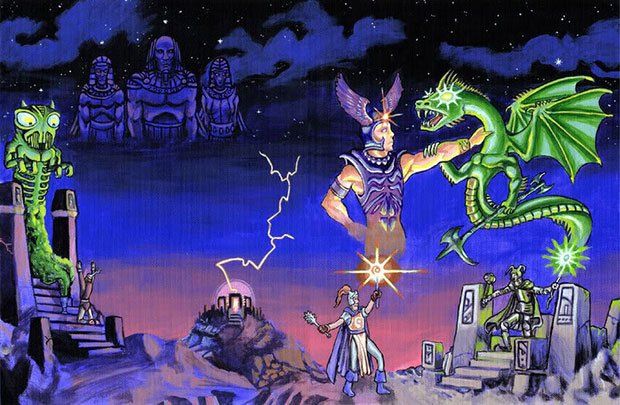
It has been some time since I added to this series. A slow-rolling series of how the Deck of Many Things works in my homebrew world of Ironguard. (Part 1, Part 2, Part 3, Part 4).
"If it weren't for bad luck, you'd no type of luck at all," - Pirates of the Caribbean.
Both of these cards fall under the 'unwanted draws' in the DoMT, but neither is nearly as bad as some other options. Still, I'd much rather draw a good card, or better yet, draw none at all.
Euryale: -1 penalty on all saving throws henceforth.
Euryale is named for one the three Greek Gorgons, of which Medusa is one (although how she spawned an entire race of fellow snake-headed stone-turning women is beyond this post). At least this card doesn't petrify its drawer.
This card exists because of an unhappy tryst between Loki and a deity of luck, fate, and serpents. Be thankful it didn't result in Loki having yet another monstrous child.
Idiot: Lose Intelligence (permanent). You may draw again.
Because taking the chance on the DoMT is NOT an intelligent choice. Ever. As such, the face on the card looks like its drawer before disappearing.
This card comes directly from Loki's sense of humor and delight in hoisting people upon their own petards. Directly powered by Loki himself/herself/itself, the Idiot card is Loki passing judgement on those that draw from the Deck.
A slow-rolling series of how the Deck of Many Things works in my homebrew world of Ironguard. (Part 1, Part 2, Part 3)
Infuryana is an ancient red hellkite, spawned in the chaotic fire and madness at the beginning of the time, the template from which all stories of dragongreed (and other dragons) come. Even Tiamat and Bahamut are respectful in her presence.
But Loki wasn't. His bargain with her was that based on the cards, her hoard would increase significantly. And over the centuries, it has. He neglected to tell her that her hoard may shrink as well, as the cards required.
She has vowed to deal with Loki eventually.
Talons: All magic items you possess disappear, permanently.
Such items, be they on the person, loaned to another, or hidden away, immediately disappear, fading into nothingness, to reappear in the horde of Infuryana. Observant card drawers have noted a rumbling laughter rolling through the air as their treasures disappear. This laughter is Infuryana's gloating at her newfound loot.
Ruin: Immediately lose all wealth and real property. (nonmagical wealth is specified later in the description.)
This card, too, is accompanied by deep peals of laughter, as Infuryana's horde increases by the amount the drawer has lost. Granted, this only applies to monetary wealth and portable trade goods. Property such as land and buildings suffer a disaster of some sort (infuriating the various deities of nature and specific places besides).
Recovering lost wealth is ... not exactly impossible, but certainly improbable. Other cards in the Deck of Many Things may recover, or at least replace the lost goods. Wishes, divine boons from certain deities, and DM fiat also return treasured things.
In theory, diligent PCs could discover the location of Infuryana's lair, and then beard the hellkite in its den, but that is considered folly by even the most jaded treasure hunters and explorers.
Still, the glory of being the ones who broke the Deck of Many Things is alluring to some.
The other day, in my post about using College Football Teams as the basis for Cleric religions, I half-joked about the new deities Avrae and Ikea, then hit
FB to crowdsource more in that vein.As can be
imagined, it was a popular topic in both groups I posted in (Dungeon Master
Resources and D&D DMs Only).
So thank you to all that participated, to include the honest individual stating that they would avoid a game that used such deities.
A few kind folks shared their homemade pantheons, and one
even went so far as to provide some creation myths and necessary domains.While I was initially planning to politely
ignore the bit about domains, it occurred to me that having them allows me to
focus my researches.
When it is all said and done, several recurring themes appeared: Disney, Uber and Lyft, and Amazon. Between this and my recent perusal of the game iHunt, I hit upon the following plan: to make full use of the panoply of apps out there and to avoid the easy pickings of using political figures/policies in the main pantheon (although it can be easily argued that such figures would be saints and champions of various deities).
Typing this up, I realize that it is American-centric. It happens.
I present to you the Meme Pantheon. Clerics (and others) praying to these deities first reach a Cosmic Call Center, where they are put through to the proper extension. Clerics with some levels already know the proper extensions. There is but one holy set of scriptures, contained within the Book of Faces. Each temple holds a copy of the Book of Faces, and the (not-so-)faithful carry a copy with them.
Holy Symbols of each faith are the brand symbols, worn on chains and/or tattooed to body parts.
Alexa - Goddess of Servants
Amazon - a demigod of delivery and messages and couriers
Avrae - Goddess of Chance
BigBox - known variously as WalMart, Target, and other names; once known as KMart, but that aspect died in the godswar.
Bowie - genderless Deity of Change and Music
Caffeine - God of Inspiration and Relief
Contractor - God of War and Ill-Gotten Gains
Covid - God of Disease, Fear, and Ignorance
Discord - God of Communication
Disney - God of Illusion, Entertainment
Dyson - God of Winds and Cartographers
Emoji - Deity of Symbolism and Misunderstandings
Evian - Goddess of Water
Gig - God of Short-term Jobs; favored by adventurers and mercenaries
Ikea - Goddess of Creation
Kellogg - God of the Harvest and Grain, attended by three faithful servants named Snap, Crackle, and Pop
Montsanto - God of deceit, greed, and the destruction of nature
Nestle - God of Drought, Rain, and Chocolate
Nicotine - Goddess of Diets, Appearance, and Anxiety
Petroleum - God of Energy (slowly dying as he is worshipped more and more)
Propaganda - Goddess of Truth
Twitter - Goddess of the People
Uber and Lyft - sibling demigods of travel, transit, and pilgrimages
Viagra - Goddess of Insecurity, Fertility, and ; loyally served by Tindr, Grindr, Zoosk, Eharmony, and others.
WHO - God of Healing
Wikipedia - Goddess of Information and Rumor
Zippo – God of Fire
Of course, the list can be refined, both with names and which domains they represent. Still, I think it can be fun, and at least some will find their way into my homebrew world. If I get to play a cleric and am offered the opportunity to choose my own religion, it is bound to be one of these (because Ecnep, Voice of Pmurt the Orange has been played and died by sentient pumpkin. I'm not even lying.)
A slow-rolling series of how the Deck of Many Things works in my homebrew world of Ironguard. (Part 1, Part 2, Part 4)
There is a temptation to tie Knight in with Throne, but for now, they will fall under two separate posts.
Knight: gain the service of a 4th level fighter.
When Ser James 'Jamie' Blackthorn cut a deal for immortality and travel, this was not his intent, but it is what he has. Over the centuries, he has served dozens of masters and mistresses, primarily adventuring sorts, and has visited cities before they were ruins, tombs and dungeons when they were new, and mountains before they were rolling hills.
So he is a jaded bastard who has been everywhere and seen everything. This makes him a sarcastic font of information, who may or may not volunteer knowledge, depending on how well he likes his current master or mistress.
Despite his vast experience, Ser Jamie never mechanically proceeds past the fourth level.
When active, he makes it a point to check up on his known and suspected heirs while traveling, going so far as to steer his master/mistress in their direction. On the rare occasion that an heir draws his card, Ser Jamie is overjoyed, and has been known to shower that lucky soul with locations of hidden treasures (that Ser Jamie may have hidden away himself), as well as useful advice. There is a reason that certain upstart kingdoms lasted as long as they did - Ser Jamie was the voice in the ear of the King.
If slain, dismissed, or the current master/mistress is slain, Ser Jamie awakens/appears in his chambers at the Keep of the Throne, holding and wearing whatever he had when he left. Once there he passes time playing chess with Steward, drinking wine, and writing his never-ending memoirs until the card is drawn again.
At that point, Ser Jamie is whisked away, wearing and carrying whatever he had at the time the card was drawn. Tales note that several times, he has arrived naked, the Card having been drawn while he was bathing.
Rogue: one of your friends turns against you. Nothing less than a wish or divine intervention can turn the traitor back - which suggests that if the Rogue is slain, they will rise as undead or otherwise return to haunt the Card drawer.
DM Note: at no point will Rogue turn Ser Jamie of the Knight card, STEWARD of the Throne card, nor any PC against the card drawer. This leaves a wide range of meek and mighty NPCs at the DM's disposal, however. That said, the Card prefers to turn those with some measure of power against the PC, if only to ensure grief. It will not hesitate to use family, if that is the best choice.
This card is powered by the unnamed deity of lies and treachery and narcissism, sometimes referred to in whispers as the forty-fifth. When drawn, a cold chill and mild electric shock passes through the drawer as the magic of the Rogue card examines the drawer's being to decide who best to turn against them.
At this point, the Rogue realizes that it is card drawer who is the cause of ALL the Rogue's woes. The magic bound within the card nurses the fears and suspicions until what begins as a smear campaign becomes outright attempts at assassination. If confronted, the Rogue attacks the card drawer in a blind rage.
On occasion, the Rogue falls in league with the Fiend of the Flames card, and then life turns ugly for the poor fool that drew both cards.
A slow-rolling series of how the Deck of Many Things works in my homebrew world of Ironguard. (Part 1, Part 3, Part 4)
Donjon: You are imprisoned. You disappear and become entombed in a state of suspended animation in an extradimensional sphere. Everything you were wearing and carrying stays behind in the space you occupied when you disappeared. You remain imprisoned until you are found and removed from the sphere. You cannot be located by any divination magic, but a wish spell can reveal the location of your prison. You draw no more cards.
All this time, I thought it was just like the Imprisonment spell, itself a reference to the Dying Earth story Cugel the Clever. As for the spell - I must say that I far prefer the AD&D version of Imprisonment. (Both a summary of Cugel the Clever and the AD&D version of the spell are HERE). Regardless, the 5e rules are rather... tame. Leaving behind the gear and belongings means that some tables will never bother with a search, because the replacement PC will get most of the last one's gear, anyhow.
So much digression to say that this card will see change.
Dragon Isle (so named due to its shape - an open-mouthed dragon's head) is lost to modern navigators, as is the ruined settlement upon it. One building that stands strangely intact is the Dragonseye Beacon - a lighthouse rising up from where an eye would be if the Isle would be viewed from above. Under the right conditions, it is said that the Beacon can still be seen and followed into the decaying harbor of nameless ruins from which it rises.
Within Dragoneye Beacon dwells the Keeper. Another mortal bargaining for immortality with Loki, the Keeper now guards those imprisoned by the Donjon card. Deep beneath Dragon Isle, deeper than the caves that are said to run under it, teeming with darkness, water, treasure, and horror, lie the hundreds of spheres imprisoning the unlucky fools that drew this card.
If found and bargained with, the Keeper can call forth a specific being's sphere, allowing freedom.
Of course, what the Keeper may want in trade for such a service is unknown.
The Void: Body functions, but soul is trapped elsewhere.
Dao are exemplars of greed and power, rivaling dragons in the hoarding of wealth. When Loki offered the Dao Sultan Haris al-Sijan a chance at becoming a private jailer of sorts in exchange for gems, Haris gladly accepted.
Since that time, whenever The Void is drawn, the stolen soul becomes a large, pampel-cut ruby, appearing on a cushion near the throne of Haris al-Sijan. These soul rubies glow with their own inner light, and upon close inspection, a humanoid shadow can be seen within. The Sultan has these soul rubies affixed to gold chains, and he wears them as proof of his might.
A pampel-cut gem.
On rare occasions, someone has been freed from their gem, and this freedom comes at the cost of negotiations and deals between the Dao Sultan and the card-drawer's allies.
Those freed return to their home plane and tend to embrace life to the fullest, having seen what missing it is like.
It is said the half-elf sage Anacharsis in the city of Skara Brae has spent the last two centuries collecting tales of those who have been affected by drawing from the Deck of Many Things, and among those tales are the location of Sultan Haris al-Sijan's palace at the intersection of Carceri and the Plane of Elemental Earth.
The bodies of those that draw the Void must be kept alive, and are effectively in a deep coma, from which only the return of the soul can waken. Given lack of care, these bodies die, leaving the soul forever trapped in its ruby. That said, there are whispers of great-great-great-grandchildren still tending to an ancestor's body, waiting patiently for the soul's return. Perhaps Anacharsis can provide details.
Note that the Vizier card (or perhaps consulting with Heimdall, the Far-Seeing) can provide the location of people trapped by both Donjon and the Void.
To prepare this series, I spent some time comparing the DoMT between rulesets: 3.5e and 5e. Both hew close to the original from AD&D, but wow, does the 5e version break down specifically how each card works.
I'll be using the 5e rules for this series, but will likely mix and match rulings to better fit my game. (Part 2, Part 3, Part 4)
Basically, the DoMT was crafted by Loki to embody the lyrics of Tom Waits, who said, 'the large print giveth, and the small print taketh away.' Along the way, the DoMT spreads Chaos throughout the planes, as it forces those bound to it to act in rather specific ways.
Flames - Enmity between you and an Outsider.
The specific contract between Loki and Etrigan is unknown to mortals, but it stings the devil enough that when Flames is drawn from the Deck of Many Things, Etrigan takes special delight in ruining the mortal drawing the card, if only because Etrigan cannot affect Loki even if it wanted to - and he dearly wants to.
So with Loki unavailable, the poor fool drawing Flames is a suitable replacement.
Initially, Etrigan sends cultists and agents to learn about the card-drawer and regular companions - with the goal being to ruin his life, not end it. Ending the life and ruining the soul comes later.
With time, Etrigan sends potent devils and sublieutenants to ruin the card-drawer. These agents are under strict orders to speak before and during combat. Specifically, they tell all within earshot that they are doing what they are doing because of the card drawer.
The final fight between Etrigan and the card drawer has so far resulted in the death and dissolution of several world-class heroes through the ages. The truth is, though, that most often the card drawer dies to a minion of Etrigan.
At the table, this means that that - like it or not - there are attacks aimed at the card drawer every other session, with evidence of other mischief designed to ruin the reputation and life of the card drawer during the in-between sessions. All told, drawing Flames results in Etrigan's ire being seen and growing as the card drawer foils attempts on his life and reputation until the final battle.
Note that whether or not the DM embraces Etrigan's namesake and only speaks in rhyme is very much table dependent. That said, I will do my best to speak in such a manner.
Clerics in DnD imply pantheons of higher beings to believe in, beings which provide the gift of miracles to their most fervent champions, all through the power of faith. A vast array of deities also means a vast array of temples and tombs to raid or defend, or at least visit and try to cajole healing from. Such temples and tombs are a staple of most fantasy rpgs.
Erol Otus, cover of Deities & Demigods, 1980
The quick and easy fix is to use the default pantheons from Forgotten Realms or Greyhawk, both leaning heavily into purely fictional gods, although at least a few Forgotten Realms deities started life as members of real world belief systems.
An easier fix is to use real world pantheons, likely cribbed in part from Deities and Demigods (with or without the Chthulu Mythos) or GodChecker. I'll admit that Deities and Demigods certainly expanded my knowledge of other faiths, and not just because of the awesome art that made up much of the book.
Jeff Dee, Bast, Deities and Demigods, 1980 - a titillating image, indeed!
After about 50 years of fantasy rpgs, there are collections of deities available, statted up for your favorite DnD ruleset. Some are heavily tied to the setting, like those of the Scarred Lands, while others like the Book of the Righteous and Petty Gods (link goes to legitimate free pdf) are just collections of deities looking for believers anywhere.
At some point, DMs and GMs decide to craft their own pantheons, either by mixing and matching the above or through some dedicated creation out of whole cloth. I've tried the latter, I really have, and Lord, is it a waste of time for how little actual use it sees at the table. Never again.
My new world is fully accepting of the fact that it is a game for the players. This isn't to say that it is full of 5th-wall-breaking nonsense, merely that background events will exist for the benefits of the players as much as for the PCs.
This includes the new religions, modeled after US College and University Football Teams.
I'll just hand this picture to prospective Cleric players and say, 'pick yer deity.'
Before rolling your eyes in disdain, consider that each team has its own colors, own slogans and symbols, and its own top coaches and players, as well as a colorful inhuman mascot. They even host holy days and have their own ring- and cup-based artifacts.
Really, those are all the trappings a fantasy religion needs.
High priest, chief paladin, or superfan?
Picture clerics draped in crimson and hounds tooth, praying to an elephant man statue, invoking the names of St. Saban and St. Bryant, punctuating their prayers with the phrases 'roll tide roll' and 'rammer, jammer, yellowhammer!' while holding aloft an oversized rhinestone-encrusted stylized A. It could be a college football game or it could be the faithful at a typical DnD-style temple - it just depends on the context.
Townsfolk at a DnD temple or fans at a football game? Who's to say?
I haven't decided yet if specific mascot-deities provide access to unique spells or if they are more like RAW clerics, where if its on the list, it can be prayed for. Clerics are such powerhouses because RAW they have access to too many spells, and should DMs play the role of the deity and provide only what is deserved by the Cleric or decided upon by the deity, players are likely to be .... upset.
All that said, a gameworld where the worship of Avrae, Goddess of Chance and Ikea, Goddess of Creation is common is a tempting one. It's just that I cannot think of any more clever references AND I lost the list I crowdsourced in one of the DnD FB groups. While I will likely try for a second list, I think that I will stick with college football faiths for the foreseeable future.
After all, college football IS the state religion of Alabama, and several other of the United States, besides.
EDIT: I began the FB crowdsource - it will need to be its own post. Off to collect ideas into a word document for later.
Erol Otus, 1981 - one of two images I always think of when dragons are mentioned.
A question in a FB group Dungeon Master Resources set me posting several links to OSR blogs, posts addressing dragons. This was because the request boiled down to making dragons 'more interesting' for 5e. Nothing is more interesting to me than what the OSR creates. If along the way more 5e players and DMs start leaning towards OSR play, all the better.
I ended up with such a fine collection of such things that I thought I would collect them here.
Third is d4 Caltrops. Currently only Black and Blue dragons are addressed, but its a start. As an aside, the OSE Encounter Activity Tables for various critters is wonderful for those folks that lean towards random rolls and emergent story. Eventually, the other color dragons will end up on the master list.
Fourth are a new take on Chromatic dragons from Coins and Scrolls. I particularly like how the format of how each is described.
Fifth is the series of d100 dragon-related posts at Elfmaids & Octopi.
In writing this post on a computer, versus Facebooking on my phone, I have better search tools (and can actually type well and see the screen). As such, here are a few more not mentioned on the FB post.
Archons March On has a Dragon Generator, and lots of other awesome tables, besides.
Blood of Prokopius has a small bit about the dragons of Holmes and Cook rules.
Throne of Salt has dragons-as-godlings, or at least that is how they come across.
Papers and Pencils has a two-part post about how he creates dragons. One and Two.
Another Smaug, this by the Hildebrandt Brothers, and from the Tolkien Calendar. My brother had it and I spent many hours just looking at the pictures. I wonder if he still does... it seems there were several calendars ranging from 1969 thru 1977. Not all were Hildebrandt, however.
In addition to what I shared, other respondents provided some solid links, with The Monsters Know What They're Doing being a personal favorite. This Reddit thread is all about dragons. Plus, lots of comments about making all dragons spellcasters, something I agree with.
Hopefully, there is something here that you can use at your table, or at least inspires your own flavor of dragon.
Yes, I am one of those gamers, letting the music of Blue Oyster Cult, Rush, and Led Zeppelin heavily influence and inspire my thinking.
Listening to music tonight makes me want to participate in a campaign that ends in Led Zeppelin's Battle of Evermore.
If nothing else, some fine inspiration for bardic magic items in the hurdy-gurdy and three-necked guitar.
From the lyrics, it suggests Middle-Earth with the line 'the ringwraiths ride in black.' But really, the song is the capstone to an epic campaign, ending with a full-scale war against dire odds (again, a Middle-Earth comparison with the Fields of Pelennor), ideally with the PCs on the winning side - be they aggressor or defender. If nothing else, it would provide me all the justification I need to finally use those mass combat rules in the Companion set.
The C in BECMI games
In fact, I imagine a blending of Battle of Evermore with Manowar's Ride the Dragon would be somehow even more epic. If you are unaware of Manowar, or at least this song, here you go.
Manowar songs are made for fan-made videos using footage from Game of Thrones, Vikings, 300, and Lord of the Rings
The catch with this dream (beyond reliable scheduling and players) is that this is decidedly a predetermined ending, win or lose.
And I don't like those, because predetermined endings mean lots of predetermined actions building up to that point. Which is what books are for, not role-playing games.
Still, it would be quite the ride getting there. Maybe one day.
Dragons should appear more in D&D sessions. After all, they are in the title of the game.
Yet I have rarely included dragons, and can only recall encountering one as a player (after a short conversation, we traded our wealth for our lives - a fair deal).
To remedy this oversight, I had a grand plan. In the wilderness surrounding Ironguard Keep, I had rough plans for a Black dragon to the south, lairing in the swamps abutting the foothills in the ruins of Xak Tsaroth of DL1 fame. This is heavily due to my loving that map since encountering it decades ago.
Xak Tsaroth - this map just cries out to be used in a game.
A green dragon claimed the forests across the river. I hadn't given that one too much thought beyond the potential of making it a short-term ally of the PCs - for the right price, of course. After all, there are lots of chaotics with treasure on that side of the river, and Greens are lawfuls that love their treasure...
Lastly is an ancient red lairing in the mountains, which is what this post is mostly concerned with.
The players were aware that at least one dragon was afoot, both through Twk-men rumors and physical evidence - they had found a large steaming pile of dragon shit, that they of course searched, discovering a golden chaos pendant from the dragon's last meal - a chaos cultist that awoke the dragon and incidentally set several things in motion. Randall's warlock claimed the pendant and made good use of it, as a future session report will show.
As for the dragon itself, it's a red. An ancient wyrm, maybe tainted with shadow. A Smaug-level dragon who has been quiet for decades, if not centuries. Now it is stirring... and hungry.
Part of the fun of running large intelligent beasties (beyond rolling all the dice when they inflict damage) is speaking for them to portray their might and occasional majesty. This video clip from the Rankin-Bass version of the Hobbit sums up how I suspect meeting this dragon would go - at least my role-playing the dragon would channel Smaug's attitude, and at least his opening lines about smelling and hearing and feeling.
A Chat with a Dragon from the 1977 The Hobbit
Dragons of this caliber have names, and in time-honored fashion, I am leaning towards a pseudo-Latin or pseudo-Greek term for fire or burning. Something pronounceable when read, so no extraneous Zs, Xs, or apostrophes. Incineratus or Incendiarius or Flagrantia. The last sounds feminine which can mean a clutch of eggs or perhaps she has decided it is time to mate. Maybe both!
If she finds a mate, you'd better believe she slays him post coitus black widow or preying mantis style. Take that, horny bardling!
Flagrantia lairs in the Worldspine Mountains that divide the borderlands and civilization, such as it is. Besides the main entrance, which is guarded by her minion Orcs and Ogres, the caves she calls home contain a sinkhole leading to the surface, providing a secret way in for clever or (un)lucky PCs. There is also a shaft descending into the Deep Underdark where dwell lots of ideas cribbed from Veins in the Earth and OperationUnfathomable. While Flagrantia is aware of this hole, even she has the sense to not explore it, and now she is far too large to try.
For now, at least, the lair is partially notional. I have a hand-drawn map, but it lacks the ... interesting suggestions found in the Draconomicon, so the map needs revision. For posterity, though, here it is:
Let's talk more about this dragon. As a child, I watched the Rankin-Bass Hobbit often. We went through one or two VHS tapes of it, and maybe even a BETAMAX tape. So that is how I will always picture a dragon.
To my players' chagrin, perhaps.
Smaug's Boast from the 1977 classic The Hobbit
This is Flagrantia. Honestly, I expect a few PCs - maybe all of them - to die trying to slay her, especially if they try and beard her in her lair. That said, players exist to surprise DMs, and the crew I had - Ben, Randall, Harley, and Kyle - probably would have done so, likely by utilizing some of the bizarro things I cribbed from assorted blogs and pdfs - an accumulation of ideas resulting in something far greater than the sum of its parts. (Had they crushed her out of hand, a party of githyanki would be in the wings, there to negotiate an alliance of sorts and ready to take out their frustration on the PCs).
Regardless, Flagrantia is always arrogant and lazy and while she has several escape plans (including the ability to go ethereal), she doesn't honestly believe it will need to use any of them. She is a spellcaster, as well, because all dragons should be. I haven't given much thought to which spells, and won't have to do so for the foreseeable future. Still, Mage Hand, Chain Lightning, and Dispel Magic at the least. Those eyebeams (because it will have them) are more flavor than spell or spell-like ability, but I imagine they should freak out players who never watched the cartoon from the 70s.
As Flagrantia keeps up the trappings of civilization, there is always the chance for the PCs to converse with her, after all, what does she fear from mere mortals? If feeling benevolent or is sufficiently flattered, Flagrantia may even let invaders leave alive if they divest themselves of all valuables, to include mundane weapons and armor and such. Basically, the dragon sends them away naked - it is not her fault that ephemerals bothered her, and frankly, they should be happy to leave alive.
Proper dragons have hoards, and have had them since at least Beowulf was written down (note that both the thief in Beowulf and Bilbo Baggins both awaken a dragon by stealing a CUP). Flagrantia is no different. I reckon I can go crazy with hoard contents, because there are no Bags of Holding or Portable Holes in this campaign, so the PCs won't be able to carry off but a small portion of it, again, reminiscent of the Dwarves sorting through Smaug's hoard in the Hobbit.
One of my favorite Dragon Magazine covers; in this case illustrating my point about dragon hoards.
In proper DM fashion, I can always repurpose a published dragon's trove, such as that of Infyrana of Dragon Mountain (pg 52-55), Flame from Dungeon #1 (pg 50-52), Vesicant from Dungeon #16 (pg 64 mostly), Aliamere (a prismatic dragon!) from Dungeon #51 (pg 37), or Felmurnuzza from Dungeons of the Dread Wyrm (pg 24-25), among many others.
I can also rely entirely on random generators, which has the benefit of being fast, but boring, or at least disconnected from the world of Ironguard Keep.
A third option is to design the entire hoard myself, which sounds like more work than I care for. Yes, DMs always have homework, but this DM prefers to keep it to reasonable amounts.
So it appears a compromise is needed. Yet, before I settle on particulars, let's see what the 5e MM suggests as appropriate hoards for Ancient Reds:
"Obsessive Collectors. Red dragons value wealth
above all else, and their treasure hoards are legendary.
They covet anything of monetary value, and can often
judge the worth of a bauble to within a copper piece at a
glance. A red dragon has a special affection for treasure
claimed from powerful enemies it has slain, exhibiting
that treasure to prove its superiority.
A red dragon knows the value and provenance of
every item in its hoard, along with each item's exact
location. It might notice the absence of a single coin,
igniting its rage as it tracks down and slays the thief
without mercy. If the thief can't be found, the dragon
goes on a rampage, laying waste to towns and villages in
an attempt to sate its wrath."
While this type of treasure provides potential story hooks (which is a good thing, and as a conscientious DM, I would do just this in detailing the multi-page trove), it still doesn't help describe it much. I say this, because as that link points out, most players don't really care - not out of maliciousness, but because such things often have little impact at the table. So I need to seek guidance elsewhere.
The Draconomicon (Get this book. PDFs exist, but the hardback is far more satisfying to thumb through) contains an excellent chapter on dragon hoards, with a variety of random tables AND sample hoards running up through CR 27 dragons (roughly 456,000gp in value, if curious). The sample hoards provide not only art objects, but a smattering of history-based items (Greyhawk-oriented) alongside the standard coins, gems, and book magic items. This book gets me thinking.
If you like dragons in your Dungeons & Dragons, do yourself a favor and get this book.
Ye olde AD&D Monster Manual, however, provides rather specific guidelines: Red Dragons have treasure types H, S, and T. Furthermore, it says that Ancient Dragons are 75% likely to have 200% of their treasure type. THAT is useful information that has impact at the table.
H is coins (all measured in the thousands, except platinum, which is measured in the hundreds), gems, jewelry (art objects can be subsumed under jewelry), and any 4 magic items, plus 1 potion, plus 1 scroll. S is potions, and T is scrolls. All of this, times two. (As an aside, looking at the Treasure Types, I am intensely curious about what creatures have treasure types U-Z as those look utterly amazing.)
Coins, gems, and jewelry are the work of random generators, followed by a bit of DM history-adding to some of the jewelry items. Magic items, though, should be at least partially decided and placed by DM.
So 8 nonpotions, nonscrolls, then upwards of 18 potions and 10 scrolls. I'm not going to roll all this, just place it. A dragon of Flagrantia's age and history would no doubt have some items that survived their owners, the owners being previous would-be dragonslayers. Perhaps this band of would-be slayers.
I'll also steal an idea from Dragon Mountain, and have a pile of faintly magical slag that was once a Dragonslayer sword. Flagrantia didn't live 900+ years by being a fool. Along with this evidence of past items is a golden ring featuring three diamonds that appear scorched from the inside out. This is a used-up ring of three wishes. Flagrantia acquired the ring several centuries ago and spent the better part of a century contemplating each wish before making it.
Her wishes were: to become ethereal at will (it allows for easy access to and from her lair), potent regeneration (15 hp equivalent per round - she will play dead if needed), dispelling breath weapon (her fire damage is normal, but those hit with it ALSO are hit with a potent not-quite-mage's-disjunction dispel magic effect).
In proper D&D fashion, at least one magic item will be outright cursed - very likely a scroll, as scrolls are easy props to make for in-person games. Speaking of scrolls, at least one scroll is a treasure map (though to where is undecided, likely a published adventure module), and a few scrolls can be turned into a captured spellbook or three, or perhaps the scorched and scarred remains of several spellbooks, for flavor.
Potions will be a mix of book potions, these potions, and maybe a custom potion or two... or quirky book potions. Like potions of incredible usefulness that also limn the imbiber with Faerie Fire. Potions of Fire Resistance and Dragon Control would be amusing, but we shall see. Castle Xyntillan features an assortment of liquors and distilled spirits that function as potions, and this idea is worth borrowing.
A dragon's trove is a fine place to throw players/PCs a bone regarding magic items by including items the party can directly benefit from. With my players in mind, it would be something for a cleric, a sorcerer, a warlock, and a barbarian. Generalizing things means some arcane items, some defensive items, and some weapons. Whether or not the players actually keep such items is on them.
My rambling is finished, so let's consider her magical trove:
Potions:
a Beaker of Plentiful Potions that pours random potions; its quirk is that ALL of its potions look, smell, and taste the same - until they hit the stomach and take effect. d6 to see which potion you pour: Gaseous Form, Fire Resistance, Speed, Cloud Giant Strength, Poison (sickened and two levels of exhaustion), Greater Healing.
Bottled Memories - there are a half-dozen of these metal vials clinking together in a felt bag. Inside the bag are six labels, apparently having fallen from the vials. There is no way to tell which label was on which vial. The labels read (in Elvish): buried treasure (treasure map); terrible secret (worst of all is beings now know you know - enjoy living in terror!); cosmic truth ; forgotten spell (drinker learns new spell); hidden technique (choose one weapon, drinker gets advantage when fighting with it, but disadvantage on all others); horrid death (by immolation 30d10 psychic damage as skin darkens and drinker burns from within). Note that (re)discovering how to bottle memories is beyond the scope of this post. (I am certain I read of bottled memories on one blog or another).
A box holding a pair of almost-matching vials, the difference being one has the image of a sword on it, and the other the image of a staff on it. These are vials of Myrmidon's Milk and Instant Power, respectively. Myrmidon's Milk is fed to a baby, and the baby will grow to be a mighty warrior. Instant Power is consumed by a child, who instantly gains 3 levels of wizard. (d4 Caltrops)
This bottle looks more like a small oil can, and contains several doses of Modron Blood. Modron Blood drives away gremlins and fixes small broken mechanical devices. (d4 Caltrops)
Potion of Bright Life - This nondescript vial smells like fresh cut grass and damp leaves when opened. Consuming it makes your skin turn green, your hair turn to small flowering vines and grass, and you can now subsist entirely through photosynthesis. The drawback is that a lengthy lack of sunlight can kill you dead. (d4 Caltrops)
Potion of Cure-All - A crystal bottle is labeled "purgative for poisons, diseases, possessions, lycanthropy, and other ailments. use with caution." in Elvish. Drinking it cures everything but HP damage. The drawback is that the drinker vomits up the nastiness in the form of 1d4+1 gelatinous cubes. (d4 Caltrops)
Tomb Sealant - A brown canister with a yellowing label reading "tomb sealant" in archaic common. Opening it finds a brush attached to the bottom of the lid and the whole thing resembling a paste pot. When applied to coffins/sarcophagi, it fuses them shut. Forever. As might be imagined, you don't want to get any of this on you. (d4 Caltrops)
Scrolls/books:
Treasure Map - claims to lead to Mimisbrunner and promises knowledge and power. It warns of Mimir and the 'eye cost of knowledge.'
Fragile tapestry that is actually a map of the empire from centuries before. Comparing it to modern maps reveals the location of several lost (and presumably ruined) cities.
Three charred but mostly readable spellbooks, containing Wizard spells (3d4 each of levels 1-5, 2d4 of level 6-7, and 1d4 level 8).
Scroll of Protection from Undead, Scroll of Protection from Fey, Scroll of Protection from Magic
Scroll of Meteor Swarm - regardless of caster's intent, it centers on reader.
Cursed Scroll - Reader is Feebleminded, no save.
Cursed Scroll - Reader petrifies (but to clear crystal). Stone-to-flesh returns to normal.
A fancy prayerbook that allows reader (if they hold) to turn undead as if 1 level higher than they are, or as a third level cleric, whichever is better. Readers not of the faith (Norse-ish) take psychic damage from reading the book.
A thick treatise on medicine written by someone named Galen, with marginalia and notes by others; healing checks are at advantage after reading this (takes three months of study) and healing spells cast by reader cascade on the top two numbers.
Items:
Ring of Djinni Summoning - as per the book, but each time used, the wearer must save or become a cloud as per gaseous form for d6 turns. That said, this ring's biggest quirk is the DM channeling Genie from Disney's Aladdin. (The djinn that appears would not be named Djinn Carter, Djinn Balooshi, Djinn Morrison, Djinn Carey, Djinn Stewart, or Djinn Kimmel, if only because I am terrible at impersonations AND my regular players too young to catch most of these puns. Djinn Rumi and Djinn Antonic are fair game, however.)
Orb of Dominance - this mammoth (about 12' diameter, but fits nicely in Flagrantia's hand) crystal ball crackles with an internal energy reminiscent of plasma balls. The attuned wielder merely makes eye contact (via light or darkvision or even if ethereal or astral) with the intended victim, and if the victim fails to save, a long-term Dominate Person is cast. The Orb of Dominance allows its wielder to Dominate up to a dozen entities, controlling their actions and seeing through their eyes. This Domination allows a save once a year on the anniversary of the first time. DM note - think of how Theoden was dominated by Saruman in LotR (and then how Gandalf cast him out - so Dominated people take on physical changes). The major drawback of this item is its size and weight.
As it so happens, Flagrantia has used it on the leadership of the Orc and Ogre tribes she dominates, but would love some non-orcs to Dominate. Preferably some would-be heroes. Then chaos shall reign!
Ring of Cold Resistance - this golden band is stretched to its limit to fit on Flagrantia's smallest wing-talon. It's drawback of Fire Vulnerability is overridden by Red Dragons' inherent immunity to Fire damage. Investigation reveals the mark of Grandfather Favarro, so it is one of his creations.
Honor - featuring the attributes of both a Scimitar of Speed and Sword of Sharpness, this bastard sword is just that - a right bastard. Honor is Sentient and extremely Lawful (LE, technically). It can detect chaotics at will, and will do so. If it finds any, it loudly calls them out and urges its wielder to attack them. Failure to do so results in Honor attempting to Dominate its wielder.
Wielders that please Honor find that it provides additional powers, notably vampiric regeneration: half of the damage done by Honor heals its wielder, but never beyond full. In addition, Honor's wielder is immune to blindness and exhaustion and saves at advantage against poison.
Wielders that displease Honor will find they strike at disadvantage as Honor twists and shifts in their grasp, as well as losing access to Honor's other abilities (Speed, Sharpness, healing and immunities). Should Honor dominate its wielder, its priorities are to 'restore its wielder's honor' by striking down people that have insulted, cheated, or otherwise disgraced the wielder. Honor doesn't care if these people are strangers, allies, friends, family or other PCs.
Staff of Mambres (Staff of Power) - as per the Staff of Power and Snake Staff in the DMG, with the added bonus of being possessed by it's creator, Mambres, who appears to the PC in dreams. While in dream form, conversations can be had, and with a successful intelligence check, remembered. Note that the eventual goal of Mambres is to reinstate the Egyptian-ish pantheon over the current Norse-ish.
Champion's Plate - this suit of +2 field plate is etched with a lion rampant and the symbols of Norse pantheon. The wearer is immune to magical fear and incapable of retreat, rout, withdrawal, or escape once battle is joined. This plate provides additional protection, in the form of Element Resistance, as well as immune to blinding, deafening, stunning, and exhaustion. Allies in your sight attack with advantage due to the armor inspiring them. All that said, the remains of the last wearer are still inside this armor and her spirit will demand a proper burial (treasure-barrow level - sealing the dragon's lair with her remains and most of the dragon's treasure inside will suffice).
Cindersoul - this longspear is etched with runes that glow a fiendish reddish-purple. In addition to piercing damage, this spear deals necrotic damage and fire damage with each strike. All beings slain by this spear find their souls/spirits bound to the spear itself. The wielder can hear these spirits as a continual whispering of words and half-sentences. Once per three long rests, the wielder must do something to appease one of the spirits (DM choice of task) or suffers exhaustion as long rests become impossible due to the voices. Discarding Cindersoul requires far more than a Remove Curse, as the spirits will continue to haunt the last wielder until someone new takes up the spear.
A Hand of Glory- the candle version, in a locked wooden box. All within its light (except holder) are held as per Hold Person or Hold Monster. All doors within the light are unlocked and opened; this includes planar portals and other portals best left closed, locked, and forgotten. Once the light goes out, the doors unlocked reseal, so hopefully the person with the candle is on the proper side of the door!
Iron Horn of Valhalla - these berserkers are Einherjar and the power of the horn compels the blower to join them in glorious combat. Should the horn-blower die during the fray, the Einherjar carry them back to Valhalla with them when they disperse. Should the horn-blower try to run away, the Einherjar attack the horn-blower for the coward that they are.
There we have it - an ancient wyrm and the more interesting parts of her hoard.
Short Rests and Long Rests are integral to the D&D 5e ruleset. Typically measured in 1-hour and 8-hour increments (PHB 186), there is an alternate rule for better grittier games, where a Short Rest is 8 hours long and a Long Rest runs 7 days (DMG 267). Short Rests provide a chance for PCs (and allies) to regain a few spells and some hit points. Long Rests return ALL spells and hit points.
In both cases, rests are presumed to take place in relatively safe areas.
Megadungeons are notoriously unsafe.
After all, the dungeon hates you.
Still, the dungeon prefers to toy with surface invaders, rather than kill them outright. It knows the centuries are long and entertainment should last and be savored. The dungeon understands that in the end, adventurers die. They always die, be it with loved ones in the sunlight or alone in the darkness.
Smart adventurers know that resting in a dungeon is dangerous, and resting in a megadungeon is foolhardy in the extreme. Despite this knowledge, rests are sometimes necessary. This necessity should spring from the PCs being too far from the surface to safely retreat, having either delved too deep or because the PCs are lost in the dungeon.
Traps, PC actions, and the occasional monster can result in the PCs becoming lost. Traps are the most common means of getting lost: chutes, pits, teleporters, disappearing or one-way stairs, one-way elevators, or the various ways to seal the path behind them. PC actions are typically of the 'running blindly from certain death into only possible death' variety, but using explosive spells or items can accidentally drop a bridge or ceiling, collapse walls and floors, flood areas impassably, or create new walls. By occasional monster, I am referring to the Crypt Thing of Fiend Folio fame.
Crypt Thing by Russ Nicholson, Fiend Folio, 1981
The Crypt Thing exists to speak cryptically and to teleport people a random direction and distance away, then tell the survivors that it disintegrated the others, and would they like to be next. Luckily, regardless of which version of D&D you play, the Crypt Thing has already been converted, so you and your players can experience random malicious teleportation regardless of your game.
For the record, the Crypt Thing in my megadungeon is more of a dungeon-sage and has some rather specific locations it teleports victims to, all for the amusement of the dungeon: A large pile of manure near one of Skara Brae's market squares; a similar midden, but elsewhere in the dungeon; above a lake near Skara Brae; above the dark lake on level 10. I may add 2-4 more, just for variety and because I have the appropriate dice.
As we see, PCs can easily find themselves lost and in dire need of hit points and spells, so they choose to rest. So what to do?
One option is to take Jeff's Reints' approach, with a table for what happens to those foolish enough to rest.
But that is a bit much, even for me.
Wise PCs study the maps they have (hopefully) been making to determine possible safe rooms, or take a chance if accurate maps don't exist. Once in a room, the entrance(s) should be secured as best as possible, using iron spikes if nothing else. That done, watches should be established and rest happens. Food is eaten, wine washes it down, wounds are bound, swords sharpened, spells cast and memorized, socks changed, etc. Long Rests are a fine time for some interparty roleplaying if you're into that. If not, move straight to the rolling for wandering monsters.
Yes, my megadungeon has wandering monsters. I'd argue that a good megadungeon should. It could be the dungeon spontaneously creates them to send the PCs' way or perhaps the monsters already exist, and the dungeon merely nudges them in the PCs' direction. But maybe - just maybe - wandering monster encounters truly are the will of Avrae, the goddess of chance.
Fortunately for adventurers with spellcaster sorts among them, several low level spells exist to help with resting in hostile environments: Alarm, Hold Portal, Silent Image, Arcane (or Wizard) Lock, Rope Trick, and Leomund's Tiny Hut. If a spell isn't in your ruleset, find a version and convert it.
Another method is to learn the 'rules' of the megadungeon and its populations. An alliance with one faction or another may provide PCs refuge and assistance, perhaps for a fee, a service, or services rendered. Realizing that nothing goes to a specific area AND removing the threat the keeps locals away buys safety, if only for a time. In theory, sections of a megadungeon level can be cleared, rendering them safe, but nature - and the dungeon - abhor a vacuum, so the cleared areas fill back up.
Establishing forward camps with supplies and maybe permanent guards is dangerous, expensive, and eventually ends badly. But until it does, this provides a fine source of safe rest and replacement PCs from among the guards and apprentices.
Magic items, such as Daern's Instant Fortress, a folding boat, or a ship in a bottle can make a safe haven, unless the Instant Fortress collapses a ceiling upon itself or until one realizes that any body of water in the megadungeon that is deep and large enough for a ship is also deep and large enough for its own inhabitants.
Not my work, google turned it up. If you know the artist, tell me.
Inhabitants that are not above the floating buffet the PCs thoughtfully provided.
Inhabitants that probably have tentacles.
Resting is as natural as working, and just as necessary for PCs as much as the people that play them. Let the PCs rest, but be sure they understand that a good rest is not guaranteed.
One of the guilty pleasures of D&D is encountering - and often slaying or being slain by - monsters.
Every iteration of the game has its own Monster Manual, Fiend Folio, and the like. Official bestiaries feature the current version of classic monsters. Those monsters and monster books are fun, though I admit a preference for older versions and the wide variety of art.
Regardless, official books mean that monsters are known. This becomes such an issue that common (and useful) advice is to still keep these iconic monsters and simply change their names.
Other people are fully in the other camp, utterly discarding old ideas (even if keeping names) and homebrewing their own creatures. These can be found in any number of blogs and individual adventures.
Myself, I love new monsters, but am terribly lazy.
Luckily, I have found three legitimate bestiaries online for the low, low price of free.
Ford's Faeries: A Bestiary Inspired by Henry Justice Ford - 116 pages of monsters inspired by the artwork of Henry Justice Ford. This will need converting to your favorite ruleset, but that is worth the work. A few of these reside in my Ironguard Keep campaign. Others will see light in the megadungeon.
A Hamsterish Horde of Monsters - 87 pages of fanged, furred, and clawed goodness, with bonus magic items. At a surface glance, this is formatted for B/X and similar rulesets. I'm looking forward to a more thorough read to find just the right creature to inflict on my players.
I could list the wide variety of unfree bestiaries available, both as hardbacks and as pdfs, and they are great to browse and use, but that is not the purpose of this post.
The purpose is to get more nonstandard creatures in your games, and the best way to that is for free.