Wednesday, March 29, 2023

Starting PC Backgrounds

A key part of any gaming campaign is its opening session, when the PCs first come together.  Popular (and therefore undesirable) tropes are meeting in a tavern, in jail requiring a prison break, at a festival when something happens, or - my favorite - the ship/train/spaceship you're all on wrecks elsewhere and you must unite to survive!

An iconic party of adventurers from my childhood

My issue with this method is that roleplaying an awkward group blind date is somehow worse than an actual blind date - but not by much.  Plus, this puts way too much work on the DM's shoulders of this cooperative game we call our own.

If you as a DM enjoy extra effort on your part, by all means ignore this post and write out your opening scenario that somehow binds the disparate PCs together in a lasting campaign.  Just don't come fussing on the FB when it comes crashing down due to the PCs' backstories/players' expectations.

(As an aside, I firmly believe it is 100% the players' responsibility to ensure their PCs have a reason to travel and adventure with the group as a whole - DnDish games being cooperative games, after all).

Then again, if you are interested in pushing work off onto players while improving the game as a whole, then consider making the PCs a circle of friends.  Not the tv show, but kinda like the tv show.  After all, the six main characters of Friends were a mix of siblings, roommates, (former) co-workers, childhood friends, and eventually (ex-)lovers.  Everybody knew everyone else, but not in the same fashion, nor to the same degree.

And it worked.  

-----

Since it works for television, there is no reason the same idea shouldn't work at the gaming table.  So here is a random table of potential shared backgrounds for your party members.  

d30 Individual PC Relationships

1    in-laws

2    siblings (half or whole)

3    cousins

4    spouses

5    parent-child

6    other family

7    (ex-)lovers

8    betrothed (willingly or arranged)

9    rivals

10    childhood friends

11    parents are friends

12    current/former co-workers

13    same faith

14    same ship's crew

15    same punishment

16    same military unit

17    same acting troupe

18    same orphanage

19    same school or academy

20    same master (presuming both apprentices)

21    same pursuer (just or unjust)

22    same dream 

23    Master-Apprentice

24    Teacher-Student

25    Knight-Squire

26    Debt Holder-Debtor

27    current/former roommates

28    chasing same person

29    drinking buddies (like on Cheers!)

30    local celebrity-fan

Some of these are merely variations on a theme, but the very terms imply different relationships beyond Person in Authority-Person Subject to Authority or Same Organization.  Thanks, connotation!

Technically, if the party makeup consists of an Elf or other long-lived demihuman alongside short-lived races, like humans, then another possible relationship is that of a family sponsor or pet owner (the Elf) and the sponsored family or pets (one or more humans).  Depending on the players, this could make for some awesome moments or a spectacular train-wreck.  

Either way, being able to look at someone and tell them honestly, 'I helped raise your great-great-grandfather, your great-grandfather, your grandfather, and your father. Each and every one reacts in similar fashion to such stresses as these. Do not presume to tell me I don't know you.' 

-----

The lovely part about using this method for PC backgrounds is that the relationships alone provide ample fuel for the role-playing fire.  These predetermined backgrounds imply that the players themselves fill out the details about their family or shared past, providing names and places and events to the DM.

Incidental collaborative world building at its finest, and all it requires is the DM pointing at players and saying, 'your PC knows their two; your PC knows these two; etc.'  In my opinion, this works best when no one knows everyone from background, just two others.  

Using this feels like an odd mixture of the popular 'I know a guy' houserule and what Axian Spice did with his Who Are You tables from his Notable Novices and Notorious Newcomers in the Axian Library collection.  All with a sprinkle of d4 Caltropsimmediate backgrounds for new PCs.  

But it works.

Note that such a circle of friends isn't necessarily jazz band adventuring, but is related and with time becomes close enough for government work.  

The same adventurers from above, presuming they are stuck in DnDland through adulthood.  Poor Uni!

-----

EDIT: I found this at Coins and Scrolls, and it allows for a quick background, once you determine how to roll a 1d500.  - 4/9/23

EDIT: Another fine example of a circle of friends is the crew of Firefly. I'm not sure how I forgot them.  - 4/9/23

EDIT: As always, Phlox has an amazing take on starting characters.  - 4/20/23

EDIT: This time from Sly Flourish: relationships for PCs at the Keep on the Borderlands and here with Fiasco-style PC relationships. - 7/3/23

Monday, March 27, 2023

Monday MtG: 5 Ways to Reduce a Deck's Perceived Power

Normally, Magic players are trying to improve their decks.  That said, sometimes social pressures result in a need to reduce a deck's power level.  Not necessarily its playability, just how fast and consistently it wins.

Especially in the Commander format.

So here are five ways to reduce your deck's perceived power level.

-----

1.  Remove nonland tutors.


Tutors not only slow the game down with searching and shuffling, but tutoring also effectively allows for multiple copies of a card in a format whose largest draw is the singleton format.  Tutors are really wild cards that can provide threats, answers, or anything else that is needed.

Removing nonland tutors means some Commanders, notably Zur, Arcum, and Magda, among others, become unusable.  Such is life.

To compensate for this lack of utility in the 99, replace your tutors with more draw, be it cantrips or bigger spells.  Every color has draw spells, just like every color has tutors, albeit some colors are better at drawing cards (and tutoring) than others.


2. Remove 0-cmc and 1-cmc rocks. 


Granted, Sol Ring or Mana Crypt are lackluster draws on turn 11, but the reason these cards and their ilk are in decks is for the early game - presuming your opening hand holds them, of course.

A turn 1 Sol Ring can speed the game immensely, especially when none of the other players answer it or play one themselves.  Slowing the opening turns just a small amount matters, and can make you appear as less of a threat.

Especially in an artifact or colorless heavy deck that untaps artifacts via this or these two.

There's a reason these rocks are banned in the Duel (or French) Commander format, after all.


3. Readjust your landbase.


Either go heavy on the basic lands or run the dual lands that enter play tapped - perhaps without Amulet of Vigor in the wings.

The inefficiency of basics and the lost turns from lands entering the battlefield tapped reduces your deck's options - and therefore power - immensely. 

An upside of heavy basics is that it saves you from people like me that run nonbasic land hate, such as Blood Moon and Ruination.  Why, if you go heavy basics, you could even run the nonbasic landhate yourself!

4.  Avoid extra turn cards, or at least the easily exploited blue ones.

Red's extra turns aren't as obnoxious, because of the phrase 'Take an extra turn after this one. At the beginning of that turn's end step, you lose the game.' Yes, there are ways to get around this, but they require effort and rather telegraph themselves.

Blue - especially in a UG shell - can take all the turns with little effort.  It's neat the first time you see it, but after that it's just an opportunity for the rest of the table to grab food or pee while the UG plays with themself.

5.  Reconsider deck strategy.

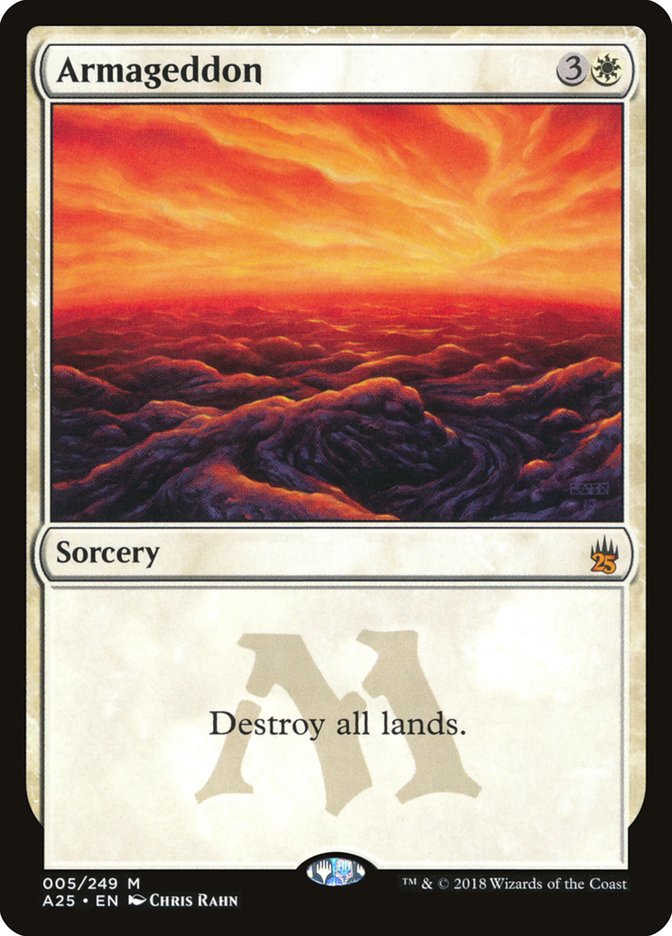
This final option is admittedly a bit extreme.  If your deck is based around Mass Land Destruction (MLD), heavy Stax strategies, heavy chaos, or Poison, don't run that deck or at least pull those cards.  These strategies can be frustrating for veteran players, but are oppressive enough to make new players quit the game or even find a new hobby in smaller local metagames. 

If your local playgroup is small enough, decks like these can ensure you aren't included in games any more, shrinking your playgroup immensely.

-----

None of these recommendations mean you cannot run interaction, strong synergies, combos, or 'I win' cards, nor does it mean deliberately making bad plays despite answers in hand and untapped mana.  

These options just slow your game enough that less invested players are willing to stick around and keep playing, either with you or at all.  

I know, you want to play the objectively good cards in an objectively good deck, so your opponents need to step up their game.  But how to convince them to do so?

There are two actions you can take to build your local player base.

Ideally, you're willing and able to tactfully improve the newer players' threat evaluation skills.  

Being new, they are unlikely to realize the potential of some cards or know that a card in play is one half of a game-winning combo.  Remind the new player that there are other options for their targeted removal and take the time to explain why specific cards might need killing more than what the player initially targets.  

Even if the biggest threat is under your control.

Especially if it is under your control.  

The other simple way to improve your opponents' decks is to tactfully make card recommendations and, if possible, give, trade, or sell them said cards.  

If nothing else, generically encouraging more interaction in a deck is a must for better games.  If you've ever been the only person running answers in a pod, you know the pain of trying to forward your gamestate while everyone looks to you to prevent someone from winning.  

Everyone bitches about blue countermagic until it would be clutch, then blue wizards are the savior yet are harassed for not countering a spell!  Blue just cannot win the social game, no matter how many Magic games it does win.

-----

A bonus video, but not by me.  Command Zone recently provided this on YouTube about affordable replacements for the expensive Commander staples.  While this video doesn't quite fall along the lines of the rest of this post, the overlap is there.

So give it a watch.


Friday, March 24, 2023

Stat Locks

Not Stat Blocks, although those are related.  

Stat Locks - fiendish magical locks that anyone can open, provided they are willing to temporarily let one of their stats drain a bit.  Not too long, but just long enough to make a return trip from opening one or more a dangerous proposition.  

Most DnDish games feature the same six stats: Strength, Dexterity, Constitution, Intelligence, Wisdom, and Charisma.  Even if your ruleset uses different amounts of stats with different names, these locks can still be used.

-----

So it looks something like this.

When discovered, a Stat Lock looks like raised block with a five-fingered handprint on it, for a right or left hand - it doesn't matter which.  It is cool to the touch, and immediately activates when in contact with the flesh of a living being's hand.  The first round drains whichever stat the lock is attuned to and changes color to red.  It drains a point of the stat each round, changing colors from red to yellow to finally green, at which point it opens with a pop and a hiss. 

Unless destroyed, the lock resets itself after 3 hours of first being activated, forcing the sequence and drain to begin anew.  This 3-hour timer includes the time the lock is open, then it closes (the door with it, as well), and the lock resets.  

Beings with hands can generally rotate through, each only losing a point before the next person slaps their hand onto the lock.  Except for the rarer version that looks a bit like a metal glove you slip your hand into - these clench around the hand until the lock is full, then it releases.  

Depending on how much is drained, this can be fatal.

Given the nature of these locks, they are typically only found in places that have plentiful minions, slaves, or prisoners because those employing these locks are not foolish enough to drain themselves.  

But PCs are foolish enough, or at least willing to try - and that's what makes these locks interesting - they attack the character sheet.  Note that regular use of such locks makes retainers and henchmen even more useful, although this will force loyalty checks.

Each lock requires a specific amount of a stat before opening (8 points is what most of my locks are), but some instead attack restfulness, leading to levels of exhaustion (4 levels is what I prefer, given that 6 levels kills a person - which is fine for NPCs, but perhaps a bit much for PCs).

While a long rest and some magics restore the stats at your rulesets various paces, this restoration eats up resources, which is the point of the exercise.  

-----

One lock might be bad enough, but they are often found in groups of 2, 3, 6, or sometimes all 7.  And they all look the same - although close inspection under bright light reveals small runes and symbols that represent the drained stat.  

The locks requiring two hands are often spheres or pyramids with handprints, while those with more may be found on a pillar or all in a row along a wall.  


Or in any other configuration the room allows.

These locks are rarely found alone and are often tied into alarm systems that bring guards before the lock even opens.   This becomes another decision point for players, because at least one PC will be occupied (back to the fight) opening the lock(s), while the others hold off trouble.  

Note that locks such as these are not picked as much as opened by forcibly draining others - a guard pressing someone else's hand to the lock is unaffected, as the lock drains whomever hand is being held there.  

Dispel Magic disables the lock, but does not open it.  Knock opens the lock, but remember the close and reset time - which might be dangerous if everyone is inside the locked area when it reseals.

-----

At the table, these locks force backwards math and maybe kill someone if a stat drops below 0 or Exhaustion hits level 6.  In addition, players/PCs will go hunting a safe place to rest and regain their stats - or burn Restoration spells doing so.  

Have fun!


Sunday, March 5, 2023

Buying Magic Items

Magic items are staples of fantasy fiction and roleplaying games.

After all, they boost the individual or group using them, they are fun in their own right, and they allow a DM to loredump without inflicting reading homework on the players.  

They are such a staple that many DMs include Magic Item Shoppes in their game worlds, and then spend hours stocking them, and then spend more hours determining how such a store does not get robbed/burgled/looted by transient PCs or NPCs.

There are several common recommendations.

From somewhere on the internet.  Not my work, though.

1. Such shops don't exist.  If that is the case, make sure your players know in session 0.  Various rulesets and player plans are item-based, and not being able to easily acquire such items is frustrating.

2. The shopkeeper is a retired high-level adventurer of sorts, using magical alarms, illusions, traps, extradimensional spaces, and other things to safeguard the product.  Probably extraplanar guard-things.

3. The shopkeeper is a retired low-level adventurer who has powerful friends (because regular folk cannot afford magic items).  Adventurers and world leaders call upon this person to keep them supplied.  They will come looking for the thieves, doubly so if the shopkeeper - their friend and source - was murdered in the process.

4. The shopkeeper pays protection to the local thieves' guild, who will assuredly come seeking to make an example of whomever made them lose face.  

5. It is a specialty store that only crafts items on commission, which is never an overnight affair.

6.  Some combination of 2-5.

7.  DM fiat.  The players automatically fail, regardless of what they do.  Don't do this.  This is terrible.

On top of all this is the need to determine an inventory.  If the store is Magical WalMart, it may have anything, and lots of it - then dice are used, and PCs end up with items that make the campaign ... difficult for the DM.  Alternatively, the DM painstakingly handpicks or even handcrafts the inventory, and is stuck describing everything multiple times to indifferent players.

All of which is a poor investment of DM time that makes me twitchy just thinking about.

-----

While magic item auctions are a possibility, they can be difficult to pull off at the table, unless you can score some guest players to run the NPC competition.  Then an auction can be awesome.  

My preferred method is to use a magic item broker or agent.  These are merchants that traffic in magic items, but do not keep their wares with them, instead procuring things as needed by wealthy customers.  Granted, such transactions are expensive and time-consuming, requiring a nonrefundable payment up front and the remainder upon delivery. 

These payments may not even be entirely in coin, but instead cost other items, goods, favors, or the like.  No doubt the contracts are signed under the watchful eye of the local deity of contracts and justice, who will (or its clergy will) ensure bad things happen to whichever party reneges on the deal.

Of course, whatever the customer wants may not be available.  Something similar may be found, or items can be commissioned, but these all take time.  Time measured in months, years, or even decades (depending on how crafting works in your game world).  I like this method because it allows PCs to have items they (mostly) want at a rate that doesn't suddenly break the table. 

Note this method means that items provided by such a broker or agent may not be exactly what the players/PCs want.  The item may have quirks or flaws, it might be a scimitar rather than a longsword, or it might be outright cursed. This is all part of the negotiations with the broker. Once a deal is struck, though, to quote what my children learned in preschool, you get what you get and you don't fuss a bit.  

Luckily, DnD even has such beings in place, at least to a degree.  The Arcane.

from the 2e Monstrous Manual

Or the Mercane, if your preferred ruleset is from a later edition.  This Deep Dive on the Mercane/Arcane is worth the time to skim read if you want extraplanar merchants that just appear as needed by PC request or DM plot.

A second species to consider as a broker is the Arcanaloth.  Granted, smart PCs should be wary of these denizens of the lower planes, because fiends historically do not have the best intentions for anything not themselves.  

A third species for a broker is the Rakshasa.  These lion-headed, backwards-handed shapeshifters are just as devious as Arcanaloths and only marginally more trustworthy.

For myself, though, I prefer brokers of standard species.  Given that my homebrew world is humanocentric, that means the main item brokers are/were human (with a few half-elves among them... and a shape-shifted dragon), with Grandfather Favarro and the rest of his family being my favorite examples from my campaign world.

Regardless of what species the broker is, these item brokers are terribly useful, both as procurers of wares and as patrons of adventurers.  After all, the magical items scattered across the lands and planes have to be recovered by someone, and who better to brave the dangers inherent in this than adventurers?

An item broker may not be all that potent, mechanics-wise, though will lean towards higher Intelligence, Wisdom, and Charisma scores and skills.  They may not be spellcasters at all, merely keeping one or more spellcasters on staff, or at least on retainer.

One thing for certain is that magic item brokers do not keep much - if any - inventory on hand.  The items they may have are for their use alone.  Any additional items lying about have been paid for and are awaiting pick up - stealing these items from the vault makes the thieves powerful enemies.

What the brokers do have on-hand are contacts: they know sages and bards to research specific items, they know mages and other casters to commission items from, and they know adventurers to go fetch the items from their last known locations/owners. 

Related to these contacts are the broker's customer base.  The sorts of people that do business with an item broker tend towards the powerful, politically and mechanically.  People robbing the broker make enemies of these customers, at least some of whom will come gunning for the thieves.

-----

Some players may want to skip all this and Wish for an item instead, which is completely doable.

Just decide during session 0 - and tell the players, not that they'll pay attention - that Wishes, including those from the Deck of Many Things or other items (and beings) - are inherently lazy and will not create something wholesale, but rather take something that already exists and bring it to the wisher.  

In the case of magic items, the former owner WILL want it back, but the DM doesn't have to even create said former owner until needed.  Unless the source of the Wish is fiendish, then perhaps the owner appears with the item.  This is extra amusing when said owner is a dragon.

Perhaps more amusing is when the Wish transports the PC to the item's location, with or without friends and companions.

Monkey pawing even shows up in Magic the Gathering.  Wishclaw Talisman.

This messing with wishes is often called monkey-pawing (from this short story which all gamers should be familiar with), and is definitely NOT for all tables, so be careful when doing this.  Or at least be up front about it in session 0. 

Monkey-pawing wishes and my session 0 both sound like other posts, so I will close here.


Saturday, February 18, 2023

Forbidden Lands Stronghold

The Forbidden Lands box set was a welcome Christmas gift this past year.  I skimmed it and put it up.


Then I stumbled across this video from Hexed Press, and now I want to put it into practice and work through the Stronghold building rules - anything to procrastinate from #Dungeon23 progress. 

So here goes.

-----

First off is determining just who is constructing this Stronghold.  We'll start with a trio of successful adventurers and their retainers.

Syr Alayna (Human Fighter), Brand (Human Fighter), Arianna Starchaser (Half-Elf Sorcerer) are the PCs and stars of this show.

Their retainers consist of two Human Fighters (squires to Syr Alayna), a Human Hunter, a Human Minstrel, a Human Rogue, and a Human Peddler.

Local allies include a pair of Druids, Elf and Half-Elf, and a Dwarf Fighter. 

These are the principal builders and suppliers of resources and skills.

-----

While our heroes could repurpose a discovered/cleared/conquered stronghold and make it their own, we'll save that for later and instead build one from scratch.  Because sometimes I like making my life difficult.

If you want to build your stronghold from scratch, you must first build a wooden house, a stone house, or a castle.  The list on page 194 indicates how long this takes and which tools and raw materials are required.

So basically, Minecraft on paper.  Something I am totally down for. Note that the rulebook states that you can draw a map of your stronghold if you'd like, but it's not required in the rules.  Crazy stuff.

Having found a hill that has ready access to fresh water, a commanding view of avenues of approach, and only a week's ride from the nearest civilized location, Team Example has opted to build a Stone House, a Tower, and a Fort enclosing them.

So 30 gold + 20 gold + 250 gold, as well as 600 stone + 400 stone + 200 stone and 1000 wood.  It takes one month + two weeks + two months, so about four months, to build once resources are on site.  

Between them, the tools required are sledgehammer, pickaxe, saw, and hammer.  Did I mention Minecraft?

You know this Keep.  Artist NOT ME.

All 1200 stone requires a nearby Quarry (controlled by the ally Dwarf Fighter) and costs 2 copper apiece, or 2400 copper.  The 1000 wood requires a Forest or Dark Forest (the Druid allies) and costs 3 copper a piece, or 3000 copper.

So 5400 copper for resources.  And time.

Resources gathered, Team Example begins construction (and to be fair, I might be misinterpreting things, and stacking the three building types is wrong, and the fort would automatically add the other two buildings, but my gut says no.  That gut is filled with cheap red wine, though, so keep that in mind).

-----

In addition to generic buildings that serve as start points, there are specific areas with specific functions that can be added to the Stronghold.  Some of which are prerequisites for other areas.

The trio sit down and plan out necessities for themselves and their followers, and decide upon a Bakery, a Fireplace, a Forge, a Garden, an Inn, a Library, a Portcullis, Ramparts, a Root Cellar, a Scriptorium, a Shooting Range, a Shrine, Stables, Training Grounds, a Vault, and a Well.

After looking at the list, the fighters add the following defenses: two Guard Towers, a Portcullis, Ramparts.  A Moat is discussed, but decided against.

So in addition to the 1200 Stone and 1000 Wood, they will need 2550 Stone and 1050 Wood and 170 Iron, so 3750 Stone, 2050 Wood, and 170 Iron as a whole.  Note that Iron is 1 silver each. 

In the end, it looks like 7500 Copper for Stone, 3150 Copper for Wood, and 170 Silver for Iron.

Presuming my math is right - I am doing heavy mental math and mixing it with wine.

Note that these various improvements bring more than just costs.  Some boost reputation, some provide defensive bonuses, some provide XP bonuses, or a variety of other things.

-----

While it takes nearly 4 months to build the basics, the specific extras require an additional six days, sixteen weeks, and two months.  Figuring four weeks to a month, that is a bit more than six additional months.

This puts us at a year of building, more or less.

Once built, money must be spent to cover salaries (especially of guards) and upkeep of the buildings.

Salaries imply hirelings beyond the main retainers.  While there may be numerous extras among the NPCs in the stronghold, a few are necessary, require salaries, and as such, are important people to keep pleased... or at least paid.

Our heroes know that they need a baker, a smith, a farmer, an innkeeper, a handyman, a pair of hunters, and several guards.  This means a daily salary of 38 copper, and 1 silver for all but the guards.  A half-dozen guards would be 6 silver per day, so 38 copper and 7 silver daily total.

If cash reserves run low, a Master Builder can be hired to supervise construction while the adventurers galivant across the land, seeking out new sources of income.  His rate is 2 silver each day. 

As the various hirelings automatically make their assorted skill checks (that is what they are paid for), it may be wise to start construction with a Master Builder instead of risking it on a die roll.

Failing to meet salary means trouble and potentially rebellion. 

Or worse.

-----

That's it - a Stronghold according to Forbidden Lands.  All told, its fairly quick, as long as resources and cash are available.  The book includes a helpful worksheet for tracking all the bits, which is free to download from the Fria Ligan site.

Having yet to actually play Forbidden Lands, I have no idea how difficult it may be to acquire said resources.  Looking at the treasure tables and the included adventures, coins are few and far between.  Affording the resources and the daily salaries is going to require a substantial down payment or serious favors owed.

So it seems the trio of adventurers were quite successful before deciding to build.  Even so, a wiser course of action might be to space the construction out over years, rather than at one time.  Just like in real life.  Neat.

What this exercise has done is makes me really want to play some Forbidden Lands.

The damaged observatory reminds me of the Ruins on Bone Hill.  Source undetermined, but not me!


Monday, February 13, 2023

Monday MtG: Away Decks II

A new year means a new set of Away Decks to ship off to Ohio.  From reports, last year's decks perform well and have a high win rate, which only encourages me.  

The Ohio games are typically multiplayer 20 life, creature-heavy affairs with decks ranging from precons to piles and all points in between, to include a massive Battle of Wits deck.  In truth, some of the decks haven't been changed in 20+ years, so there is no telling what may appear.  That said, there are favorites among the various players, so at some point, Bob's elves, John's slivers, or Lisa's lifegain decks are going to make an appearance.


Other house rules to keep in mind are that mana burn often still exists (depending on whose house we play at), and all players have the option to substitute a draw to instead reveal cards off the top of the library until they hit a land.  The revealed cards get placed on the bottom of the library in random order and the revealed land goes into the hand.  

This last rule lets folks actually play their decks.

Like last year, I'll build three decks using Commander rules, knowing that they probably won't be used for Commander games, just casual multiplayer games of 3-8 players. Unlike last year, I want to keep costs low on these decks, while still keeping them viable.  

Luckily, a local store has boxes of poorly sorted cards at great prices: .10 a common, .25 an uncommon, and .40 a rare (although a few rares are in a binder at higher prices).  All I need do is invest the time to sift through several 5-row long boxes.

In fact, I have already been sifting, leaving me with solid removal for a GW deck: Generous Gift, Swords to Plowshares, and Beast Within.  The same box provided several other sweet uncommons for well under market value, as well.

This means that one of this year's Away Decks is GW.  As I am using all the colors again, I am opting for UR and B as the other two decks.  Now that color choices out of the way, all I need do is choose Commanders and start building.

-----

The Commander solution lies in all of the partial decks I have neatly stacked in my MtG closet. Yes, I have an MtG closet. There are other things in there, but the closet's main purpose is Magic.  It saddens me that my closet does not open into another dimension.  I guess we'll have Narnia that in this house!  

Looking at the various piles of partial decks, I see Niv-Mizzet, Parun, as well as Lathiel, the Bounteous Dawn and Ayara, First of Lochthwain.  

These meet my color needs and promise variety, so it looks like these are my Commanders.  As I have partial decks, that will save money as I already own many of the cards that will be going into each deck.  Ideally, the sleeves will be the largest expenditure for each deck.  

I kid.  Cards will be - and have already been - purchased.  My goal is just not as much as last year.

-----


My thoughts are to make Niv-Mizzet a steal other players' stuff deck, utilizing Stolen Strategy, Etali, Spelltwine, Diluvian Primordial, and the like. This means that the deck won't overly rely on comboing out with Niv in play.  Yes, some of those cards will be in the 99, but they won't be my main path to victory.


The flaw to the 'play others' decks' strategy is that it relies heavily on the other decks in the game, which can be a dangerous reliance.  Still, it will be fun and, more importantly, different.

And that is really the whole point of the exercise.  

Just in case the stealing whiffs, the deck's backup plan will involve chaos and Dragons.  I'm tempted to lean into the UR spell-slinging archetype, but that makes me uncomfortable in regular Commander games, so my trepidation for the Ohio meta is even higher.

Regardless of how I go about it, I want this deck to draw and draw and draw some more, which means Teferi's Puzzle Box, Mindmoil, and Arjun; maybe Teferi's Ageless Insight as well.  Alongside this strategy are the myriad cards that expand my handsize and Elixir of Immortality, so I can draw everything again.

An expectation of blue is countermagic. Personally, I am a terrible countermagic player; I tend to put my hand down and visit or do other things when it's not my turn, so I've lost count of the times I could have countered a game-changing spell, but failed to do so, because I wasn't paying attention. Still, this is a deck for counterspells, especially if I lean into the UR cost reduction spells.

Enough counterspells makes Haughty Djinn a consideration.  There are lots of ways this deck can go, and I am excited to see what the final list looks like.


-----


Lathiel, the Bounteous Dawn almost builds itself - creature beat down, supported with lifegain.  

As there is no guarantee that Lathiel will see play each game in Ohio - although if these were standard Commander games, she'd see play all the time - I need to make sure each card has an impact related to her, but not dependent on her.

Granted, all decks should be built with the thought that each individual card can stand on its own (sorry combo decks), but Lathiel really wants to see lots of counters and life gain, so this deck will feature more synergistic cards than normal - normal for an Ohio game, but about right for a Commander game.

To compensate, I am considering adding cards that are group hug or at least some form of politics.  After all, GW lends itself to hugs, with Selvala and Gluntch in its ranks. It's a shame that Primal Vigor is pushing $30ish, as it would be a perfect addition.

If nothing else, this is the perfect deck and meta for Capricopian.  It even plays nice with the +1/+1 counter synergies in the deck.


-----


Last, but not least, is Ayara, First of Locthwain.  In truth, this deck is already in draft form, and I am now in the 'choose 28 individual swamps with the same border but different art that I find appealing' stage - a part of deckbuilding that I spend far too much time on: selecting the right basic lands.

It makes me regret that I didn't buy up the APAC basic lands for $3-$5 each when I was stationed in Korea back in the late '90s.  I can still picture that table lined with the individual lands, particularly this mountain.  


My thoughts at the time were 'who would pay $5 for a basic land?'  Lots of folks, it turns out.  Now that same basic land will set you back close to $100.

Such is life.

Anyhow, my Ayara deck is currently sitting at 40+ creatures, with hints of reanimation, EtB, and aristocrat tricks. I am vacillating between adding several demons and Liliana's Contract or cutting those for other cards - this would free up nearly 10 slots in the deck.

Two cards not in the deck are Grave Pact and Dictate of Erebos.  I own both cards, but won't be giving them up, as they are beyond the budget of replacing, at $28 and $15, respectively.  If this deck were for my use alone, both would be present, alongside other monoblack staples Cabal Coffers and Torment of Hailfire

How selfish of me.

I'm on the fence about adding Skullclamp.  This equipment lives for token decks, which Ayara basically is.  That said, Skullclamp is closer to $10 than not, and I've already spent a bit on Cabal Stronghold, Nirkana Revenant, Magus of the Coffers, and Bubbling Muck (it IS monoblack) for the deck, so this may not make the cut to keep costs down.

Gray Merchant of Asphodel is here though, as are other EtB all-stars and the means to continually recast or replay them.  This is a black deck, after all, so such should be expected. 


-----

Cards not found in any of these decks, nor in the first set of Away Decks, are the expected mana rocks (beyond Thought Vessel and Decanter of Endless Water - both included for the no hand size limit).  The meta these decks are intended for is not one where folks are racing to combo or racing to do anything, and the houserule about lands means mana-fixing is minimized (and also that MLD is easily remedied).


Cutting out rocks (and keeping decks to one or two colors) frees up lots of space in the 99, and frankly, I find it refreshing.  Nonland tutors are not present either.  I appreciate the power of a Demonic Tutor, but when decks are played a few times per year, likely by folks who didn't build the deck, a nonland tutor means every card in the deck is read.

While that does allow everyone time to pee, grab food, or have a smoke, tutoring unnecessarily extends an already long game.  To compensate, all the decks I build have strong draw power, be it through green's burst draw, black's life-for-cards and creature-for-cards, blue's cantrips, or red's wheels. 

The last reminds me, I should pick up a Reforge the Soul for Niv-Mizzet, it is such a lovely card.  


Then again, it is close to $10, so it may not make the 99, after all.


Wednesday, February 1, 2023

Small Update

This has been an exciting month for me, as several Kickstarters have asked for their shipping.

Secrets of the Black Crag, Scourge of the Northland, and something else that I am not sure of.

That said, I did buy some add-ons from Barkeep on the Borderlands, and these add-ons (the coasters) can be used in my terrible beer-swilling YouTube channel, so I am extra happy.

It certainly wasn't the add-ons from City of Tears, because I picked those up today.  I added hardcopies of NGR rules, Gnomes of Levnec, and Gellarde Barrow.  Admittedly, I own PDFs of two of these, but hardcopies are hardcopies.  Now I can see and easily read my games!

Next up is hopping on the Yoon-Suin, Second Edition kickstarter before it goes away in about a week.  Yoon-Suin has always looked interesting, but I am a real-book junkie.  So now I can get my fix.

All the way from Britain.

So now I am international!

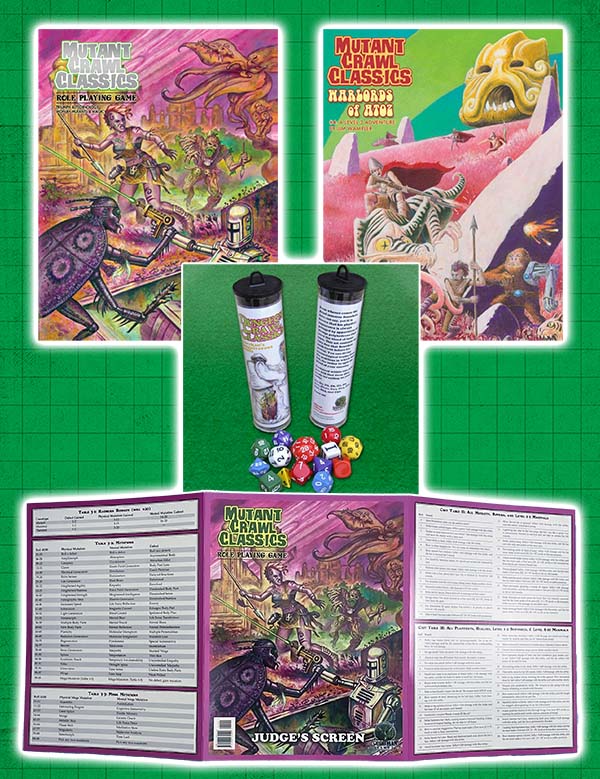
Last up for this month's budget is the Mutant Crawl Classics fan starter kit.  Granted, a hardback of the MCC rules would be better, but for this price, I won't complain, especially as it brings dice, rules, charsheets, and an adventure for a low price.


To be honest, these eat into March's budget, too, but I don't think I care all that much.

Anything to force me to not spend money on Magic singles - I don't play enough to justify buying all the admittedly awesome cards out there.

Even the cards I can afford!

-----

I reckon that this post means I need to go to confession for pride.