Wednesday, May 12, 2021

Quirks, Flaws, and Imperfections in Magic Items

This document exists because I firmly believe that magic item usage in D&D should be a meaningful decision for players, not an automatic one.  As such, adding costs in the form of quirks, flaws, and imperfections to items make players truly think about the merits of using an item at any given time.  Either as part of a custom item or merely attached to something from a published source, these twenty options provide the DM with an imperfect method of balancing otherwise potent magic items.

Remove Curse spells do not remove these traits, and they have no affect on attunement, because these traits are not curses – they do not bind the cursed item to the user, they merely affect the user when the item is used.  Successfully unbinding one of these traits typically destroys the item in the process.

Some of these suggestions work better with certain types of items than with others.  Mixing and matching these effects can also make for some entertaining items.  Durations of these effects vary between long rests and entire sessions.  This is to prevent people gaming the system and the whole exercise being a waste of time.

Erol Otus, from Moldvay Basic, 1981
 

  1.  Exhaustion. Each use of this item leaves the user with a level of exhaustion. 
  2. Footprints. For the next several hours, the user’s footprints glow, sear, form chalk outlines, steam, or otherwise make it readily apparent which way the user went.  These footprints remain for the rest of the session.
  3. Glows. Using this item places a Faerie Fire upon the user.  This particular version lasts until the next session.  The color of the glow may be dictated by wielder’s alignment, by random, or may be a specific color each time. 
  4. Volume.  Using this item either makes the wielder mute until after the next long rest or forces them to shout everything until after the next long rest.  Roleplayers rejoice!
  5. Synesthesia.  Activating this item affects the user’s voice, and their words come out and appear above them in glowing letters.  These words are visible to anyone with eyes, and of course, the words can still be heard.  Shouted words are LARGE AND IN ALL CAPS, while whispered words are far smaller.  All of the words glow bright enough to see by.
  6. Addictive.  Using the item forces a Wisdom save DC 12 or immediately use it again, even if not a tactically sound move.  That time forces a DC 14 save.  The next time a DC 16.  Etc.  If a wielder successfully saves, the next time used starts at the DC left off on.  This is how stories of berserkers begin…
  7. Senseless. Using the item renders the user temporarily blind or deaf until after the next long rest.
  8. Reduces stat. This item is powered by its wielder’s Strength, Dexterity, Constitution, Intelligence, Wisdom, or Charisma.  Activating the item reduces the appropriate stat by 2d4+1 (or a fixed amount, as you prefer) for the rest of the session.
  9. Vulnerability. When carried, this item makes the carrier/user vulnerable to 1d6: 1 silver, 2 iron, 3 wood 4 fire 5 water 6 truth.  Alternatively, when activated, the user becomes vulnerable to that substance for the rest of the session. 
  10. Spell immunity. The bearer/user is immune from all spells of specific levels (typical 0 and 1, or 2, or 3, etc).  All spells, enemy, ally, and self, fail to work on the PC.  Discarding the item helps, but the immunity takes a month to wear off.
  11. Enrages.  All living and unliving things that encounter you are enraged and want to ruin you (physically or in reputation, if they cannot reasonably win a fight.  Even allies are affected, but their familiarity nets them a DC 14 save to not attack.  EDIT: It might just enrage beings of a certain race or species.
  12. Draws fire.  The user mystically draws the attention and anger of all opposing combatants, so when in doubt, they attack the user and try to kill him/her dead.
  13. Magic Surge.  When used, a blue sphere of light surges out from the user for 60’ in all directions. All spells cast in that 60’ radius automatically force a roll on a good Wild Magic table.  This affect wears off after a full night’s rest.
  14. Lucid Dreaming.  Using this item guarantees strange dreams or visions during the next long rest; even creatures that typically don’t dream are affected by it.  Some of these dreams are oracular in nature, providing a hint or answer to a current problem.  Others are hellish nightmares, resulting in the long rest being disrupted. 
  15. Unlucky.  This item is powered by fate.  Activating it makes the user roll at disadvantage the rest of the session.
  16. Vampiric. This item is powered by allies’ spell slots, luck, or hit points.  Never the bearer/user, though.  Just their allies.  If there are no allies to drain, the item fails to function. 
  17. Magic Draining.  This item is powered by other magic items or spell slots.  When used, the nearest item loses a charge or becomes useless if a single-use item.  If no items are available, the wielder loses their highest spell slot for a month.  Should the wielder not have an item or spell, the power is leeched from the nearest such item or caster.
  18. Forgotten.  With each use of this item’s power, a necessary NPC utterly forgets the PC’s existence. Family, friends, and patrons – all are eligible.  In theory, a PC might forget the other PC, but that requires actual roleplayers and DM scheming.  One person forgets per use.  A PC utterly forgotten by all s/he knows dissipates into nothingness.
  19. Haunted.  This item has one or more ghosts bound to it; exorcising them probably disenchants the item as well.  The ghost might be the creator, the first wielder, or one or more beings slain by it, if a weapon.  Go all American Werewolf in London and the ghosts only begin manifesting after the first being slain.  Of course, they all have their own agendas and offer all sorts of commentary. 
  20. Elemental.  Activating this item creates a wave of elemental energy that deals damage to all in a 60’ radius, to all but the wielder.  The element type may be random or may be static due to nature of item. 

Sunday, May 2, 2021

Fey Bargains

In many DnD games, bargaining with Fey beings is an option.  Fey being Fey, they have no need or desire for mundane things like gold or mortal magic.  Instead, their prices are more intangible, more meta.  Players being players, they readily accept such bargains, thinking they can weasel out of them or that they will otherwise emerge unscathed. 

The Fairy Market, by Charles Vess

Here are 10 prices for a Fey to ask.  What they need these things for is entirely their business, and prying mortals will regret asking.

1.     Your last breath.  Mechanically, this means your PC now only gets two death saves instead of three.  (I read this on Facebook, so if it is yours, thank you).

2.     Your luck.  Only three times, and only temporarily.  Mechanically, this means your PC rolls at disadvantage for everything for an entire session.  Three sessions, actually.  At the start of each session the DM (or the player under DM supervision) rolls a d6.  On a 1 or 2, this cost is paid.

3.     Your <stat>.  Stats are Strength, Dexterity, Constitution, Intelligence, Wisdom, and Charisma.  Only three times, and only temporarily.  Mechanically, this means your PC loses 2d4+1 in the named stat for an entire session.  Three sessions, actually.  At the start of each session the DM (or the player under DM supervision) rolls a d6.  On a 1 or 2, this cost is paid.

4.     Your innocent rest.  Only three times.  Mechanically, this means your PC suffers nightmares during a long rest, so it has no benefits.  Each time a long rest is attempted, roll a d6.  On a 1 or 2, this cost is paid.  Note that RAW, no more than one long rest can be attempted in a 24-hour period.

5.     Your voice.  For an entire session, your PC cannot speak, sing, or cast spells with verbal components.  Whether or not the Fey chooses to impersonate you with your voice and stir up mischief is entirely up to the DM.  At the table, the player should embrace this role-playing opportunity.  At the start of each session the DM (or the player under DM supervision) rolls a d6.  On a 1 or 2, this cost is paid.

6.     Your memories and experiences.  This Fey is particularly jaded and is looking for some new thrill.  Living vicariously through a mortal will suffice.  Mechanically, this means that whenever experience points are doled out, the DM (or player) rolls a d6.  On a 1, the PC gains no experience points for the session.  This continues until the Fey is satisfied or convinced to stop.  Alternatively, the player throws out the PC’s backstory and plays dumb if encountering someone or something from it.

7.     Your sense of purpose and being.  For an entire session, your PC is afflicted with terminal ennui.  Mechanically, this means making a DC18 (or more or less, depending on the Fey bargained with) Wisdom save to do anything meaningful: travel, cast, fight, use skills, heal someone, heal self, eat, drink. The only things the PC can do without issue is sigh loudly, talk about how pointless everything is, wear black, and write bad angsty poetry.   At the beginning of each session, the DM (or player) rolls a d6.  On a 1 or 2, this session goes goth for the PC.

8.     Your service. At some point, the Fey will need something accomplished, and the PC is contractually obligated to see that task through or die trying. Mechanically, this means that the Fey can summon and command the PC to act for it. If the PC refuses, they act under a Dominate Person spell until the task is accomplished (or they die, which is far more likely). Unbeknownst to the PCs, their own bonds tie them together, so that when the PC is summoned and given the task, the rest of the party travels with him or her. Note that the rest of the party is free to refuse, but the PC that made the bargain must fulfill it. Whether or not this service takes one session or spans several is up to the DM and players.  This happens at the DM’s choosing – probably when nothing else is planned.  If nothing else, the Fey needs an item retrieved from the Gardens of Ynn or the Stygian Library.

9.     Your aggression and desire to harm.  This bargain makes the PC a born-again pacifist for an entire session.  Mechanically, the PC spends the session avoiding combat, or defending self but not striking back.  Running away, surrendering, negotiating, healing, holding torches, and anything else that results in not harming others, to include explanars, undead, constructs, and other such things, is still possible.  If the PC does inflict harm on another (DC18 Charisma to try), that damage is dealt tenfold back on the PC. 

10.  Your magic.  The Fey needs to fill a battery with sorcerous power, and your magic will suffice.  It needs 3d6x10 spell levels to fill the battery.  Mechanically, this means that each time the PC casts a spell, the player rolls a d6, and on a 1 or 2, the spell fizzles and the spell levels go to fill the battery instead. So that Fireball is considered three spell levels, unless upcast to 5th level, then it is worth five.  The spell slot is regained as normal with a short or long rest.  Once the battery is full, spells stop fizzling.

Whether or not you roll for the price or choose something fitting is entirely up to the DM … and the Fey in question.

Edit: I found THIS d100 table of non-gp payments, and it fits with this post. 

Edit: I also found this d100 table at d4 Caltrops - so you know it'll be good!

Alone Time with MegaMek and MekHQ

I haven't written much lately because my free time has been absorbed with the latest stable version of MegaMek and MekHQ.  There are many posts in draft form, needing completion, but for now, it has been computer games.

For those unaware, these two free games simulate all the fun of table top Battletech games without the need for having a room dedicated to painting and storing (and using) minis and terrain.  What is Battletech? It is a wargame set initially in 3025 where humanity is at war with itself, and has been several hundred years. Battlemechs are giant human-piloted war machines and the principal means of solving political issues.  Players are typically mercenaries trying to keep their 'mechs functional and units financially solvent.  Sarna's Battletech Wiki addresses ALL the in-game lore, of which there is centuries worth.

Rifleman by Shimmering-Sword on DeviantArt

There are multiple units and regiments saved on my hard drive for earlier versions of the game.  My experience, though, is that the unit and planet knowledge gets too large and the saved games just stop loading.  Downloading the latest version of Java helps, but sometimes, I just have to shelve the game for awhile.  Which is a shame, because my first unit has at least two regiments' worth of short fiction in the individual biographies of each pilot and several techs and vehicle crewmembers, fiction that is effectively lost.  In Battletech, a regiment is approximately 108 'mechs, plus air support, armor, infantry, and artillery, for a proper combined arms approach.  While I still have to rely on the Bot to fly my air support, I have worked out the rest of the combined arms, and it is good.  So, yeah, lots of character sketches gone.  

With this latest unit - the Heartbreakers, founded in 3025 - I have expanded the initial company to a full battalion of 'mechs, with plans for appropriate aerospace and armor (and maybe artillery) support.  I play Against the Bot and the bot provides lots of delicious salvage, to include three Awesome 'mechs.  For those unaware of the beauty of this 'mech, I'll let Tex of the Black Pants Legion explain:


While the Awesome is near the top of my favorites list, what I find perfect is the Wolverine-M.  It jumps, it pummels, and its' kicks are big enough to leg a light 'mech, providing me more salvage.  Coupled with a skilled pilot, typically with the Melee Master and Jumping Jack abilities, and this version of the Wolverine is a fast nightmare for armor and light 'mechs.

Yes, I am aware of several Battletech and Mechwarrior computer games, but of them, I prefer MekHQ, and not just because it is free. I enjoy the minutia of managing a mercenary company: hiring new employees; leveling veterans in the unit; salvaging, repairing, and replacing equipment; negotiating new contracts; writing (questionable) fanfiction about the units; managing the TOE of each lance and company; fiddling with the options (and there are so many options); the turn-based combat.  

Now, I have a box of plastic minis, from the first round of Alpha Strike lances that Catalyst produced, as well as a decent selection of Heroscape terrain, and one of Stratagem's roll-out hex printed map to lay it all out on.  The boys love playing 'robots' with the whole mess, and frankly, it IS fun to build maps and move minis about them.  Time spent setting up and taking down is typically longer than the actual playing, though, so mostly it is a now-and-then game.

As an aside, I debated supporting the kickstarter for the new version of Lance Packs that match the 'mechs in the recent box sets, but in the end refrained.  I don't regret it, but I admit to hints of want when I see them.

A Warhammer, Phoenix Hawk, Rifleman, and Commando (I think) - so sweet.

Storytime: the one time I attended GenCon, I stumbled onto an open game that was the Battle of Tukkayid.  I was assigned to the Inner Sphere, and given control of an Awesome and a Catapult.  A squad of Elementals did in the Awesome, and the Catapult joined the Awesome in death a few rounds later.  In the end, both minis became wreckage - represented by large washers - on the huge table-top map.  They joined the dozens of washers already there.  In Battletech lore, that is a historical battle, stopping the Clan Invasion in its tracks.  For college-age me, it was just awesome.


Awesome by Shimmering-Sword on DeviantArt


Thursday, April 22, 2021

Twilight 2000


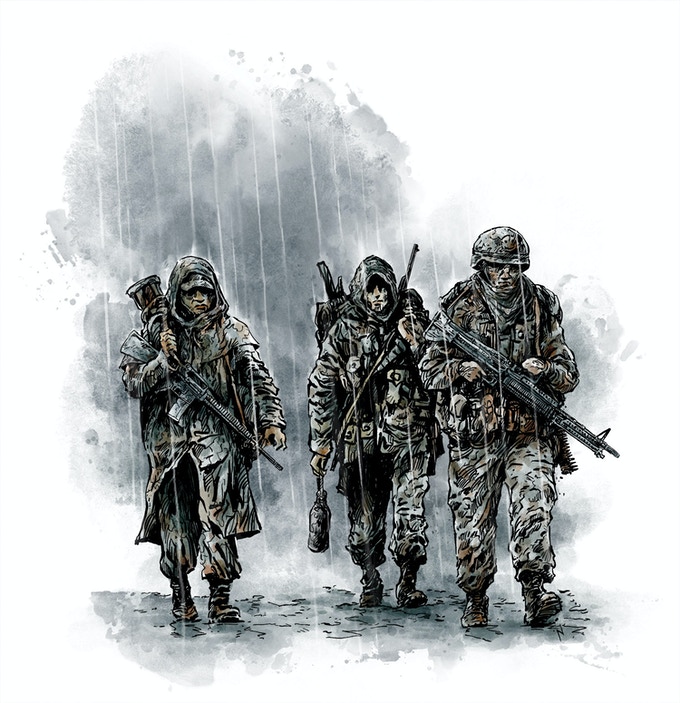
Despite the image, I'm not talking about the GDW ruleset.  I backed the kickstarter from Fria Ligan (creator of Tales from the Loop and Mutant: Year Zero, among other games), because as a child, I couldn't afford the game.  Still, it fascinated me, as did all things military at that point in my life - I'm fairly certain I did a book report on Team Yankee while in middle school (the comic book miniseries is a solid retelling, if you can find all six issues).  For awhile, I got my fix from the video game version of T2K, but that only worked for so long.

So when the chance to own T2K coincided with my having funds, I jumped on it.

I received the Alpha pdf before Christmas.  After skim-reading it, I set it aside for other things. This weekend, the Beta pdfs arrived, so I've been reading through them in my spare time, and it comes across as somehow more grim than before.

Which is fitting, as the game itself is set in a WWIII that never was.  Still, some of the packaged scenarios in the referee's book quickly begin morally grey, and then wallow in it.  Particularly the adventure set around a former military academy run and protected by students-turned-child-soldiers.

Soviet spies posing as Americans (or Americans serving as Soviet spies) is a recurring theme in the game which resonates with me, because last year I learned that one of my fellow platoon leaders from long ago was convicted of being a Soviet spy. 


There are rules for creating your own homebase, which reminds me a bit of the Fallout video games, as the PCs scrounge for parts, alongside scrounging up food, clean water, miscellaneous other supplies, and ammo.  Ammo is always in demand, because despite T2K being more of an RPG about tired soldiers trying to get back to the states (itself in a bit of a post-apocalyptic mess, just without zombies), combat is a very real possibility, and combat with modern-ish fireamrs relies on having enough ammo.

Because for many people in-game, the war is still going on, at least to a degree.  Local militias, Russian troops, and marauders from both sides will gladly engage any Allied (mostly American) troops they encounter, if only to kill/enslave them and take their stuff.

Grim or not, T2K is a role-playing game, which means PCs of some sort are needed. Players take on the roles of survivors of the disaster in Kalisz and WWIII in general.  The rules provide two options for creating PCs: archetypes and lifepaths.  The former are pregenerated PCs and the latter the means for creating your own PCs from scratch.  Both options require PCs to have a specified moral code, big dream, and a buddy (chosen from among the other PCs).  These three traits ideally help drive the role-playing side of the game. 

The truth is that I have no idea who among the gamers I know might be interested in playing T2K. I know I can draft my eldest to play through the combat-related rules, but for actually playing through several sessions, I haven't a clue.

Even if I never get to play it properly, I can still mine it for my fiction writing, which tends towards the post-apocalyptic.

If nothing else, the box set will look cool upon my shelf.

Art from one of the rulebooks; presumably by Niklas Brandt, Gustaf Ekelund, or Jarek Kubicki

Tuesday, April 20, 2021

Fire Puzzle Room

A puzzle room that qualifies as a Special when stocking a dungeon.

Picture this, but the bowl is ten feet in diameter and the fire is HOT.

The PCs enter a large rectangular chamber from the only open door.  The air in the room is noticeably warmer than the hall, the heat coming from the large black iron brazier near the middle.  As someone nears the center of the room, the brazier flares up, illuminating the rest of room and casting eerie shadows on the walls.  At this point, a doorway is visible on the far wall, opposite the entrance.  A large block of stone seals the door. Also visible in the light is a plaque which reads:


A fiery sacrifice 

opens the way 

to the closed room.

Other methods

open the way

to assured doom.


The first stanza makes it plain that casting things into the fire (which is a one-way portal to the Elemental Plane of Fire) opens the door.

10,000 gp worth of nonmagical valuables is the simplest method, with the door rising up slowly until the full amount is burned.  Brave PCs might try to slip under a partially raised door...

A half-dozen single use magic items (potions, scrolls, charms) or two permanent magic items work, again raising slowly.

Note that any DM-approved combination of the above work together.

The cultists who made use of this fiery lock saved money by casting living beings into the flames.

The door raises completely with a sentient being's life, or multiple nonsentients (animal companions, familiars, etc), voluntary or not.  So, in theory, a noble PC might throw herself into the flames to open the door.  In this case, just like the other unwilling sacrifices, they are irrevocably gone, consumed by the flames of the Elemental Plane of Fire, as it is the consumption of lifeforce that opens the door.

Sacrificing another being is an Evil act.  Alignment matters in my game, and PC alignment shifts straight to Evil.  Sacrificing different types of beings result in more than just an open door, however.

A cleric or champion of same or opposing deity - The PC is forever marked as an enemy of the faith, and the faithful sense and know it on sight.  1:6 chance a representative of the deity quests to destroy the sacrificer. The one doing the casting suffers nightmares for the next 1d6+1 months, with a 4:6 chance of having a long rest disrupted by them.  After that time frame, it becomes a 1:6 chance.

A cleric or champion of a Good deity - As above, but if the cleric is of the same or higher level as the sacrificer, the PC casting them into the flame gains a permanent level and the enmity of that deity and its minions.  If the sacrificed was level 9 or higher, the chance that something begins actively hunting the sacrificer becomes 4:6.

A sentient being - the being weeps, wails, begs, bargains, and voids its bladder and bowls while being cast into the flames.  The one doing the casting suffers nightmares for the next 1d6+1 months, with a 4:6 chance of having a long rest disrupted by them.  After that time frame, it becomes a 1:6 chance.

A Good sentient being - as above, but the sacrificer gains a permanent +1 bonus to a randomly determined stat for each Good sentient cast into the flame.

In each of the above cases, a fire demon (be it demon, efreet, or fire elemental) appears to the PC in a public setting - with witnesses - to congratulate the PC on joining it in its crusade against Good, then begins lashing out at random while calling to the PC to join it on a rampage.  It will disappear before it can be gravely injured.  

A magical creature -  as sentient beings, but it is the Fey that are angered and come gunning for the sacrificer.  Nightmares are the same.

A Good magical creature - as magical creatures, but sacrificer gains an immunity or power based on the specific creature sacrificed.  Nightmares are the same.

Animals - the least of the evils.  The animals whimper and scream and piss everywhere as they are picked up and cast kicking into the fire.  Whenever a long rest is attempted, 1:6 means nightmares and night sweats disrupt the long rest.

PCs that stand by and let others cast living beings into the flame are culpable and become tainted, requiring atonement and perhaps a quest before falling back into the good graces of their deity (and themselves).  They too, suffer nightmares, losing the benefits of a long rest 1:6 each long rest.

The second stanza suggests using other methods (typically knock or stone shape spells, but also brute force and anything else that doesn't involve a sacrifice) would be a poor decision.  

And it is.  

Dao, Monstrous Compendium, I think

Attempts to open the door trigger an ancient warding magic that summons an angry Dao (who is pissed because he has spent the last five centuries setting something up and the PCs have ruined it) and a full dozen earth elementals under the Dao's control.  The earth elementals come out of the walls and up from the floor, surrounding the PCs and begin melee, while the Dao directs things from afar.  One bit of direction it is partial to is having elementals try and knock PCs into the flame and immediate burnination.

Note that knock and stone shape and the other methods do, in fact, open the far door as surely as if something valuable was burned.  It is that using such methods triggers the guardians.  Defeating these guardians means looting them.  While the earth elementals merely crumble into rubble (that may contain uncut gems at the DM's discretion), the Dao has more entertaining options.

Source not me.  I would love to know, though, as I bet they have done other critters this way.

So either way, the door is opened, and the PCs pay for it in some way, shape, or form.  If particularly wicked (or unthinking) PCs end up calling down an extraplanar crusade upon themselves to save a few gp, well, that seems a fitting response, and certainly beats some alternatives.

Megadungeon Rumors

I've discussed rumors before.  

A good megadungeon should have its own rumor table.  A table that changes and grows based on PC (and NPC) actions.  

The mechanic I'll be using is to allow each player one roll, plus an additional roll per Charisma stat bonus, at the start of each session beginning in Skara Brae (which should be most, if not all, of the sessions).  Whether or not the PCs share the rumors they learn with the others is on them.

Which means that I'll either need to prep things ahead of time using note cards, or do lots of writing as we go.  The note cards seem the simplest method, while providing a useful tactile prop.

Greg Irons, from the AD&D Coloring Book, 1979

After all, some people, even adventurers, need external motivation, and good rumors provide just that.

As the picture suggests, the Green Dragon plays host to the ne'er-do-wells that fancy themselves adventurers in Skara Brae.  Given its crowded confines and flowing alcohol, all sorts of things about the megadungeon might be overheard there, spurring the limited objectives that make a megadungeon campaign work. Marketplaces, shops, bathhouses, religious services, festivals, and the streets themselves are also potential places to overhear rumors.  Hearing the same rumor repeatedly may lend credence to it, or might merely suggest a popular or fascinating bit of gossip.

The initial rumors list will be fairly close to this:

 d20

 Rumors (italicized words are false)

 1

Watch the water that is not water, and beware the basilisk! 

 2

 Old Ebeneezer Hardbottle will pay well for a live meazel - if such things actually exist.

 3

My own shadow tried to kill me in the pillared hall; my friends' shadows did kill them.

 4

The megadungeon connects to ancient tombs that predate Skara Brae.

 5

Caves connect the megadungeon to the sea. 

 6

The oracle in the third deep likes his ale.

 7

I delved too deep and found myself in a large cavern with green glowing fungi on the walls that danced and stirred.  I could make out a city in the distance! 

 8

There is an unguarded entrance to the third level near the forest lake.

 9

Statues down there are far more than odd art. 

 10

Tristan's bride-to-be Isolde was kidnapped and her dowry stolen by the bandits on the first level.

 11

A flaming sword was lost to the orcs on the first level.

 12

A treasure-laden funeral barge floats on a vast reservoir on the tenth level. 

 13

Cadmael Addewid is an elf of his word - just be careful as to what that word is!

 14

The Church of Starry Wisdom keeps its treasure vault on the second level. 

 15

The goblins of the first level can be bargained with.

 16

Ghosts of those slain in the dungeon still wander its halls.

 17

Angeber Loweherzen swore to eradicate the bugbears of the second level.  He, his flaming sword, and his companions haven't been seen since.

 18

Wicked and depraved cults still practice their foul worship in the darkness.

 19

I followed stairs deep into the darkness of the seventh level, but ran when I realized the stairs had been chiseled from the bottom up!

 20

The dungeon is alive - and it hates us!  

The falsehoods have yet to be fleshed out.  Replacement rumors will be generated between sessions.  This may or may not result in nested subtables, as I number the notecards 7a, 7b, 7c, etc.  

I already have ideas for the truth behind rumors #8 and #10.   #16 means I need to reconfigure the wandering monster table(s) with a ghost subtable.  

#13 references the leader of the bandit/berserker faction on the first level, while #1 was lifted directly from the Dungeon of Dread.  I may need to reread that book.

It seems that The Church of Starry Wisdom has a toe-hold in Skara Brae; I will make time to reread some Lovecraft.   Rumors that span the levels suggest that some adventurers have made it that deep and returned to tell of it.  Those same rumors also suggest that the megadungeon is deeper than imagined.

Basically, a good rumor table builds the world while providing players/PCs with focused options of what to do next.  Similar things can be accomplished through job boards and the town council and such, but I prefer the simplicity of a few dice rolls and then off to adventure.  With gaming time at a premium, maximizing the adventuring is crucial.


Undead in my Megadungeon

Archaeology Graverobbing can be a lucrative hobby, both in the real world and in D&D-land.  Grave goods tend to be durable and valuable: silver, gold, gems, lost knowledge, weapons, and in D&D-land, magic.  

The major difference between archaeology graverobbing in real life and D&D is the threat level, because undead are only a threat in D&D-land.  D&D being D&D, undead are practically a guaranteed hazard of graverobbing.

Undead:

"Undead are evil creatures that have been created through dark magic. They are unaffected by things that affect living creatures, such as poison, and are not affected by spells that affect the mind, such as sleep and charm person. They do not make noise." (B44)

Basic Undead are Ghoul, Skeleton, Wight, and Zombie.  Expert adds Mummy, Spectre, Vampire, and Wraith to the list.  Shadows can be found in Basic, but are not  undead.  

Expert also expands and slightly changes the definition of Undead, to read:

"Undead are evil creatures that have been created through dark magic. All were once living beings. They are unaffected by things that affect living creatures, such as poison, and are not affected by spells that affect the mind, such as sleep, charm person, and hold. Undead usually do not make any noise." (X41)

The final sentence of both definitions means undead make excellent ambush monsters.  Silent.  Usually.

Jim Holloway, from B4

What makes the undead truly frightening isn't so much the silent waiting, the special attacks (paralysis, level drain, disease, or other), or the need for silver and/or magic weapons to hit them, though.  It is the Morale score of 12 that most of them have (Ghouls 9, Spectres and Vampires 11) that is terrifying.  For readers that are unfamiliar with Morale, a score of 12 means that undead never retreat or quit.  They just keep coming.  (As an aside, if you don't use Morale rules, give them a shot and make combat fun and unpredictable again - or at least potentially shorter).

Yes, clerics can turn undead, but they cannot do it often or continually.  So the threat of a unending horde of undead assailants - especially if backed into a corner or other dead end - is a palpable one, especially if PCs are a lower level.

Those eight undead won't be the only undead in the megadungeon, though.  I recently read something at The Manse about ghosts, and I like it enough that I am adding such ghosts (in a nested subtable) to the random encounter tables for my megadungeon.  So more undead; this plays into what is already on the rumor table.

In addition to those ghosts are the undead variations from BECMI and AD&D, because converting isn't that difficult.  Ghasts, banshees, coffer corpses, sons of Kyuss, liches, and more will all eventually be found somewhere in the depths.  What are now the classics.

All this is important (to me) because there is a semi-hidden passage right off of the first level that leads to a series of crypts, tombs, and catacombs dedicated to an ancient and best forgotten deity of death and decay. What I am planning is a multi-level sublevel, because I dream big. I'm intending to use the sussurus from the Lichway adventure as a set up, because what self-respecting adventurer wouldn't attack a spiky humanoid-shaped thing that does nothing but make noise and attack sources of open flame?

Fiend Folio, 1981

Of course, this sublevel has its own entrance to the surface, still used by the cultists that dwell in Skara Brae.  It occurs to me that run-ins with the cultists should lead to players/PCs recognizing some of the slain cultists as people they have dealt with: innkeepers, shopkeepers, etc.  Inevitably, some of the slain should still be seen alive and well on the surface, leading to doppelgangers or something worse.

As to why the PCs would be exploring this sublevel to begin with, well, that is the point of D&D as I see it: exploration.  With exploration comes risk, but also rewards.

And those rewards are what draw the PCs down deeper, darker corridors and stairwells.