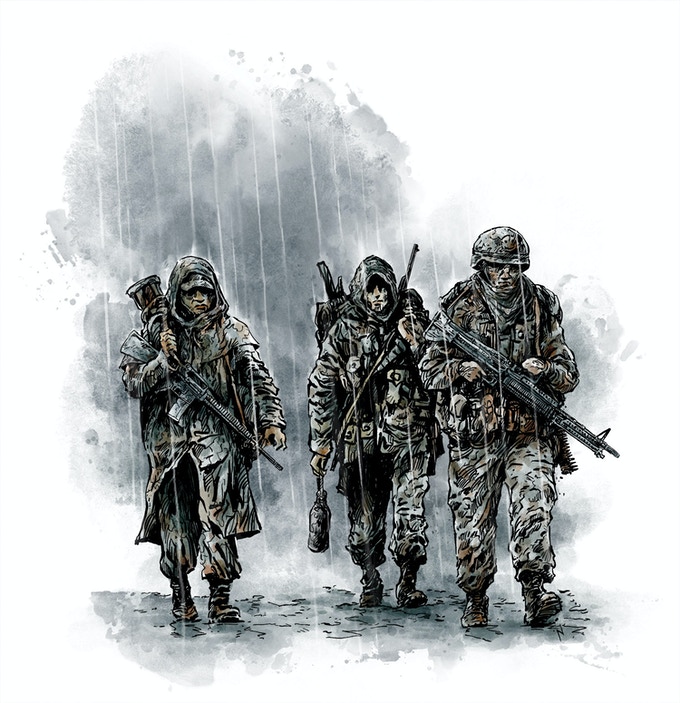
Despite the image, I'm not talking about the GDW ruleset. I backed the kickstarter from Fria Ligan (creator of Tales from the Loop and Mutant: Year Zero, among other games), because as a child, I couldn't afford the game. Still, it fascinated me, as did all things military at that point in my life - I'm fairly certain I did a book report on Team Yankee while in middle school (the comic book miniseries is a solid retelling, if you can find all six issues). For awhile, I got my fix from the video game version of T2K, but that only worked for so long.
So when the chance to own T2K coincided with my having funds, I jumped on it.
I received the Alpha pdf before Christmas. After skim-reading it, I set it aside for other things. This weekend, the Beta pdfs arrived, so I've been reading through them in my spare time, and it comes across as somehow more grim than before.
Which is fitting, as the game itself is set in a WWIII that never was. Still, some of the packaged scenarios in the referee's book quickly begin morally grey, and then wallow in it. Particularly the adventure set around a former military academy run and protected by students-turned-child-soldiers.
Soviet spies posing as Americans (or Americans serving as Soviet spies) is a recurring theme in the game which resonates with me, because last year I learned that one of my fellow platoon leaders from long ago was convicted of being a Soviet spy.
There are rules for creating your own homebase, which reminds me a bit of the Fallout video games, as the PCs scrounge for parts, alongside scrounging up food, clean water, miscellaneous other supplies, and ammo. Ammo is always in demand, because despite T2K being more of an RPG about tired soldiers trying to get back to the states (itself in a bit of a post-apocalyptic mess, just without zombies), combat is a very real possibility, and combat with modern-ish fireamrs relies on having enough ammo.
Because for many people in-game, the war is still going on, at least to a degree. Local militias, Russian troops, and marauders from both sides will gladly engage any Allied (mostly American) troops they encounter, if only to kill/enslave them and take their stuff.
Grim or not, T2K is a role-playing game, which means PCs of some sort are needed. Players take on the roles of survivors of the disaster in Kalisz and WWIII in general. The rules provide two options for creating PCs: archetypes and lifepaths. The former are pregenerated PCs and the latter the means for creating your own PCs from scratch. Both options require PCs to have a specified moral code, big dream, and a buddy (chosen from among the other PCs). These three traits ideally help drive the role-playing side of the game.
The truth is that I have no idea who among the gamers I know might be interested in playing T2K. I know I can draft my eldest to play through the combat-related rules, but for actually playing through several sessions, I haven't a clue.
Even if I never get to play it properly, I can still mine it for my fiction writing, which tends towards the post-apocalyptic.
If nothing else, the box set will look cool upon my shelf.
Art from one of the rulebooks; presumably by Niklas Brandt, Gustaf Ekelund, or Jarek Kubicki
A puzzle room that qualifies as a Special when stocking a dungeon.
Picture this, but the bowl is ten feet in diameter and the fire is HOT.
The PCs enter a large rectangular chamber from the only open door. The air in the room is noticeably warmer than the hall, the heat coming from the large black iron brazier near the middle. As someone nears the center of the room, the brazier flares up, illuminating the rest of room and casting eerie shadows on the walls. At this point, a doorway is visible on the far wall, opposite the entrance. A large block of stone seals the door. Also visible in the light is a plaque which reads:
A fiery sacrifice
opens the way
to the closed room.
Other methods
open the way
to assured doom.
The first stanza makes it plain that casting things into the fire (which is a one-way portal to the Elemental Plane of Fire) opens the door.
10,000 gp worth of nonmagical valuables is the simplest method, with the door rising up slowly until the full amount is burned. Brave PCs might try to slip under a partially raised door...
A half-dozen single use magic items (potions, scrolls, charms) or two permanent magic items work, again raising slowly.
Note that any DM-approved combination of the above work together.
The cultists who made use of this fiery lock saved money by casting living beings into the flames.
The door raises completely with a sentient being's life, or multiple nonsentients (animal companions, familiars, etc), voluntary or not. So, in theory, a noble PC might throw herself into the flames to open the door. In this case, just like the other unwilling sacrifices, they are irrevocably gone, consumed by the flames of the Elemental Plane of Fire, as it is the consumption of lifeforce that opens the door.
Sacrificing another being is an Evil act. Alignment matters in my game, and PC alignment shifts straight to Evil. Sacrificing different types of beings result in more than just an open door, however.
A cleric or champion of same or opposing deity - The PC is forever marked as an enemy of the faith, and the faithful sense and know it on sight. 1:6 chance a representative of the deity quests to destroy the sacrificer. The one doing the casting suffers nightmares for the next 1d6+1 months, with a 4:6 chance of having a long rest disrupted by them. After that time frame, it becomes a 1:6 chance.
A cleric or champion of a Good deity - As above, but if the cleric is of the same or higher level as the sacrificer, the PC casting them into the flame gains a permanent level and the enmity of that deity and its minions. If the sacrificed was level 9 or higher, the chance that something begins actively hunting the sacrificer becomes 4:6.
A sentient being - the being weeps, wails, begs, bargains, and voids its bladder and bowls while being cast into the flames. The one doing the casting suffers nightmares for the next 1d6+1 months, with a 4:6 chance of having a long rest disrupted by them. After that time frame, it becomes a 1:6 chance.
A Good sentient being - as above, but the sacrificer gains a permanent +1 bonus to a randomly determined stat for each Good sentient cast into the flame.
In each of the above cases, a fire demon (be it demon, efreet, or fire elemental) appears to the PC in a public setting - with witnesses - to congratulate the PC on joining it in its crusade against Good, then begins lashing out at random while calling to the PC to join it on a rampage. It will disappear before it can be gravely injured.
A magical creature - as sentient beings, but it is the Fey that are angered and come gunning for the sacrificer. Nightmares are the same.
A Good magical creature - as magical creatures, but sacrificer gains an immunity or power based on the specific creature sacrificed. Nightmares are the same.
Animals - the least of the evils. The animals whimper and scream and piss everywhere as they are picked up and cast kicking into the fire. Whenever a long rest is attempted, 1:6 means nightmares and night sweats disrupt the long rest.
PCs that stand by and let others cast living beings into the flame are culpable and become tainted, requiring atonement and perhaps a quest before falling back into the good graces of their deity (and themselves). They too, suffer nightmares, losing the benefits of a long rest 1:6 each long rest.
The second stanza suggests using other methods (typically knock or stone shape spells, but also brute force and anything else that doesn't involve a sacrifice) would be a poor decision.
And it is.
Dao, Monstrous Compendium, I think
Attempts to open the door trigger an ancient warding magic that summons an angry Dao (who is pissed because he has spent the last five centuries setting something up and the PCs have ruined it) and a full dozen earth elementals under the Dao's control. The earth elementals come out of the walls and up from the floor, surrounding the PCs and begin melee, while the Dao directs things from afar. One bit of direction it is partial to is having elementals try and knock PCs into the flame and immediate burnination.
Note that knock and stone shape and the other methods do, in fact, open the far door as surely as if something valuable was burned. It is that using such methods triggers the guardians. Defeating these guardians means looting them. While the earth elementals merely crumble into rubble (that may contain uncut gems at the DM's discretion), the Dao has more entertaining options.
Source not me. I would love to know, though, as I bet they have done other critters this way.
So either way, the door is opened, and the PCs pay for it in some way, shape, or form. If particularly wicked (or unthinking) PCs end up calling down an extraplanar crusade upon themselves to save a few gp, well, that seems a fitting response, and certainly beats some alternatives.
A good megadungeon should have its own rumor table. A table that changes and grows based on PC (and NPC) actions.
The mechanic I'll be using is to allow each player one roll, plus an additional roll per Charisma stat bonus, at the start of each session beginning in Skara Brae (which should be most, if not all, of the sessions). Whether or not the PCs share the rumors they learn with the others is on them.
Which means that I'll either need to prep things ahead of time using note cards, or do lots of writing as we go. The note cards seem the simplest method, while providing a useful tactile prop.
Greg Irons, from the AD&D Coloring Book, 1979
After all, some people, even adventurers, need external motivation, and good rumors provide just that.
As the picture suggests, the Green Dragon plays host to the ne'er-do-wells that fancy themselves adventurers in Skara Brae. Given its crowded confines and flowing alcohol, all sorts of things about the megadungeon might be overheard there, spurring the limited objectives that make a megadungeon campaign work. Marketplaces, shops, bathhouses, religious services, festivals, and the streets themselves are also potential places to overhear rumors. Hearing the same rumor repeatedly may lend credence to it, or might merely suggest a popular or fascinating bit of gossip.
The initial rumors list will be fairly close to this:
d20
Rumors (italicized words are false)
1
Watch the water that is not water, and beware the basilisk!
2
Old Ebeneezer Hardbottle will pay well for a live meazel - if such things actually exist.
3
My own shadow tried to kill me in the pillared hall; my friends' shadows did kill them.
4
The megadungeon connects to ancient tombs that predate Skara Brae.
I delved too deep and found myself in a large cavern with green
glowing fungi on the walls that danced and stirred. I could make out a city in the distance!
8
There is an unguarded entrance to the third level near the forest lake.
9
Statues down there are far more than odd art.
10
Tristan's bride-to-be Isolde was kidnapped and her dowry stolenby the bandits on the first level.
11
A flaming sword was lost to the orcs on the first level.
12
A treasure-laden funeral barge floats on a vast reservoir on the tenth level.
13
Cadmael Addewid is an elf of his word - just be careful as to what that word is!
14
The Church of Starry Wisdom keeps its treasure vault on the second level.
15
The goblins of the first level can be bargained with.
16
Ghosts of those slain in the dungeon still wander its halls.
17
Angeber Loweherzen swore to eradicate the bugbears of the second level. He, his flaming sword, and his companions haven't been seen since.
18
Wicked and depraved cults still practice their foul worship in the darkness.
19
I followed stairs deep into the darkness of the seventh level, but ran when I realized the stairs had been chiseled from the bottom up!
20
The dungeon is alive - and it hates us!
The falsehoods have yet to be fleshed out. Replacement rumors will be generated between sessions. This may or may not result in nested subtables, as I number the notecards 7a, 7b, 7c, etc.
I already have ideas for the truth behind rumors #8 and #10. #16 means I need to reconfigure the wandering monster table(s) with a ghost subtable.
#13 references the leader of the bandit/berserker faction on the first level, while #1 was lifted directly from the Dungeon of Dread. I may need to reread that book.
It seems that The Church of Starry Wisdom has a toe-hold in Skara Brae; I will make time to reread some Lovecraft. Rumors that span the levels suggest that some adventurers have made it that deep and returned to tell of it. Those same rumors also suggest that the megadungeon is deeper than imagined.
Basically, a good rumor table builds the world while providing players/PCs with focused options of what to do next. Similar things can be accomplished through job boards and the town council and such, but I prefer the simplicity of a few dice rolls and then off to adventure. With gaming time at a premium, maximizing the adventuring is crucial.
Archaeology Graverobbing can be a lucrative hobby, both in the real world and in D&D-land. Grave goods tend to be durable and valuable: silver, gold, gems, lost knowledge, weapons, and in D&D-land, magic.
The major difference between archaeology graverobbing in real life and D&D is the threat level, because undead are only a threat in D&D-land. D&D being D&D, undead are practically a guaranteed hazard of graverobbing.
Undead:
"Undead are evil creatures that have been created through dark magic. They are unaffected by things that affect living creatures, such as poison, and are not affected by spells that affect the mind, such as sleep and charm person. They do not make noise." (B44)
Basic Undead are Ghoul, Skeleton, Wight, and Zombie. Expert adds Mummy, Spectre, Vampire, and Wraith to the list. Shadows can be found in Basic, but are not undead.
Expert also expands and slightly changes the definition of Undead, to read:
"Undead are evil creatures that have been created through dark magic. All were once living beings. They are unaffected by things that affect living creatures, such as poison, and are not affected by spells that affect the mind, such as sleep, charm person, and hold. Undead usually do not make any noise." (X41)
The final sentence of both definitions means undead make excellent ambush monsters. Silent. Usually.
Jim Holloway, from B4
What makes the undead truly frightening isn't so much the silent waiting, the special attacks (paralysis, level drain, disease, or other), or the need for silver and/or magic weapons to hit them, though. It is the Morale score of 12 that most of them have (Ghouls 9, Spectres and Vampires 11) that is terrifying. For readers that are unfamiliar with Morale, a score of 12 means that undead never retreat or quit. They just keep coming. (As an aside, if you don't use Morale rules, give them a shot and make combat fun and unpredictable again - or at least potentially shorter).
Yes, clerics can turn undead, but they cannot do it often or continually. So the threat of a unending horde of undead assailants - especially if backed into a corner or other dead end - is a palpable one, especially if PCs are a lower level.
Those eight undead won't be the only undead in the megadungeon, though. I recently read something at The Manse about ghosts, and I like it enough that I am adding such ghosts (in a nested subtable) to the random encounter tables for my megadungeon. So more undead; this plays into what is already on the rumor table.
In addition to those ghosts are the undead variations from BECMI and AD&D, because converting isn't that difficult. Ghasts, banshees, coffer corpses, sons of Kyuss, liches, and more will all eventually be found somewhere in the depths. What are now the classics.
All this is important (to me) because there is a semi-hidden passage right off of the first level that leads to a series of crypts, tombs, and catacombs dedicated to an ancient and best forgotten deity of death and decay. What I am planning is a multi-level sublevel, because I dream big. I'm intending to use the sussurus from the Lichway adventure as a set up, because what self-respecting adventurer wouldn't attack a spiky humanoid-shaped thing that does nothing but make noise and attack sources of open flame?
Fiend Folio, 1981
Of course, this sublevel has its own entrance to the surface, still used by the cultists that dwell in Skara Brae. It occurs to me that run-ins with the cultists should lead to players/PCs recognizing some of the slain cultists as people they have dealt with: innkeepers, shopkeepers, etc. Inevitably, some of the slain should still be seen alive and well on the surface, leading to doppelgangers or something worse.
As to why the PCs would be exploring this sublevel to begin with, well, that is the point of D&D as I see it: exploration. With exploration comes risk, but also rewards.
And those rewards are what draw the PCs down deeper, darker corridors and stairwells.
A few decklists are still at MTGSalvation; I had several others at EDHRec, but it seems they purged members at some point, and mine got zapped. I have started a new account at Deckstats, so a few can also be found there. I've linked what is out there, but most simply don't exist outside my vague memories. That said, most such decks kind of build themselves.
Akroma, Angel of Fury - red goodstuff and big mana
What isn't counted are the legends that have (or have had) deck bits set aside for eventual decks that never saw completion. Also ignored are the legends that are worthy of being commanders that I slip into the 99 for various reasons.
Full disclosure: many of these decks were inspired by a decklist and/or primer on MTGSalvation. Some are entirely homegrown, but most are - at least somewhat - net decks. And I am okay with that. A fine side effect of netdecking is that you quickly learn what cards are good or not, based on others' experience. When it comes to spending money on painted cardboard, getting bang for your buck is the only smart way to spend.
A quick scan reveals that I am partial towards mono- and bi-colored decks. This is chiefly because the landbase is simpler. In the case of monocolored decks, I grab 28 appropriate basic lands (each a different image, to include some sweet APAC and Euro lands) and 8-10 nonbasics for utility, and I am done. Other decks follow a similar pattern, with the lion's share of lands being basics. Not only is this easier on my wallet, but it spares me the pain of a Ruination or Blood Moon. Granted, these are only threats when people play using my other decks, but still...
The drawback to running mostly basic lands in a deck with more than one color is the threat of being mana-screwed, either out of a color or just in general. Opponent strategies can exacerbate landscrew, but that is the cost of playing Magic. Artifacts help in this regard, with Chromatic Lantern being a key piece of a 3-5 color deck, and the assorted Signets and Talismans helping immensely.
Regardless, monocolored decks dominate, which means card overlap in regards to 'staples'. Some, like Erebos, Gonti, and Horobi are wildly different, due to interactions with the commander. Others, like Poulkranos, Selvala, and Iwamori are basically the same strategy, so many of the same cards appear in the decklists.
If I were attempting to keep all of these decks assembled, I would either go broke with the multiple copies (especially Sol Ring and certain fancy lands), print lots of proxies, or have some amazingly slow and overall bad decks in continual need of tuning. Luckily, I gave up on that plan years ago when I sold off cards, keeping only an irregularly supplement Commander Box. Keeping myself limited on available staples keeps me from having decks that are too similar in strategy built at the same time.
Part of building a campaign world includes names and naming conventions of people, and ideally, places.
Some people, notably author David Eddings with his Belgariad series, among many other authors and works, may create their own naming conventions.
I am not that clever, so instead assign real-world names to different groups, then use lists of appropriate names and baby name generators for NPCs and suggested PC names. Kate Monk's Onomastikon comes in handy with the names that no one names their chirren anymore.
For example, in the Ironguard Campaign, the majority of human names were either German or French, with a merchant family using Italian naming conventions. Elves were Welsh and Gaelic, while Dwarves were Norwegian. Had the game not folded, the players may have discovered that skulls of historical occultists made up the Bone Library, as well as providing names for the Butterfly Vampires (yes, Kyle, the other five would have made appearances at some point - Chaos was waxing, after all!)
In Skara Brae and its megadungeon, I foresee heavy use of Magic the Gathering character names, rounded out with a hodge-podge of names that I can pronounce easily from a mix of real-world cultures. This works because most of my anticipated players also play Magic, and because pronounceable are preferred. That said, anagrams of player names are acceptable, as are mere backwards spellings - Neb has been the name of more than one of my PCs through the years, and I see no issue with others continuing such a tradition.
Surnames can follow old traditions and be based on parentage (Olafsdottir, Erikson), home of record (von Lufstadt), or occupation (Weaver, Fletcher). Kennings and pseudo-kennings work as well (Waverider, Kegtapper, Steelheart, and the like).
Names are important to me, because nothing derails a game faster than player-assigned nicknames for NPCs. I've seen it happen, and have happily instigated and participated in such behavior, and much of it is due directly to names with too many syllables, and/or lots of Xs, Zs, hyphens and apostrophes.
Adventuring is a dangerous business. Not just because an adventurer can end up dead in any number of painful nasty ways, but because they can turn into a monster themselves, although not how Nietzsche implied.
The most common means to become a monster involve vampires and lycanthropes, although other undead, curses, and polymorph spells can turn one monstrous as well.
At a gaming table, there are two main ways to approach this: let the player run the PC when it is changed, which has its merits - and its own gamesystems. The other option is what happens in my world: the PC becomes an NPC. Permanently, in the case of vampirism (and other undeadness), or only temporarily, when the change comes upon the PC.
I would argue that BX expects run-ins with Vampires and Lycanthropes, based on the updated equipment list in the Expert book. The Equipment list adds Mallet and Stakes (3), Garlic, and Wolfsbane (bunch), to the Mirror for some specific monster answers. These are lifted straight out of folklore and Hammer films. Note the Garlic is 5gp for an unspecified amount, so I am picturing a string of garlic bulbs. If nothing else, the iron rations will taste better.
Vampirism (and other undead)
To become undead, first one must be dead. This being DnD, the death was likely sudden and violent.
Once dead, someone (typically a necromancer) ensorcells your remains, binding your spirit to them, potentially pulling it back from the afterlife, to dwell in torment as your physical body is forced to execute the necromancer's whims until someone or something puts you down permanently. This is the most common source of undead in my world (and also why necromancy is Evil).
That said, necromancers aren't the only source of undeath in my world. Curses from places, beings, or items may result in the cursed rising as undead upon their eventual death. Stronger undead can simply create more of themselves by slaying living creatures: wights, specters, wraiths, and vampires. It is even whispered by some in Skara Brae that rituals exist that transform a willing being into one of the undead.
Despite the best efforts of some awful fiction - books and the movies they spawned - vampires are monsters, first and foremost. Buffy knows this, as do Blade, Solomon Kane, and the Winchester brothers. While these five may not be residents of Skara Brae, their purpose (and perhaps in-game clones...) does reside there, in the form of individuals, a temple, and at least one order of hunters.
Clyde Caldwell, cover of I6 Ravenloft, 1983. Who doesn't want to stake this guy?
Monsters are the DM's purview, so that is why once a PC turns undead, they slip into NPCdom. If a player wants to play a vampire, I'll recommend they try a different table and probably ruleset.
Lycanthropy
Sticking to the BX rulebooks, the only lycanthropes found are the sneaking wererats, brutish wereboars, murderous werewolves, capricious weretigers, and friendly-ish werebears. BX also features the Devil Swine, which are man-eating spellcasting monsters. Between myth and other games, there are far more potential weres. Ananasi (from White Wolf) are the first lycanthropes I'll convert, if only because they are in the Ironguard Campaign which takes place to the east of Skara Brae, in a land where 5e dominates. As needed, I will dip into the AD&D Monster Manual and other books for additional choices (2e has many more options).
I am considering implementing the rule where only humans can contract lycanthropy, and all other races just die horribly from it. That said, subdividing which races can become which types of lycanthropes could be a fun/useful/amusing approach in a more lycanthrope-centric game.
Regardless, contracting lycanthropy isn't something to seek out in my world, because not only is the transformation painful, as the video suggests, but it also results in carnage that most PCs and players would rather not want.
From American Werewolf in London, 1981
Lupin transforms in Harry Potter and the Prisoner of Azkaban, 2004
Furthermore, once the change takes place, there is a temptation for the DM to dictate precisely what the now-NPC were does, but I find it far more entertaining to let the player roll a die on this d30 table from Telecanter, What You Did While You Were a Werewolf (as an aside, all of Telecanter's things are worth a look). Granted, different weres should have their own tables (the werebear one will have something to do with giant bees and honey, or a mead brewery), but the inspiration and overlap begins here.
If I were a better blogger, I would add a table or pdf covering one or more of the other weres, in Telecanter's style.
Bernie Wrightson
Unlike vampires, lycanthropic changes can be gradual in nature, and these changes leave the PC in the player's control. The movie Wolf does this in fine fashion, regarding enhanced senses.
Speaking of movies, the 1981 American Werewolf in London is worth watching, if only for how it treats lycanthropy. Seeing the ghosts of everyone he has slain in wolf form is just icing on the cake and the fodder for a one-on-one game, perhaps. Dog Soldiers is another great werewolf film. These are the films that inspire my thinking.
So let the PCs get infected with lycanthropy, then make them fear the full moon, if only because other adventurers will hunt them down with fire, silver, and magic.
Skara Brae and its Megadungeon
Both vampirism and lycanthropy can spawn lots of in-game objectives and role-playing - putting down the friend-turned-monster or finding a cure, and temporarily binding the were-PC until the cure is effected can take several sessions, between research, acquisition of needs, and putting the needs to practice. A simple Remove Curse is unlikely to cut it.
Should the PCs feel they are too low-level to tackle a vampire or werewolf alone, perhaps due to vampiric level drain, the looming threat may span multiple sessions and result in all sorts of changes to Skara Brae itself. If word gets out that the PCs are the cause and source of the current troubles, well, things will get interesting, indeed.
I already intend for wererats to lair on the second and third levels, wereboar (loose) allies to the orcs throughout, and werewolves lurking as humans or wolf-people here and there. I see weretigers (and devil swine) as being more interested in Skara Brae itself, although the wererats can be found in the city as well. I'm unsure about the potentially friendly werebears, perhaps on the outskirts of town or in a cave near the surface, no doubt with giant bees nearby.
Vampires will initially be bound and sealed away, but PCs being PCs, the vampires will be freed one by one. They'll be freed because there is something about a sealed sarcophagus covered in warnings, yet radiating magic, that cries out to PCs to open. Perhaps as a thank you, the vampire will only kill one or two of its rescuers before fleeing to Skara Brae proper.